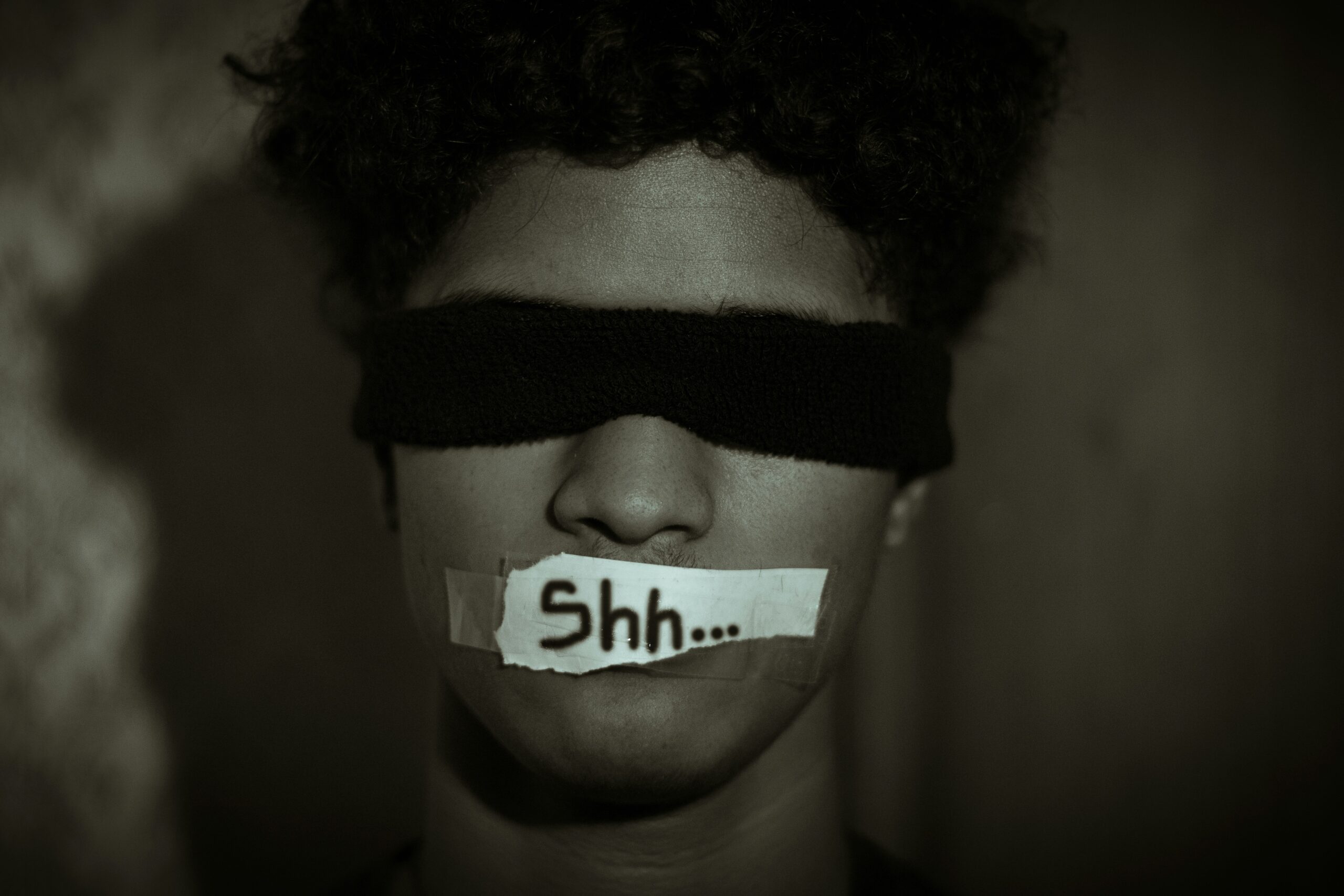
Do you remember the coronavirus? The pandemic that froze the world, reshaped our routines and exposed the fragility of modern life. Today, although we rarely speak about that virus anymore, another one is spreading silently. It is less visible, yet far more capable of eroding the foundations of a free society. This new virus is self-censorship, an infection that does not travel from person to person but flows downward from the State to the citizens, infiltrating institutions, media, digital platforms, and ultimately individual consciousness. Its symptoms are both easy to identify and difficult to cure: fear of expressing one’s opinion, submission to the ideological expectations imposed by a small but influential minority, and, above all, the internalization of that fear until people stop speaking freely without anyone needing to forbid it. At that point, the disease reaches its final stage: censorship no longer acts from the outside but becomes a habit of the mind.
Understanding this dynamic requires revisiting the core meaning of freedom of expression. From a libertarian perspective, it can be understood as the inviolable right of every individual to express their ideas without any form of State coercion, limited only by the obligation not to violate the property and rights of others.This definition, grounded in the individual rather than the State, reminds us that freedom of expression is inseparable from the concept of self-ownership. Without the ability to speak, dissent, or challenge authority, a person loses the essential tool that allows them to be autonomous. Where speech is granted only with permission, there are no citizens, only subjects. And a society that must ask for authorization before thinking is no freer than an animal trained to obey commands.
Europe, once proud to be the cradle of political liberalism, is now sinking into a bureaucratic decline marked by growing mistrust toward its own citizens. European institutions have built a regulatory framework that turns free expression into a conditional privilege. They do so under the rhetoric of combating hate speech, harmful content, or disinformation—categories so elastic that they are easily weaponized. The State no longer censors directly. It outsources the task to universities, cultural bodies, and above all, to tech corporations that act as ideological gatekeepers in the name of public safety. Censorship in the 21st century no longer wears a uniform, it wears the suit of a bureaucrat and the invisibility of algorithms.
Spain is an especially clear example of this process. Public universities, once arenas of open intellectual debate, increasingly operate as ideological filters where inconvenient opinions are excluded. Journalists such as Vito Quiles have been barred from university campuses, while political figures like Iván Espinosa de los Monteros have had events canceled after threats from radical groups claiming to fight “fascism.” Institutions, instead of defending freedom, rewarded intimidation. To this we must add a legal framework that, despite proclaiming freedom of expression in Article 20 of the Constitution, maintains laws such as the 2015 Citizen Security Law, which allows fines for recording police officers, and offenses like insulting the Crown or offending religious sensibilities—often applied arbitrarily against artists, comedians, or ordinary social media users.
The digital sphere mirrors these tensions. Meta has been repeatedly accused of suppressing dissenting voices across Europe. Portugal’s Chega party faced long-term restrictions without explanation, while journalists in Germany and Italy have been suspended for “hate speech,” a term used with increasing vagueness. The EU’s Digital Services Act has turned tech companies into executors of political criteria, and the so-called “fight against disinformation” functions as a license to remove content without judicial oversight. Countries like Germany, France, the United Kingdom, Belgium, and the Netherlands all exhibit a consistent pattern: power defines truth and dissent becomes a threat to be managed.
In this environment, self-censorship becomes the deepest symptom of democratic decay. No explicit dictatorship is required—only a normative, social, and technological ecosystem that makes citizens afraid to speak. In the 21st century, genuine rebellion no longer lies in marching through the streets, but in saying what one truly thinks without asking for permission.
But if the disease is advancing, there is also a cure. Restoring freedom of expression in Europe and Spain requires a strategy that combines legal reform, institutional restructuring, cultural renewal, and a revival of individual courage. The first step is to dismantle the legal framework that allows the State to determine which forms of speech are acceptable. Laws that regulate “truth,” define “hate” ambiguously, or penalize offense must be repealed or rewritten under a clear principle: speech must be free unless it constitutes direct coercion. This is not a call for impunity but a defense against turning subjective sensitivities into political weapons.
At the same time, it is essential to decentralize cultural and academic power, restoring universities to their role as competitive arenas of ideas instead of ideological strongholds funded by the State. Intellectual competition, not subsidies, is the only antidote to the rise of monolithic thinking. This decentralization must also extend to the digital sphere, where tech giants act as private regulators of expression. Europe must foster open, decentralized, and transparent platforms where users—not governments or corporations—set the standards of moderation. Technological diversity is the best defense against algorithmic censorship.
No institutional reform, however, will be effective without a profound shift in education. A society afraid to speak is a society trained to obey. Education must promote critical thinking, personal responsibility, and a culture of open debate, not rote learning of moral dogmas or ideological surveillance. Teaching citizens how to dissent is as important as teaching them how to read.
But the most decisive transformation occurs on an individual level. Self-censorship only disappears when people refuse to practice it. Freedom is not secured solely by laws. It is secured through everyday behavior: expressing an uncomfortable opinion, defending those who think differently, resisting the temptation of silence. The virus of self-censorship weakens each time someone chooses honesty over fear. A free society does not require uniformity but respect for the diversity of human judgment.
Europe and Spain now stand at a crossroads: continue down the path of bureaucratic control or recover the tradition of individual liberty that once defined them. Freedom does not collapse overnight. It erodes slowly, like an organism weakened by a virus that operates from within. Self-censorship is the final symptom of that infection. And the cure begins where it always has: with the individual who chooses to speak the truth, even when silence seems safer.
This piece solely expresses the opinion of the author and not necessarily the magazine as a whole. SpeakFreely is committed to facilitating a broad dialogue for liberty, representing a variety of opinions. Support freedom and independent journalism by donating today.