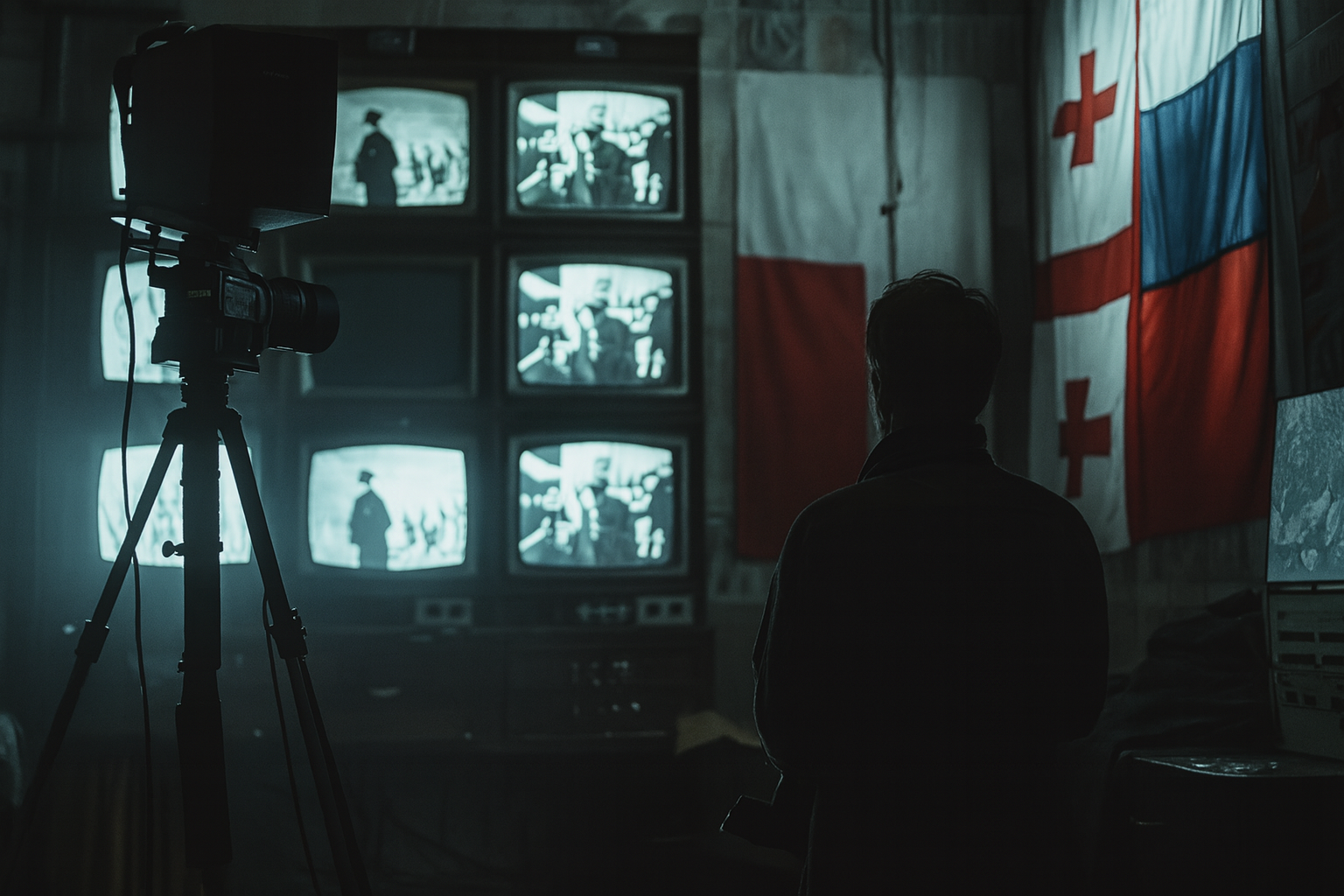
In a move that was both shocking and predictable, the European Commission’s 2025 Enlargement Policy report has halted Georgia’s EU accession process. The report cites a dismantling of the rule of law and a crackdown on independent media, confirming a political crisis that has been ongoing for years.
One of the main threats to democracy in Georgia is the state-captured press. The main narrative that Georgian Dream (the ruling party) uses is that the country’s media landscape is polarized because the state only officially funds one media outlet in the country.
This is a misleading understatement. In Georgia, there is a lack of free exchange of ideas. The information sphere is dominated by a “three-headed monster” of state control: a “public” broadcaster funded by all citizens; “private” networks run by businessmen affiliated with the Georgian Dream government; in addition to the government that uses violence and repressive laws to crush any actual competition.
The “Public” Broadcaster: The Official Voice
The first head of this hydra is the Georgian Public Broadcaster (GPB), or 1TV. In a free society, individuals can choose which media to support. The GPB, however, is funded by the taxation of every single citizen, including those who despise its content.
This model’s failure is predictable. A state has no incentive to fund its own watchdog. The exact opposite is true, the state has every incentive to fund its own propaganda machine. As a result, the GPB, which recently defended its own impartiality amid the EU’s criticism, is widely seen as a government mouthpiece. Reporters Without Borders (RSF) has criticised GPB for purging independent voices and its failure to provide critical oversight. This is the definition of state-funded propaganda: forcing citizens to pay for their own indoctrination.
The “Private” Allies: The Echo Chamber
For an international audience, it is crucial to understand that the most powerful broadcasters in Georgia are not independent. They function as arms of the ruling party’s propaganda machine.
The biggest is Imedi TV, which is one of Georgia’s most-watched television networks, giving it mainstream legitimacy. However, its owner, Irakli Rukhadze, is an outspoken supporter of the Georgian Dream government.
Imedi’s political mission is not a secret. Rukhadze has publicly stated that the channel’s main objective is to prevent the opposition from ever returning to power. This isn’t journalism – it’s a political operation. Imedi functions as the “respectable” echo chamber, laundering state narratives to a mass audience. For example, it was Imedi TV that aired a lengthy report alleging a vast, west-funded “revolutionary plot”. This claim perfectly mirrored the government’s own propaganda used to justify its crackdown on youth protests.
Second is Postv, which is a newer, more aggressive channel that serves a different, but complementary purpose. It is the official media platform for “People’s Power”, the parliamentary group of MPs who nominally split from the ruling party to voice much more radical, anti-liberal, and sovereigntist narratives.
The channel’s ownership exposes its function: its controlling stake was acquired by Viktor Japaridze, a former Georgian Dream MP and a founder of People’s Power. Postv acts as the “attack dog”, disseminating the hard-line, anti-EU, and anti-American talking points that the mainstream Georgian Dream party can distance itself from. It was Postv and its allies who were the primary champions of the infamous “foreign influence” law.
Another source of government propaganda in Georgia is Rustavi 2, a network that used to be the main opposition channel before the 2019 change of ownership, after which most of the leading journalists were ousted, and Rustavi 2 became a “competitor” of other state-controlled networks.
Together, 1TV, Imedi, Postv, and Rustavi 2 form an information bubble, leaving no room for dissent. They have been closed to opposing voices, becoming platforms reserved solely for the ruling party, even refusing to air opposition campaign ads before the 2024 elections.
State Violence and Repressive Laws
What happens to the actual free press and the independent journalists who challenge this narrative? The state deals with its opponents in two ways, through legislative strangulation and tolerated violence.
The state passed the “foreign influence” law, a direct assault on the ability of the independent media to even exist, let alone to criticize the government.
As well as passing representation laws, the state also fails to protect the rights of individuals, its only legitimate function. The US State Department’s 2024 human rights report on Georgia confirms that those who attack journalists are treated with impunity. Unfortunately, this remains the norm in Georgian society. Unidentified assailants frequently assault Media workers believed to be acting on behalf of the ruling Georgian Dream party, a problem also noted in Freedom House’s 2025 report.
This creates a chilling climate of fear, sending a clear message that if you criticize the state, they will not protect you.
The Future in an Echo Chamber
If this trend continues, the outcome is not just polarization; it is the death of free speech. When the state and its allies are the only legal and well-funded voices, objective reality is suffocated.
The European Commission’s 2025 report, which commented on the stagnation of Georgia’s accession process to the EU, is the main consequence of the lack of media freedom. This is the future that state-controlled media builds – a nation cut off from its democratic allies, filled with corruption, and trapped in an information bubble where the government’s ‘truth’ is the only one available. The ‘sovereignty’ the government claims to protect by silencing its critics becomes a hollow word. A nation without a free exchange of ideas is not a sovereign nation, but a captive one.
Georgia’s catastrophic drop in press freedom – now plummeting from 77th in 2023 to 114th in the world, according to RSF – is a tragedy. It is also the predictable outcome of a government that has abandoned its only legitimate functions and embraced authoritarian control.
A free society cannot exist when the state and its allies own all the megaphones. The EU didn’t abandon Georgia. The Georgian government, by trying to destroy the independent media, has chosen a path that is fundamentally incompatible with liberty.
This piece solely expresses the opinion of the author and not necessarily the magazine as a whole. SpeakFreely is committed to facilitating a broad dialogue for liberty, representing a variety of opinions. Support freedom and independent journalism by donating today.