On the night of January 3, 2026, within the span of a few hours, the geopolitical order of the world was once again thrown into question—this time by the so-called Operation Absolute Resolve, namely the capture of Nicolás Maduro, socialist president of the Bolivarian Republic of Venezuela, by the armed forces of the United States, led by Republican president Donald Trump. Accused of drug trafficking—and indeed of outright narco-terrorism against the United States—Maduro was deported and incarcerated on U.S. soil, where he now awaits the issuance of a verdict against him.
The issue around which praise and criticism immediately coalesced could only concern, first and foremost, the concept of state sovereignty. If on the one hand the operation was described as an act aimed at defending the sovereign interests of an America now worn down at its foundations by attacks perpetrated by foreign powers (Trump even spoke of a personal reinterpretation of the Monroe Doctrine), on the other hand the capture of Maduro raised concerns about the possibility—on the part of a powerful state (or rather, a superpower)—of overthrowing with such ease and impudence the government of another state, moreover a far weaker one. Critics of Trump’s operation thus invoked international law, according to which the sovereignty of all nations must be considered inviolable (the principle of sovereign equality), while any military action that seeks to erode that sovereignty must necessarily be condemned from an ethical standpoint (the prohibition of the use of force), as stated in the Charter of the United Nations.
Although at first glance the objections raised by supporters of international law may appear well-founded, the solution they propose does nothing but ratify the most paradoxical points of the legal phenomenon conjured by Trump’s operation. Upon closer inspection, while the prohibition of the use of force aims to preserve the principle of sovereign equality, it simultaneously exposes its underlying aporias. After all, what purpose would a prohibition serve if nations were already equally sovereign? If the sovereignty of all nations enjoyed the same constitutive power, the world would already live in an immobile and perpetual harmony. Even if a head of state wished to attack a neighboring nation, such an assault could only dissolve into nothingness; the force of the structural equilibria inherent in such a geopolitical scenario would preemptively curb any form of interventionism.
We thus understand that the proposal advanced by the proponents of international law implicitly refers back to its own conceptual problematicity, indeed to the problematicity upon which the ontological artifice of every form of law is based. It therefore becomes easy to intuit how Trump was able to circumvent the legal norms in force. Not without reason, during an interview with The New York Times, the U.S. president declared that what restrains his power is not international law, but only his own morality—and thus his own power. In the tautological value of such a statement there is consummated, unsettling and scandalous, the egoism of the individual who, by opposing himself to the altruism embodied in moral subordination to an external, alien, abstract, and spectral power, reclaims his material interests and extinguishes the threat of alienation.
It is against the background of this juridical landscape, fractured in its most essential ethical contours, that the possibility emerges for us to return to the Venezuelan question in order to discern its true governmental face. After the downfall of Pablo Escobar’s cocaine empire in Colombia in the 1990s, the FARC—the Revolutionary Armed Forces of Colombia—perceived in the newly created economic vacuum an opportunity to sustain and revitalize the Marxist-Leninist cause on a national scale. That, especially once Hugo Chávez rose to power, the FARC very likely decided to collaborate with the Venezuelan government, itself socialist in orientation, is indicated not only by the 2010 United Nations report, which clearly demonstrates the Venezuelan origin of more than 50% of the cocaine exported to Europe, but also by the testimony of the U.S. Southern Command general John F. Kelly, as well as that of the Venezuelan drug trafficker Walid Makled García.
One must not overlook here the profound (though secret) philosophical nexus between socialism and narco-terrorism. Even if today not all scholars agree on the nature of the alliance forged between the FARC and the Venezuelan government, according to the present reconstruction it could only have been precisely the proto-socialist nationalization of oil—thanks to which Venezuela had already been able in the 1970s to rise as a preferred commercial partner of the United States, following the embargo imposed by Saudi Arabia and other Middle Eastern countries on the U.S. as punishment for its support of Israel during the Yom Kippur War—that prepared the path for the terrorist exportation of narcotics onto American territory. Thus, the infamous and controversial Cartel de los Soles, whose name refers to the military insignia worn by high-ranking Venezuelan officers, if its existence were to be confirmed, should in any case be understood not as an organization parallel to the Venezuelan state, but rather as an organism born precisely within it: it is no coincidence that Trump now places Maduro himself at the apex of the Cartel de los Soles.
At this point, a political figure with paradoxical contours emerges, namely that of the terrorist state, of which the Venezuelan government has in recent days been accused of being the most emblematic representation. How can the state—whose sovereign existence is legitimized, at the moment of its foundation, by the law that it itself founded (and of which it is therefore the legitimate sovereign)—simultaneously correspond to the incarnation par excellence of the criminal, that is, to the figure of the terrorist? The state is essentially bound to law, insofar as it is derived from it. In turn, law is founded by the state. Within the circularity of this onto-genetic relation, a closed (hermetic) and empty space is formed in which the concept of sovereignty is finally allowed to emerge.
If by the word “sovereignty” one typically indicates the capacity of a state to control the totality of its territory, we can now condense its meaning into the following formula: the state is law, law is the state. State sovereignty refers to juridical sovereignty; juridical sovereignty refers to state sovereignty. It is only by virtue of this strict relation of identity between state and law that sovereignty can thus be defined as the political condition in which the state holds the monopoly of juridical de-cision. From the Latin de + caedo—“to cut down, to cut away”—the state monopoly of juridical decision, assumed as destiny by sovereignty, cuts, breaks, violates. For this reason, beyond any moral judgment one might have of it, it will always also configure itself as a monopoly of violence.
But what is the origin of this violence? If we have said that it expresses itself essentially in sovereignty understood as the state monopoly of juridical decision, what—prior to this—made it possible? Is it legitimate to speak of an originary violence, and thus of an arche-violence, to which the violence of sovereignty refers as its subterranean foundation? Since the state derives its reason for being from the law that it itself had previously founded, we can identify arche-violence in the power with which, originally, the state affirmed and impressed (inscribed) its own existence into the world. At the same time, this allows us immediately to recognize the paradoxical (but not illegitimate) nature of the very concept of arche-violence: since it concerns power, and thus individual force, violence can never be originary, insofar as it can never be traced back to an arché external to the margins of the world, or to an uncontaminated and abstract beginning.
The individual there-is-already-always-in-the-world: open to its “There” as nullity traversed by freedom toward death, the singular being is constant thrown-project, continuous dif-fered potentiation. The concept of arche-violence (or arche-writing) used here, therefore, far from being useless, attempts—by way of an axiom—to bring to light the always-already-breached nature of every foundation. Its terminological value becomes particularly clear when it is juxtaposed with its negation: we note how the founding event of arche-violence, in order properly to give rise to the violence in which sovereignty later resolves, must be immediately negated, barred within the violence that constitutes it, and relaunched by the state as law, that is, as the moral archetype par excellence. (Indeed, to be precise, this is how the state itself is first born.)
Once violence (writing), and thus the breaching of every foundation, which originally underlies individual power, has been purged and excluded, the state stabilizes itself (from the Latin status, “to stand still”), grounds its existence in law (the voice of the ad-vocate), and only at this point can it definitively become a state, finally acquiring sovereignty by means of the collective and monolithic identity of the people (monopoly) over whom it dominates (de-cides).
In the fanatical pursuit between state and law, however—during which each attempts to grasp the other as its own foundation, without realizing that one will always be the creator of the other, and vice versa—sovereignty immediately emerges as a cause of self-estrangement, as a cause of alienation. The concealment of the traces of violence, or rather the concealment of the arche-trace as irreducible individual power, refers to the decentralization of the already-always-decentralized essence of the individual, and thus to the fatal centralization of the individual in the exteriority of law, understood as a fixed and incontestable idea, alien to the self, or as a phantom that demands obsession toward the moral sacredness of which it would be the most authentic abstraction.
With sovereignty understood as the state monopoly of juridical decision (or as the violent concealment of the violence of arche-violence), fundamentalism is born—namely fixation on any kind of foundation (arché), the demonic possession of rigidified bodies. The self-extension of originary violence disappears, the force of individual will as an act—precisely—voluntary, spontaneous, which finds within itself the foundation of its own movement and by virtue of which it counts that its realization—as will to power—can occur by itself. Consequently, the negation of the will intervenes, that is, the coercion upon which the monopoly of decision rests, the violence of an inscription (of a verdict) that is ashamed to recognize itself as such, thus ending up pretending to be the absolute command of abstraction from the world.
It is within this framework that we can now examine the phenomenon of terrorism, questioning in particular the relationship it maintains with the Venezuelan state. If on the one hand we have said that the state, by founding law as its own foundation, attempts to erase the violence of individual power—and thus the trace of the breached foundation (the arche-trace) in which it finds its origin as arche-violence—on the other hand we understand that paradoxically it is precisely such an exorcism of violence that provokes the violence in which sovereignty consists as the state monopoly of juridical decision (alienation, demonic possession).
Holding the monopoly of juridical decision, the state rises to sovereign entity, while law can decide—freed from every constraint—only insofar as it is founded and gathered by the state: this means that, in any case, both state and law resolve themselves in the sovereign violence of absolute and ab-solute decision (cf. the very name of Trump’s operation, Absolute Resolve). The violent cut of absolute decision, that is, the violent cut of abstract decision, alien to individual power, separates good from evil, and indeed imposes good and evil as juridical categories of ontological value, situating them at the same time within the moral framework by which it is essentially determined and oriented. Consequently, if the state is law (the good), the state is also crime (the evil). After all, law would not be such if it did not radically distinguish itself from its opposite, namely crime. The shadow of crime thus runs—negatively—through law in its entirety, and at any moment the state can turn into a criminal.
This becomes particularly evident if one looks at the example of the black market: although it is by definition situated outside the boundaries of law, the state nonetheless remains the only entity capable of using it with impunity, and indeed of maintaining privileged contacts within it. The nexus between socialism and narco-terrorism, previously sketched, here takes on its essential contours: the complete collectivization of the means of production (statization, nationalization) coincides with the most accomplished extension of law (and thus of crime) to every field of human life. If the liberal state flaunts, as its own foundation, a presumed separation between what belongs to law and what is excluded from it, socialism unmasks the secret mechanism of inclusive exclusion (or exclusive inclusion) upon which the state monopoly of juridical decision—that is, sovereignty—rests.
It is no coincidence that in the Soviet Union under Stalin the criteria according to which political enemies were persecuted continued to change, rendering Stalin himself all the more paranoid as the persecution became more sanguinary. The figure of the terrorist state therefore no longer appears to us as a mere paradox; rather, it now acquires a greater internal coherence: the luminous law of the state can only ever be secretly traversed by the dark crime of terrorism, and from now on any alternative formulation will prove logically incomplete.
But if terrorism is the negative double of the state, how can we describe its action in society? What are its aims? Also born from an individual effort (an arche-violent effort) that is then punctually negated, terrorism motivates its existence by founding crime as its own foundation. Resting on crime—understood as the dimension one seeks to appropriate in order to express the most radical dissent toward law—terrorism paradoxically aims to acquire the legitimation (the law) to be such, and thus to act terroristically in the world. At the same time, it is already always sovereign over it, as its original creator. The sovereignty that follows is therefore not too dissimilar from that of the state, configuring itself as: the terrorist monopoly of juridical decision. Terrorism too, in fact, operating always within the category of law (albeit negatively), claims to hold the monopoly over the violence that is juridical decision. Thus, in a manner analogous to what was previously described with regard to state sovereignty, terrorist violence resolves itself in the coercive subordination of individual will to an external, alien, absolute crime.
We can better understand the nature of terrorist coercion (and again the nexus it maintains with socialism) by recalling in particular the analysis carried out by the French philosopher Jean Baudrillard concerning the Red Brigades and the role played, in the kidnapping of Aldo Moro, by the figure of the hostage. If once hostages were captured and then offered for negotiation, in the case of the Red Brigades it is negotiation itself (understood as the spirit of capitalism) that is radically refused: the terrorist is such insofar as he is ready to die; the hostage in his hands becomes not only a talisman of inestimable value but also his irreducible alter ego, thus referring to an impossible exchange with state power—an exchange that can be carried out only if the latter accepts the terrorist’s own premise, and thus only if state power also promises to die, transforming itself into terrorism squared.
In short, by opposing on the political plane the capitalist logic of globalization, according to which everything is interchangeable, the socialism of the Red Brigades—on the existential level—attempted to abolish the individual will (the violence of arche-violence) from which it itself originated. It is therefore not surprising to note that the immobility at which terrorism aims, analogously to what was previously discussed regarding the state, reveals an eminently fundamentalist, fanatical character.
Yet if in the struggle against law terrorism forces the state to become terrorist as well through a violent suspension of exchange (crime), in the same struggle terrorism itself cannot but transform into a state. Crime, in fact, is never unrelated; rather, it is always traversed—within its positive constitution—by the negativity of its opposite, namely law. Here lies the per-fidy (the perversion of trust) proper to both state and terrorism: like a Janus with two faces, one is always also the other; consequently, it becomes impossible to trust the foundation proposed by the state (law) or the foundation proposed by terrorism (crime).
The perfidy of terrorism emerges with particular clarity if one looks precisely at the example of Venezuela: if on the one hand drug trafficking—in its criminality—is used by Maduro’s government as a terrorist weapon to eviscerate U.S. sovereignty, on the other hand the capture of the socialist president by Trump is immediately relaunched by terrorism as an unforgivable proof of an infraction of international law by the most powerful state in the world. The fact that appeals to international law arose predominantly after Trump’s operation, while in the past the crimes perpetrated by Maduro’s regime were largely ignored (or at any rate acknowledged with cynically resigned tones), testifies to this strategy.
Something analogous occurred during the conflict between Israel and Palestine that erupted on October 7, 2023: although the massacre carried out by Hamas could only fall within the most heinous sphere of crime, the most devastating weapon used by the Palestinian resistance against Israel was legalism, through which—before the entire world—it continued to remind the Jewish state of its illegitimacy under international law, precisely at the moment when Israel was forced to respond to the war unleashed by Hamas (and thus effectively to violate its own law). This perfidy, analogously to the Venezuelan case, is moreover recognizable in the pervasiveness with which law and crime were extended throughout Gaza by the Hamas government by means of strategic underground tunnels, making it consequently difficult for Israel, during the conflict, to distinguish between militants and ordinary citizens.
The Venezuelan question, however, precisely by virtue of how it has taken shape, allows us to further specify the phenomenon described here: the force of terrorist perfidy is in fact incarnated in particular by the drug trafficking of which Maduro’s government is accused, insofar as it is through the Venezuelan case that we are able to identify the spirit of law as a narcotic of public opinion, which—by exciting many about the absolute sacredness of the state—simultaneously dulls their judgment regarding the criminal activity for which their own state has made itself responsible.
In this condition of perpetual insomnia, the necessity emerges to find rest from both law and crime. If by relying on law one plays the game of terrorism, and if by believing in crime as an expression of radical revolt one adopts the fundamentalism of a new form of state, no solution remains other than the peace of anarchy, by virtue of which one opens oneself to a new political scenario, where both law and crime reveal themselves to be impotent, and where—beyond good and evil—the only thing that matters is precisely the mute and null neutrality of individual power, arche-violence.
Unlike what is envisioned by the most radical wing of classical liberalism (right-wing libertarianism), the present conclusion does not aim—perhaps naively—to reduce, restrain, or even abolish violence by condemning its use in the world. Nor is it a vague ethical prescription, tinged with socialist flavor, in the name of which one intends to give voice to personal hopes for a utopian future governed by harmony and justice. Rather, it is legitimate to speak of a ruthless onto-historical diagnosis, of which political existence will have to take account—for reasons strictly immanent to its own being—whether it wants to or not.
Behind the narcotic fumes in which we now live immersed, in truth, things already stand as we have described them: upon closer inspection, the violence of sovereignty—understood as the monopoly of decision—does not in any way constitute a moral guilt, but is instead first and foremost a metaphysical error, one that immediately refers to (mortiferous) pacification in arche-violence. If both the state and terrorism create a foundation to legitimize their existence, it is precisely in this way that they also end up doing the opposite, sanctioning their ontological impossibility—namely, the impossibility for any intramundane entity to rest upon a foundation alien to its own individual force. In this sense, Trump’s words—regarding the sanctity of international law and his own morality—testify to a geopolitical shift as epochal as it is inevitable.
Good reporting is cheaper than heavy-handed regulation. Support freedom and independent journalism by donating today.
The Piece appeared first on Nicolas’s Substack. Read more here.
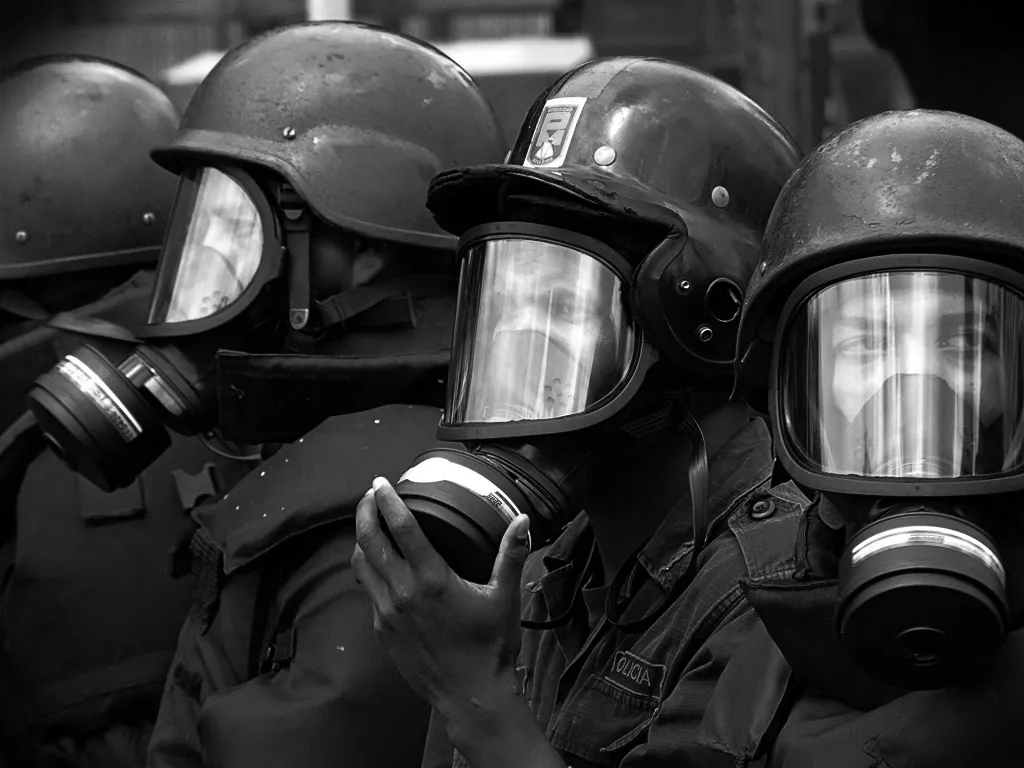
Image: “Policemen getting ready” by Rodrigo Suarez, CC BY-NC-ND 2.0
This piece reflects the author’s views, not necessarily the entire magazine. We welcome a range of pro-liberty perspectives. Send us your pitch or draft.