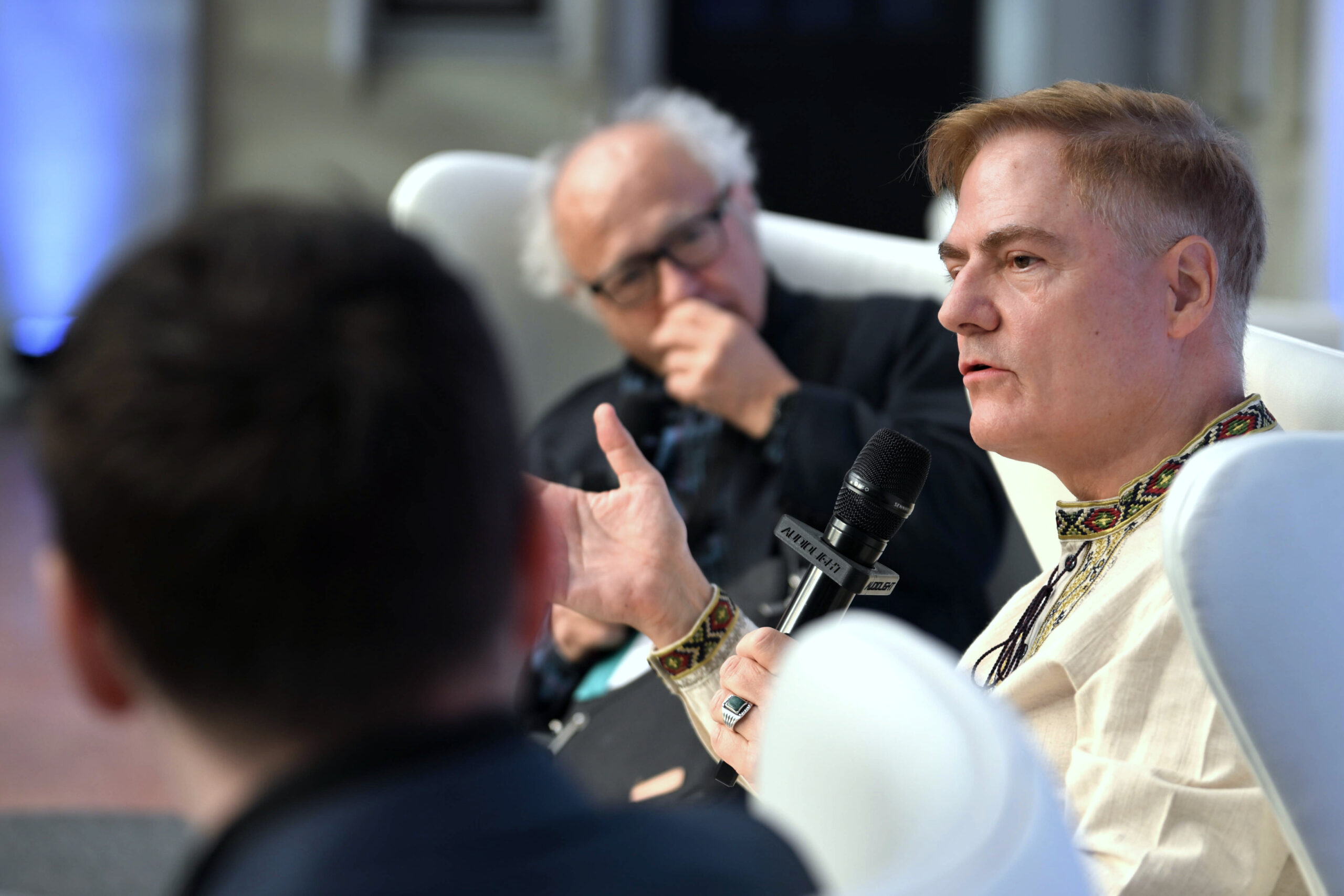
Tom G Palmer is one of the most recognisable voices in modern libertarian and classical liberal thought. He is a Vice President of International Programs at Atlas Network and a Senior Fellow at the Cato Institute. He joins SpeakFreely Magazine for an interview about the hard problems facing liberal movements today, including why liberal parties struggle to communicate, how to avoid being stereotyped as defenders of elites, and what persuasion looks like in an age of fast-moving media.
The interview touches on the lessons of electoral defeat for FDP, the temptations and limits of populism, and the fiscal and demographic pressures that are reshaping welfare states. Palmer also speaks about Ukraine, civil defence, and conscription, alongside a principled defence of equal rights and a warning about the political dynamics of scapegoating and fear. Dr Palmer can be found on Twitter.
SF: Let’s start with a round of rapid fire questions. Cats or dogs?
TP: I like both.
SF: Gadsden snake, Lady Liberty, or porcupines?
TP: Oh boy, each one has a different meaning. I think Lady Liberty always has a strong historical connection.
SF: Holiday in the Sahara Desert or the South Pole?
TP: South Pole. I don’t like hot weather.
SF: Friedman or Hayek?
TP: I admire both of them. I’d say I’m somewhat more inclined toward Hayek’s more general approach, but I appreciate Milton Friedman as well.
SF: John Locke or Montesquieu?
TP: That’s easier for me, Locke.
SF: Crypto or gold?
TP: I’m not a monetary economist. I have no special insight into investing, so we’ll let the market decide.
SF: Where’s the future of liberty, the Old Continent, the New Continent, or somewhere else entirely?
TP: We’re going to find out. I’m hoping there’ll be a strong stand for liberty in Europe, and this is very important to me. But we also see more awareness of liberal ideas and policies in Africa and Asia. So we’ll find out.
SF: What book would you smuggle into North Korea?
TP: A book for intellectuals, which is where you would want to start. One that had a big impact in China was Karl Popper’s The Poverty of Historicism. Not one most people put on the list, but it’s a fantastic refutation of Marxism.
SF: If you had to privatise one immediately, the forests or the oceans?
TP: If by that you mean well-established property rights, like in Iceland and New Zealand over fisheries, I’d say the ocean would probably be my priority.
SF: We’re here in the archive of the FDP, the liberal party in Germany. They recently suffered a crushing defeat in the parliamentary election. What lessons are there for liberals and libertarians who want to make change through politics?
TP: We need to be more effective communicators. These are complex matters, such as why people vote, strategic voting, and so on. But we need to communicate the value of voting for liberty and having a very clear liberal program that’s appealing to people. Not just to stake out a position, this is where we stand, and not to shock people with some radical view they may or may not hold, but to show that this offers a better future for people. That’s our challenge, to be better communicators, particularly in this age of rapid-fire media changes.
SF: FDP is often tarnished by the stereotype that it represents the interests of business. How do we avoid falling into the trap of seeming like a pro-capitalist movement that only represents business?
TP: One thing is to point out the cronyism the other parties represent because they say we’re for the ordinary people, and they’re enriching their own leaders, their cronies and their friends. Equality before the law for everybody benefits everyone, and in particular the poorest members of society, by ensuring they have equal respect and open access to the market. Privileges and interventions confer benefits on a small minority clustered around people who hold power. It used to be the case that liberals were better at communicating that. If you look at the Liberal Party in England, they pointed out that free trade raises wages. This is true. And we need to communicate that wage earners are the primary beneficiaries of free trade, not the rich.
SF: Libertarians have been excited about Milei in Argentina. Are libertarians learning lessons from Argentina? Is there a new openness to populism in the broadly defined libertarian movement because of Argentina?
TP: Argentina has unique characteristics. It had been swirling down the drain for a long time, and people were finally fed up, and Milei was able to channel that anger. He campaigned in a very angry style. However, once in office, he hasn’t done any of the scary things you normally associate with angry politicians of that sort. A couple of mistakes and some false steps, but that’s normal in any strategic interaction. And it’s generating positive benefits. Inflation has come down. People can see some light at the end of the tunnel, that they’re going to escape this downward spiral. It’s not clear that the strategy is going to work in a lot of other countries. So we have to be very careful. In general, an angry style of politics generates collectivism, because when you’re angry, it generates hateful feelings, and hating the enemy is a recipe for collectivism, not for liberalism. So I don’t think the Argentine case is a particularly good model for everyone else. But there are things to be learned from it, especially how he assembled a coalition in Congress. They pushed through positive legislation by one vote because he had very good managers who assembled the coalition. That’s part of the story too. We have to be better at that.
SF: Another populist libertarian development was the Department of Government Efficiency idea in America, supposed to slice budgets and uncover corruption. Then it turned out there was basically nothing to slice, and it was a miserable attempt, without consulting people who actually know where the waste lies. Did this destroy prospects for cutting waste for years to come?
TP: I would say this was an overall failure. They didn’t bring a model for reducing state expenditure. What’s happened is this corrupt group, who’ve taken ove,r are now spending money on the things they like. Trump took over the Kennedy Centre. I’d like to see the Kennedy Centre subsidies removed from the budget. It’s a subsidy to rich Washingtonians at the expense of poor Texans and Vermonters, people who pay the taxes but don’t get the benefit. What happened? Now that Trump’s in charge, they increased the budget by two hundred million dollars because it’ll be doing the art he likes. It’s like North Korea. They increased the budget for internal policing through ICE, and now it has a bigger budget than the United States Marine Corps. So they’re not cutting the budget. There is no spending being cut. They’re increasing spending and increasing indebtedness quite dramatically because for them it’s not about reducing government. It’s about seizing control of the state and using it for their purposes. They’ve been explicit about this. Not like the old ones who sometimes said we should limit expenditures. They say to hell with that; the whole point is to seize the state and use it for our purposes. It’s exactly the opposite of what we should be looking for. Anyone who had fantastic ideas that we’d see a net reduction in the state under this populist government should have dropped that illusion some time ago. It’s not happening. This is a big government coalition spending money to subsidise their friends at the expense of others.
SF: Thinking long term, to what extent does our system of governance revolve around favouring older generations at the expense of the young more and more? Social Security and Medicare are huge expenses in the US budget. There are seniority systems and so on. Will populism intersect with this gerontocracy where it’s impossible to reform entitlements? Is gerontocracy our future, and how do we escape it?
TP: I’m afraid that demographically, this is almost inevitable. The question is, how do we address this? It’s also a question of how you communicate with older people. When people say we want to cut your benefits, they don’t like it. If you phrase it as we want to make sure there’s something left for your grandchildren, you have a more winning argument because they don’t want to tax their own grandchildren; they want to tax everyone else’s grandchildren. In most cases, if you rephrase it as making sure we don’t destroy the economy for your benefit at the expense of your grandchildren, you have a better chance. The big problem many wealthy countries face is the base of the demographic pyramid is not expanding. Most retirement and medical systems are structured as pyramid schemes. You have to have a constantly expanding base because the money that comes in is immediately spent out; it’s not invested or set aside to grow. The unfunded liabilities are staggering, much greater than the official public debt held by the public, which is called the national debt. The unfunded liabilities, anticipated expenditures for which there’s no corresponding income, are overwhelmingly Social Security benefits, pensions, and state medical payments. And if something can’t go on, it won’t. And this can’t go on. So how does it stop? Does it stop with a collapse? With internal combat and wars, possibly generational? Or is it addressed in a way that allows a softer landing, allowing younger people to save for their own old age, not finance their grandparents and parents, and have nothing for themselves?
SF: What do you think about the abundance movement? Can it open the left to at least some free market thinking, especially as scarcity politics becomes exhausted?
TP: I think insofar as people have begun to speak rationally about economic growth, creating more abundance, more good stuff, including healthcare and education, that’s positive. For that you need a functioning economy. There’s also a general increase in understanding incentives. You can’t mess with incentives too much and still expect people to continue to produce. If you want more wealth in the future, you need to get the incentives right today. Another thing we’re seeing on the centre left is a greater awareness of the benefits of trade. This is partly epistemic tribalism. The right wing is becoming increasingly protectionist and anti-trade, so the left, distinguishing itself, becomes more pro-trade. That’s tribal mentality, but I’ll take it. If it gets people to appreciate the benefits of freedom of trade, then let’s encourage it. I’m encouraging people to talk in a language the centre left understands about authentic free trade. There’s a real opening for our ideas because the right in many countries has been taken over by deeply illiberal people who’ve turned toward collectivism, statism, and an oppositional enemy mentality, with undertones of racism and national conflict. That turn away from liberalism needs to be combated on its own terms, but it also means finding new allies, often on the centre left.
SF: One issue you care deeply about is Ukraine. You’ve been very active in transporting aid. But there’s also debate about policies like conscription in Europe. What do you think about the return of conscription?
TP: Conscription is unjust, and it’s also inefficient. When people talk about increasing defence spending, it may have good justification, but they usually only think about spending on equipment, planes, tanks, and gear. They leave aside the personnel question. Instead, it’s easier to force that burden onto younger people. That overlooks the real cost being borne. It’s much better to invest in personnel, pay soldiers more, and treat them as professionals. Poland has been talking about offering voluntary military training for civil defence, and that’s quite reasonable. If an aggressor were to attack, an aggressor we all know would be the Russian state, and they would find a population that was ungovernable and unconquerable. In Ukraine, when territorial defence, entirely voluntary, stepped up, invaders found people behind trees, shooting out of windows. In many cases, it was common citizens. The aggressor should understand that every window is going to have a grandmother with an AR-15 or a high-power rifle, and that makes them less likely to attack. Voluntary civil defence is a positive thing. It’s one reason no one has messed with Switzerland for a long time, partly because Swiss people have firearms in their homes and know how to use them. Invest in the personnel for the military, don’t only think of expenditures as equipment. Think also of well-trained soldiers whose job is to protect the nation.
SF: What about conscripting women? Switzerland has conscription and even a tax on men who don’t serve. Finland has called to conscript women. Denmark and Sweden have moved in that direction. What do you think about gender inequality around conscription?
TP: I wouldn’t generally think that if there’s an injustice committed against one group, the better approach is to commit it against another group as well. My focus would be on getting rid of conscription and offering more pay and inducements to engage in the protection of the country, and that’s for women as well. One positive change is when women have the right to engage in combat roles. There are a lot of women serving in Ukraine, snipers, infantry units, and so on, because warfare isn’t about upper body strength anymore. That was a medieval mentality. Modern defence isn’t based on hitting each other with sharp pieces of metal. Recruit women, pay them properly, and show them respect. Same for gay and lesbian soldiers. No reason they can’t be part of national defence as well. And then, symbolically in the US, they’re kicking out transgender soldiers. There’s no reason to think a radar officer can’t be an efficient radar officer because of gender identity. Who cares? It’s self-defeating stupidity. We should have open, equal access focused on defence. No, I don’t favour conscripting women. I’d rather change the policy to pay men and women properly for their service.
SF: You mentioned gay soldiers, and you famously fought for gay rights at a time when there were violent repercussions. You also survived an attempted assault because you were armed with a handgun. But countries like Poland and the Czech Republic still don’t have gay marriage. What’s the best approach, given that many LGBT organisations are often very left-wing?
TP: Unfortunately, some people have fallen prey to bigots who say these are special rights, and people have fallen into the trap of accepting that language. I think it’s just equal rights. That’s the basis of the fundamental struggle. It’s not special rights. It’s equal rights for everyone, the same civil rights, the right to live your own life, and the right to love someone who is a voluntary participant in the relationship. It’s no one else’s business. If two people want a marriage relationship, the church will decide what it wants to do, churches, mosques, synagogues, that’s their business. It’s not for the state to dictate. But the state should have an equal rule for everybody. If two people want to get married, that’s between them, and the state can recognise it in a contract governing property, children, and other complex matters. There should be equality, not something special. One of the biggest changes that transformed many countries was more people coming out to family and friends. It’s harder to hate people when you realize that’s my niece, or my uncle. That transformed societies and opened the way to ask why shouldn’t they be able to marry? I remember a debate in the United States where a very conservative figure said something that mattered to him. He knew a firefighter whose fellow firefighter had a boyfriend. When the firefighter was sick, the boyfriend wasn’t allowed to visit because he wasn’t family. He died without being able to see the most important person in his life. And the conservative figure said, is that right? That doesn’t sound right to me. That’s a better way to argue than claiming it’s a radical attack on social structures. It’s not. It’s about fairness, the same rights.
SF: Do you worry about reversals on this in the West, in America, given some polling showing a slight fall in acceptance?
TP: Yes, I think it’s going to get worse. The MAGA movement is always looking for victims, people to identify as the enemy. Right now, it’s Asians, Mexicans, and Muslims. The horror of kidnapping people on the streets, people who look like foreigners, what does a foreigner look like? This is a shocking development. People say, oh, that’s normalised. They remove African Americans from positions of power and authority. Trump said, we’re going to militarily occupy cities that all have black mayors. Interesting. There are cities with white mayors and higher crime rates, but he’s not talking about those. It’s black mayors. So it’s setting up the idea that black people are the enemy, brown people are the enemy, and I think there’s no question that gay people will be on the list too. I view the rise of right wing hyper nationalism as dangerous for everybody. There needs to be strong pushback. People should remember, they start with a group that’s easy to identify, first they came for that group, but I was not a member, then they came for me, and there was no one left to defend me. When we stand by and let them target groups based on gender identity, race, language, and national origin, remember, you’re on that list too.
SF: There seems to be a divide between libertarians and techno optimists, transhumanists, versus those who want conservative values. I’ve been thinking about rebranding liberal thought around immortality or radical longevity. Could immortality give liberalism more purpose and persuasive power?
TP: Expanding lifespans is a very good thing, and we’ve seen it over time. It may be reaching limits with available science and technology, but it’s exciting. Younger people are likely to live longer lives than my generation, and I’ve lived longer than my parents did. Immortality, I don’t know if that’s possible. Life extension sounds positive, but we should also think about the quality of life. Not just living forever while sick and weak, but extending a healthy life with meaning and purpose. What it has to do with liberalism is unclear to me, except that we want people to innovate and introduce new products that extend life, and not be blocked by people who think it’s ordained we only live a certain length and won’t allow longer. That’s madness. I don’t see a direct connection between life extension and liberty. Speculatively, if people live longer, they may become more risk-averse and less tolerant of innovation. A society full of very old people set in their ways might become more resistant to change, possibly leading to more social and technological ossification. That’s speculative, but worth thinking about.
SF: Circling back, what country are you most optimistic about besides Argentina?
TP: Remember, Argentina starts from a low base, so they’ve done remarkably well. One hopes it continues without backlash or derailment. Milei has managed positive changes through Congress within the constitutional order and the rule of law, which is really important to me. Other places, across Africa, long-term, not the next two or five or ten years, there’s greater awareness of the benefits of liberty and less willingness to live as our parents lived. The internet has a positive influence. Young people ask, why should we live with a corrupt government and corrupt police, violence? Why can’t we have better lives like what we see? I’m bullish long-term about Africa and libertarian, classical liberal movements growing across the continent. I was in Kenya recently for the African Liberty Forum. It was exciting. Young people were coming up with incremental ways to make their societies freer and more just. For over fifty years or more, I think there will be huge changes in Africa. Ukraine is an interesting example. If the full-scale invasion can finally be stopped, it’s hard to know how it plays out. Ukrainians have come to see the benefits of social pluralism and freedom partly through contrast with the invader, which is a totalitarian state. Total control over religion. People are afraid all the time. Persecution of gay people. They’ve labelled the so-called international gay and lesbian movement a terrorist organisation. Now it’s illegal for someone to say, I think I might be gay. It’s an upside-down world. Ukrainians look at that and say we don’t want that, which means a greater embrace of a free, open society. Worship where you want, live as you want, not be afraid. Ukraine is moving toward a more open society. People inside Ukraine see the problems, corruption and so on, but from the outside, having been in and out a lot, I see an astonishing rebirth of freedom that inspires me. I hope it inspires Europe and the world.
SF: Given how terrible Russia is, why does the right in the US sometimes treat Russia as a conservative paradise? And more broadly, what happened to the right wing, especially in places like the UK, where conservatives were once more intellectual but now seem overtaken by populism?
TP: Trump is part of the story. We should remember that things happen that surprise us. There are random mutations, and sometimes they have big consequences. Look at species history, random mutations add up. Trump is a kind of random mutation. In 2015, there were seventeen Republican candidates. Fifteen were normal politicians, senators, and governors, within normal parameters. One was a brain surgeon, very intelligent, a bit puzzling. And then one reality TV guy with an instinctive ability to manipulate, take all the oxygen in the room, dominate every space, and he got the nomination. Few predicted it early on. It seemed implausible with a deep bench of normal politicians with good track records, and then this creature takes over and makes everything in his mould. That wasn’t inevitable. It was a freak situation. But there are trends behind the growth of illiberalism. One is alienation, people feeling disconnected from their society. I’m a big fan of freedom of movement and immigration, which enriches societies, but it’s rapid and some people feel unmoored. We’ve seen rises in illiberal nativism as rapid immigration takes place. This happened in the US early twentieth century. The Ku Klux Klan grew rapidly as huge numbers of immigrants came in. They didn’t like Catholics, Greeks, Italians. They viewed them as non-white invaders. Now those groups are considered white. Whiteness changes over time. Today they complain about brown people, black people, Asian people, yet their grandparents were considered alien invaders earlier. Immigration needs a thoughtful response. A crucial issue is the way right wingers portray immigration as an invasion. They show scenes of disorder at borders and it scares people. A good response is an orderly immigration procedure. It’s very hard to get into the US legally to work today. Many cross borders, though most undocumented people actually overstay visas. They didn’t cross the southern border illegally. But they’ve successfully portrayed armies invading, and it scares people. The sensible response is an orderly policy so people aren’t dying in deserts in the night or crossing the Mediterranean in flimsy boats. Another point, the Kremlin has weaponized migration flows. They helped drive over a million people out of Syria through bombing and destruction, causing a disorderly inflow of refugees to destabilize liberal politics in Europe, with significant success. They’re doing it now across the Belarus Poland border. People were told by Belarusian security forces, either go this way or we’ll kill you. The purpose is to promote extremist illiberal movements in Europe and bring about the destruction of the European Union. That’s their policy goal. Active destabilisation by the totalitarian regime in Russia contributes to the rise of illiberalism.
SF: Are these problems more structural? Richard Hanania argues liberals live in a world dominated by the written word, while conservatism is more pre-literate, more based on infotainment, podcasts, and emotional narratives. Liberal opinion often comes through an intermediate class, lawyers, journalists, professors, while conservatives lack that and ideas are shaped by extremist movements.
TP: That’s a lot to digest. I do think liberals engage in more complex and abstract thought. For one thing, we believe every person has rights, not just members of my ethnic group, but every person, regardless of ethnicity, language, or race. That requires abstraction. Another abstraction, we believe in rules, not just choosing outcomes. Populists believe in magic; we can magically get the outcomes we want if we elect the right politician or chant something. They’re disappointed because that’s not how the world works. We can’t choose outcomes. We can choose procedures we hope will generate outcomes, based on knowledge. That takes more abstract thinking, and it’s harder to explain. Emotional populist appeals, foreigners are taking our jobs, have surface plausibility even though they’re not true. It’s easier for them to campaign. We tend to appeal more abstractly and logically. That’s why they call us cold, the social coldness of liberals, because we use reason, not emotional appeals, usually negative ones like hatred, rage, resentment. That fuels populism. We don’t go there. Our job is harder. That’s the world we inhabit. How can we do better? Partly by appealing to people who can communicate emotionally. We also have to demonstrate that we care deeply about outcomes, helping disadvantaged people, helping those who feel left behind. Aaron Wildavsky put it neatly. They’ll care what you think when they think that you care. So we need to express authentic moral commitment to improving everyone’s lives in a way people understand, and then give the argument for why liberal policies deliver better outcomes, why free trade raises wages, and protectionism impoverishes people. That’s our challenge.
SF: Thank you so much for the interview.
TP: Thank you. This has been a real pleasure.