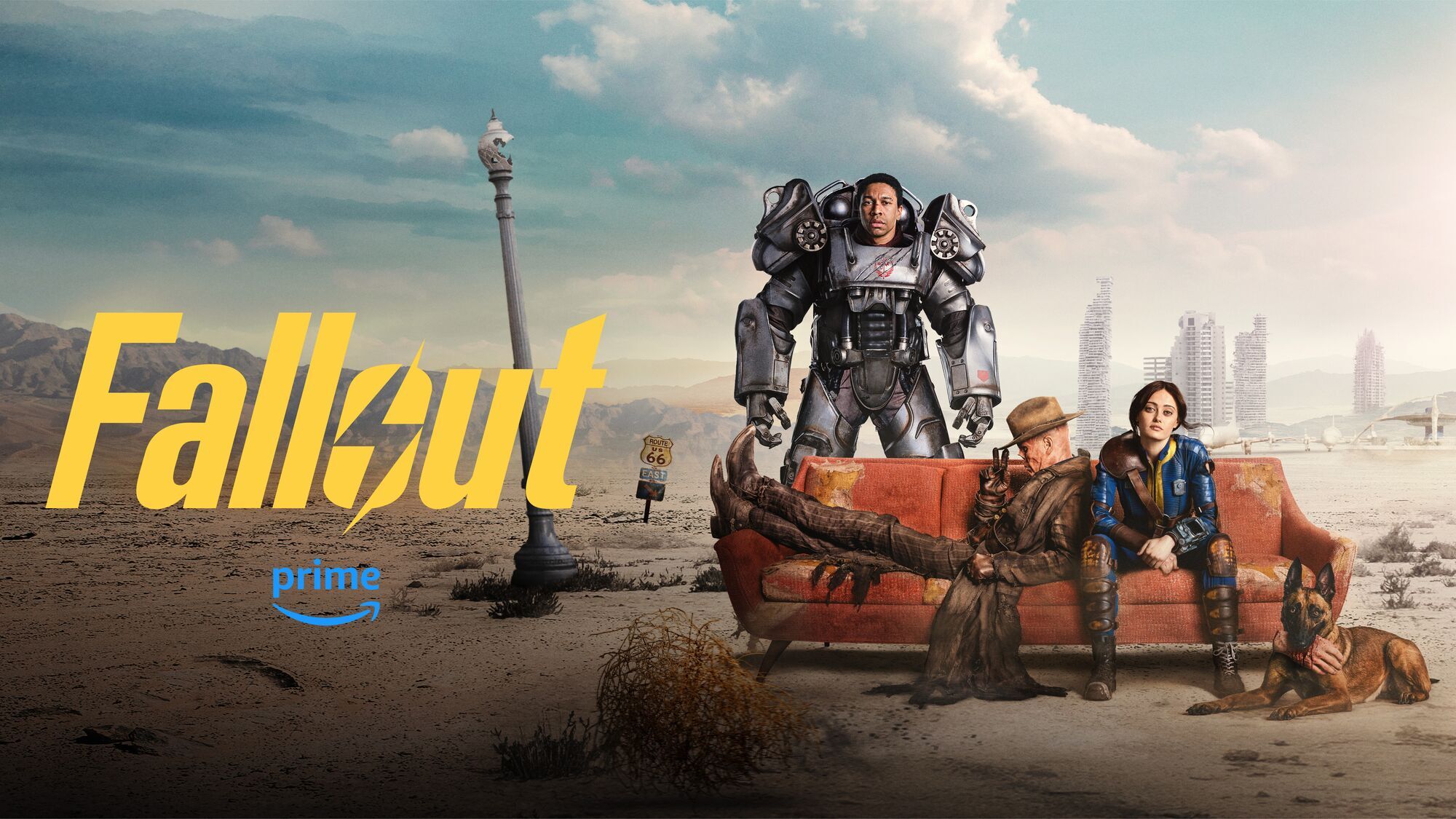
Fallout is arguably one of the most successful video game adaptations ever put to screen. With season 2 expanding the wasteland’s horizons, the series continues to offer a visually stunning, darkly comedic, and brutal look at a post-apocalyptic America. But for someone with a background in international relations, watching it feels like shooting a cannon at a mosquito.
It is no secret that the original games were deeply political, grappling with the logic of Cold War nuclear doctrines. The franchise was always a perfect vehicle to dramatize some of the most high-stakes concepts in mainstream IR: nuclear posturing, deterrence, command-and-control failures, and cooperation under the “security dilemma” that traps superpowers like the US and China in a spiral of escalation. These are IR jargons, but they are also the terrifying mechanics which underpin Fallout’s premise of how the world may actually end.
Especially now, as we drift toward a new era of great power rivalry, Fallout had a golden opportunity. It could have taken the dense literature on nuclear doctrines and made it accessible to a mainstream audience, showing us exactly how rational state actors can sleepwalk into Armageddon. But, of course, Hollywood couldn’t help themselves. Instead of a genuinely interesting political thriller grounded in the reality of statecraft, they had to blame it on “corporate greed”. Why would the earth blow up? Because of Google or something. Those greedy businessmen oppressing us by trying to voluntarily offer us goods and services at accessible prices, suddenly deciding to blow up their own customer base for… profit, somehow? In my view, the series is a waste of a brilliant premise. Sad.
The central, unfortunate, premise of the show’s adaptation is that Vault-Tec, the mega-corporation behind the survival shelters, conspired to drop the nuclear bombs themselves. Their logic? To wipe out the competition and secure a “true monopoly” over the future of humanity. This narrative framing is just another Hollywood strawman of capitalism: the idea that the profit motive is so pathologically destructive that a company would murder its entire customer base just to gain market share. It is a cynical critique that conflates free enterprise with cronyism. But if we dig deeper, we find that Fallout isn’t actually critiquing capitalism. Instead, it is unknowingly critiquing the very state interventionism it seeks to defend.
The defining moment of the series’ political argument is in the Season 1 finale (and is reiterated throughout Season 2). In a dimly lit boardroom, the heads of America’s major corporations, namely Big MT, RobCo, Repconn, gather with Vault-Tec to discuss the “threat” of peace. Peace, they argue, is bad for business. Vault-Tec’s representative, Barb Howard, comes up with a brilliant idea: the only way to guarantee a return on investment for their vaults is to drop the bombs themselves.
To understand the absurdity of Vault-Tec’s boardroom conspiracy, one must look at some of the functional mechanics of a market economy. Households provide factors of production (labor) to firms in exchange for income (wages), which is then spent on goods produced by firms, creating a cycle of production, income, and expenditure. This is called the circular flow of income. Dropping the bombs is, methodically, the ultimate destruction of capital.
In the real world, dead people do not buy products. If a corporation incinerates 99% of the global population, it has simultaneously vaporized 99% of its consumer base, its labor force, and its entire supply chain. Furthermore, a corporation exists to generate returns for its shareholders, measured in a universally recognized medium of exchange. The moment the bombs fall, the New York Stock Exchange evaporates, fiat currency becomes entirely worthless, and global trade networks cease to exist. You cannot hold a monopoly over a market that has been destroyed. There is nothing left! Vault-Tec’s plan to rule the wasteland is not an example of ruthless capitalism, but it is economic suicide.
Hollywood writers frequently confuse the economics of defense contracting, which thrives on the persistent threat of conflict AND requires a functioning tax base to fund it, with total annihilation. Lockheed Martin profits from the threat of war. They would go bankrupt in a nuclear apocalypse, because The U.S. Treasury would cease to exist to fund them.
This brings us to the show’s most profound analytical failure: it fundamentally misidentifies its villain. Fallout presents Vault-Tec as the monstrous creation of “unchecked” free markets, a creature of pure, deregulated capitalism. In reality, Vault-Tec is just an example of cronyism and the military-industrial complex. It operates as a government-sanctioned monopoly, heavily subsidized by the Department of Defense and deeply embedded with the “Enclave,” a shadow government offspring. How in the world is this “unregulated capitalism”? This is the fundamental distinction between capitalism and cronyism that the series entirely ignores. Capitalism is a system of voluntary exchange where businesses must compete to serve the consumer, and where failure to do so results in bankruptcy. Cronyism, or corporatism, occurs when the state merges with private enterprise, using the government’s monopoly on force to protect favored companies, prevent competition, and fund projects through coercive taxation.
However, for the sake of argument, let’s assume, hypothetically, that Vault-Tec was operating in a free, unregulated market, and for some reason they conspired to blow up the world. They would face immediate ruin. Investors would flee, insurers would drop their coverage, and whistleblowers would expose the plot to competitors. Vault-Tec survives only because it is an arm of a corrupt state. When the series blames “capitalism” for the apocalypse, it is actually describing the unchecked power of the Military-Industrial Complex (a very libertarian theme, too!)
The irony of the show’s politics deepens when we examine the societies that emerge in Season 2, particularly the contrast between the New California Republic (NCR) and the autocracy of Mr. House in New Vegas. The writers seemingly intend to present Mr. House, a pre-war tech billionaire who preserved his city through private missile defenses, as a symbol of techno-libertarian tyranny. Yet, the on-screen evidence tells a different story. The NCR, depicted as a restoration of “old world” democratic values, is shown to be a bloated, corrupt bureaucracy struggling to provide basic services and which taxes heavily. Its “citizens” live in shanty towns while its leaders play political games, repeating the very mistakes of the pre-war government.
In contrast, New Vegas is one of the only locations in the wasteland with reliable electricity, clean water, physical safety, and a thriving commercial economy. Mr. House’s “private city” works not because he is a benevolent leader, but because he treats the city as a capital asset. Namely, property rights are strictly enforced, and trade is facilitated rather than suffocated by bureaucracy. Even the Vaults themselves, often derided by critics as “libertarian fantasies” for the rich, are shown to be totalitarian command economies. The Overseers are dictators, resources are rationed by central planners, and private property is nonexistent. They are similar to underground Soviet republics, and their frequent, catastrophic collapses due to resource mismanagement or horrific social engineering mirror the real-world historical failures of centralized planning.
Despite its economic missteps, the show does accidentally get one thing brilliantly right: it illustrates the Mengerian view on the origin of money. Austrian economist Carl Menger argued that money is not the invention of the state, but a spontaneous social phenomenon that emerges when market actors converge on a single, “most marketable” commodity to solve the inefficiencies of barter. We see this perfectly in the wasteland with bottle caps. Just like in R.A. Radford’s famous 1945 essay “The Economic Organisation of a P.O.W. Camp,” where prisoners spontaneously agreed on cigarettes as currency because they were durable, divisible, and desirable, the wastelanders didn’t wait for a government to print green, worthless paper.
In Fallout, they adopted caps because they possessed the physical properties of good money: they were scarce (manufacturing had ceased), durable (they didn’t rot), and portable. In the original 1997 game lore, this was even more sophisticated. Caps were backed by the Water Merchants of The Hub, representing a claim on a standardized measure of clean water. By showing money emerging from the bottom up rather than the top down, Fallout, perhaps unwillingly, pays homage to one of the most important concepts in free-market economics, illustrating how institutions may emerge under anarchy, something which would be interesting to explore later.
Ultimately, despite the television adaptation’s desperate attempts to rewrite the franchise’s themes, I remain convinced that the Fallout universe is inherently and staunchly libertarian at its core. The original games understood the mechanics of spontaneous order, the natural emergence of commodity money, and the catastrophic failures of the administrative state and the military-industrial complex. They presented a wasteland where survival depended on voluntary exchange, and seriously grappled with the idea of anarchy.
The television series, however, settles for the classic Hollywood economic illiteracy. By reducing the complex, terrifying reality of international relations, nuclear deterrence, security dilemma and state failure into a cartoonish parable about “corporate greed,” the showrunners fundamentally misunderstand basic market incentives and miss the mark on a brilliant premise. The wasteland of the video games remains a harsh but brilliant testament to human resilience and market mechanics in anarchy, defined as the absence of the state. The television show, however, offers a wasteland built on a foundation of economic ignorance, proving that, as war never changes, Hollywood’s inability to understand basic economics is the one constant that truly survives the apocalypse.
We roast sacred cows medium-rare. Help fund the habit!
This piece reflects the author’s views, not necessarily the entire magazine. We welcome a range of pro-liberty perspectives. Send us your pitch or draft.