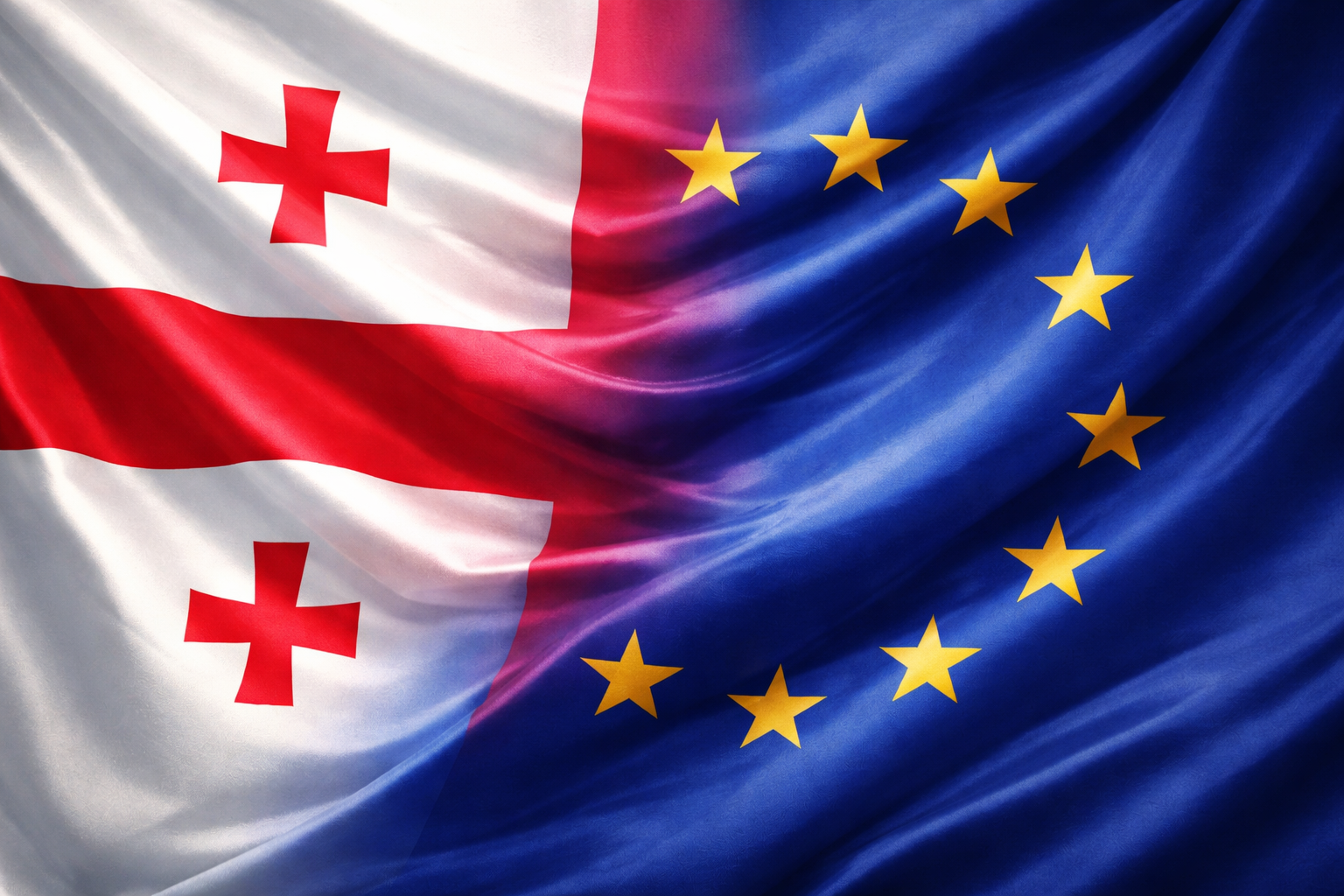
For the past decade, Georgia has been regarded as a leading aspirant for European integration among the Eastern Partnership countries. The nation signed an Association Agreement with the EU in 2014 and even amended its constitution to enshrine the goal of EU membership. Public support for joining the EU has consistently remained around 80%, reflecting a deep-rooted pro-European sentiment in Georgian society.
However, in recent years, Georgia’s democratic trajectory began to falter. Under the ruling Georgian Dream (GD) party, observers noted growing signs of democratic backsliding, including politicized justice, pressure on media and civil society, and a political strategy that increasingly relied on polarization and “enemy” narratives. This erosion accumulated through repeated controversies over judicial independence, selective accountability, and the shrinking space for opposition. Over time, the backsliding began to collide directly with the logic of EU enlargement, which is built on the assumption that candidate countries steadily adopt democratic norms and strengthen institutions.
By June 2022, these concerns were significant enough that while Ukraine and Moldova were granted EU candidate status in the wake of Russia’s invasion of Ukraine, Georgia was pointedly not. Instead, Georgia was given a “European perspective”, a conditional promise of candidate status once it met a list of 12 key reforms recommended by the European Commission. The reforms ranged from judicial and electoral changes to measures on media freedom, de-oligarchization, and anti-corruption.
Over 2022–2023, the European Parliament and other Western observers repeatedly warned that Georgia’s democratic trajectory was deteriorating, putting its hopes for the EU at risk. Despite these warnings, momentum toward candidacy built in late 2023. In November 2023, the European Commission recommended granting Georgia EU candidate status, a long-awaited “green light”. The recommendation came with explicit caveats and expectations: the status was granted “on the understanding” that Georgia would follow through on reforms. In mid-December 2023, EU leaders formally granted Georgia candidate status.
In Tbilisi, the move produced a real and understandable celebration. For many Georgians, candidate status felt like recognition of a long-standing national choice and an affirmation of belonging. Yet beneath the symbolism sat an uncomfortable political fact: Georgia’s government had not completed the deep reforms candidate status is meant to reward.
The EU’s Green Light and Georgian Dream’s Narrative
European diplomats hoped candidate status would encourage reform and strengthen pro-European incentives inside the Georgian government. Initially, Georgian Dream officials welcomed the news with triumphant rhetoric. Prime Minister Irakli Garibashvili called the Commission’s recommendation “well-deserved” and promised progress toward “full-fledged EU membership”. Parliament Speaker Shalva Papuashvili lauded it as a “historic recommendation”. GD’s leadership presented the decision as validation not only of Georgia’s European future but also of GD’s governing model.
That framing mattered. Candidate status is a uniquely valuable political asset. It can be used to reassure swing voters, neutralize criticism, and claim international legitimacy. In Georgia’s polarized context, it also became a tool for narrative warfare. The governing party used the EU’s decision to brand itself as the only “responsible” pro-European force, while casting opposition parties and civil society as radical, externally manipulated, or destabilizing.
Crucially, this pro-European self-presentation coexisted with an intensifying pattern of anti-Western insinuation. Throughout 2023 and into 2024, GD and its allies repeatedly suggested that Western actors had hidden agendas, which are pushing Georgia into confrontation with Russia, orchestrating regime change, or using NGOs as instruments. This duality did not soften after the EU granted candidate status. If anything, candidacy made the narrative strategy easier. GD could claim European legitimacy while resisting European pressure as “unfair interference”. It is precisely this contradiction, symbolic “Europeanness” without European standards, that turned the 2023 green light into a domestic political amplifier.
Democratic Reversals After Candidate Status
If candidate status was intended as leverage for reform, the post-December 2023 period showed how quickly leverage can become limited once the reward is banked.
In April 2024, the GD-dominated parliament revived the so-called “foreign agents” law, despite having withdrawn a similar bill in 2023 under public pressure. The “Transparency of Foreign Influence” framework sought to stigmatize civil society and independent media by forcing registration based on foreign funding thresholds. The surrounding narratives, that NGOs were foreign-controlled, that protests were externally orchestrated, that critics were enemies of the state, echoed classic illiberal playbooks.
The consequences were immediate. Thousands of Georgians returned to the streets to protest. The state response escalated, which brought police dispersals, arrests, and a harsher official tone toward demonstrators. The European Parliament explicitly referenced concerns about intimidation and repression and condemned the deteriorating climate. Meanwhile, Western diplomatic messaging increasingly warned that these moves were incompatible with the EU’s trajectory.
By mid-2024, Brussels’ patience visibly thinned. EU-facing policy communication started describing Georgia’s accession process as effectively paused amid democratic backsliding. What should have been a historic milestone began to resemble a frozen process. Candidate status existed on paper, but accession was practically stalled in practice.
2024 Elections and Propaganda Windfall
For Georgian Dream, candidate status became political capital, not a reform mandate. It allowed the governing party to claim that Europe had “confirmed” its course, even while Europe was simultaneously warning about regression. This created a powerful domestic messaging advantage. GD could selectively amplify the symbol (candidate status) while discounting the substance (democratic conditionality).
In the lead-up to the October 2024 parliamentary elections, this dynamic hardened. GD Founder Ivanishvili and other GD figures leaned on a fear-based narrative of “peace versus war”, portraying opponents as agents of external forces trying to open a “second front” against Russia. The “Global War Party” conspiracy narrative became a signature theme of GD’s campaign messaging. This narrative served multiple functions at once:
- It reframed pro-European civil society criticism as a national security threat.
- It delegitimized opposition parties as foreign-controlled.
- It turned Western criticism into proof of “external pressure”.
- It offered GD a justification for tighter political control “in the name of stability”.
Candidate status, paradoxically, strengthened this propaganda structure, as GD could point to December 2023 and say, “Europe recognized us”. It became easier to insist that all subsequent criticism, about foreign agent laws, repression, or elections, was political hostility rather than democratic concern. The government claimed that they are pro-European, the West is unfair, and their opponents are destabilizers. Candidacy made that triangle more credible to parts of the electorate, especially voters less engaged with EU conditionality details.
After the elections, tensions deepened further. Georgian Dream’s leadership framed EU and European Parliament criticism as “blackmail” and “insults”, while announcing a freeze on EU accession negotiations until after 2028.
The Core Unintended Consequence
The central policy problem the EU decision created domestically is that the symbol of candidate status became louder than the substance of conditionality. Candidate status was granted with the intent of empowering reforms, but it also empowered messaging. In a system where political legitimacy is fiercely contested and media ecosystems are polarized, a symbolic achievement can be converted into an argument for staying in power. GD used candidacy to “prove” its pro-European identity, then used that “proof” to justify further propaganda, marginalize dissent, and resist EU pressure as illegitimate interference. The result was a political feedback loop:
The EU gives candidate status → GD claims legitimacy → GD tightens narrative control → GD frames criticism as sabotage → reforms stall → EU leverage declines (because the reward has already been delivered).
The concern was never that Georgia should be denied a European perspective, but that granting the top symbolic milestone too early, under a government showing clear illiberal tendencies, could reduce the EU’s leverage and unintentionally strengthen the very actors resisting reforms.
Green Light at The Wrong Time
In hindsight, Georgia’s EU candidacy in 2023 was a double-edged sword. It affirmed the country’s European future in principle, but in practice, it arrived at the wrong time, bolstering an incumbent government that turned the mandate against its own democratic obligations. The task now, for both Georgians and their European friends, is to prevent this GD’s Pyrrhic victory from becoming a permanent setback. That means insisting on accountability for democratic backsliding, supporting the Georgian people’s European aspirations (independent of any one regime), and perhaps rethinking the EU’s approach to conditionality so that “green lights” encourage genuine progress, not provide cover for retrenchment. Georgia’s story is still unfolding, and the hope is that all is not lost.
This piece solely expresses the opinion of the author and not necessarily the magazine as a whole. SpeakFreely is committed to facilitating a broad dialogue for liberty, representing a variety of opinions. Support freedom and independent journalism by donating today.