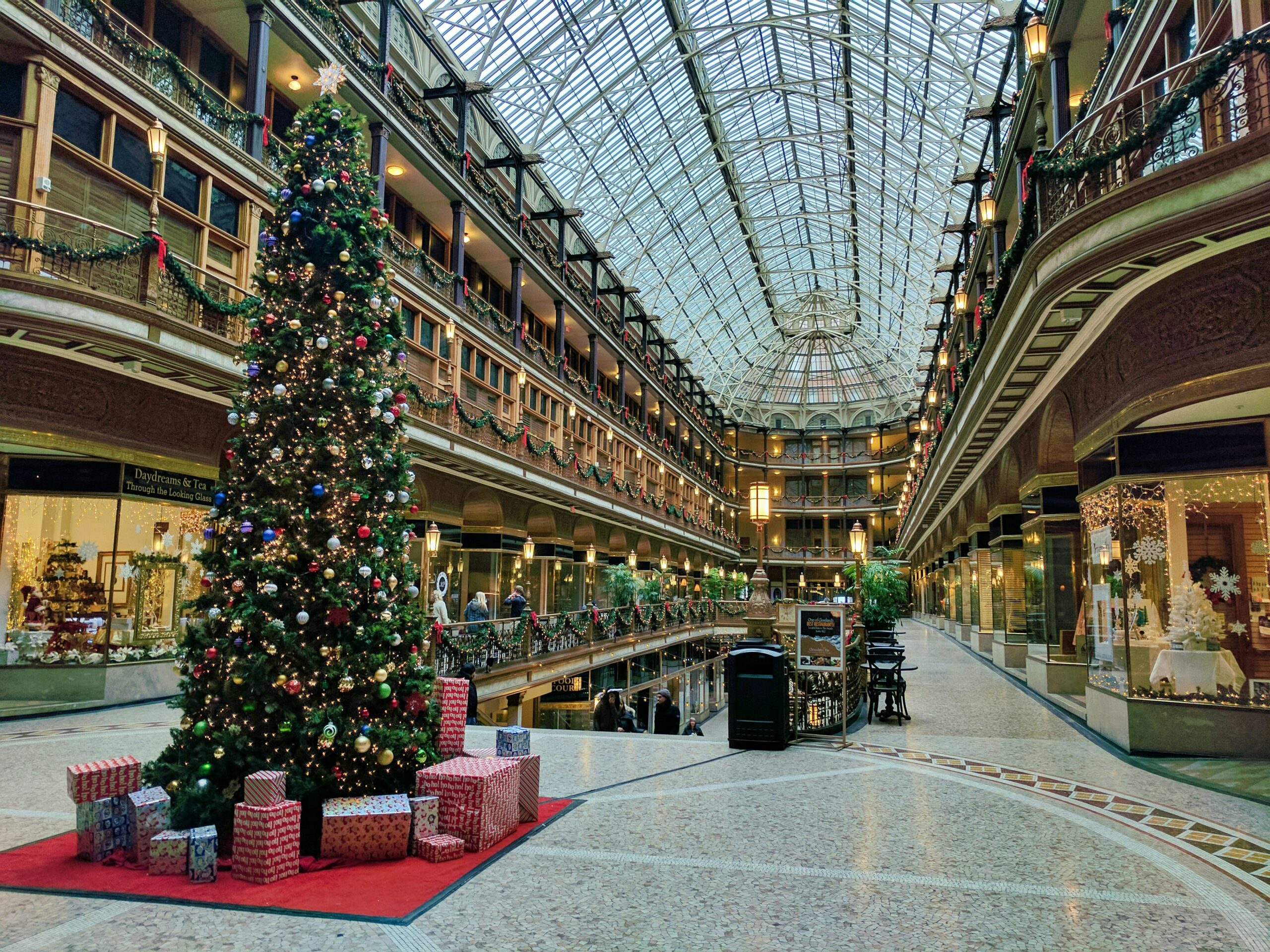
I was walking through downtown, where every lamppost was wrapped in lights and every storefront was blasting the same three Christmas songs on repeat. Somewhere between “Merry Christmas” and a blow-up Santa slowly collapsing onto the sidewalk, I started thinking about freedom. Nothing forces a philosophical crisis like holiday music at full volume.
Christmas is supposed to be the season of goodwill, generosity, peace on Earth. But when you look closely, it is also one of the few cultural rituals where people instinctively act like liberals, sometimes without noticing.
December is the month of voluntary action. Donations, gift giving, community food drives, strangers paying for someone else’s coffee. Not because a law mandates it. Because people choose to. Civil society wakes up for a moment, unprompted and uncoordinated, and somehow it works.
Bastiat would have smirked at this seasonal proof of principle. After all, he warned us: “The state is the great fiction through which everyone endeavors to live at the expense of everyone else.” Yet Christmas flips that script. People do not wait for officials, budgets, or programs. They simply act. The generosity is decentralized, spontaneous, and voluntary in the purest sense.
Walking through a mall feels like watching a Hayekian miracle. Millions of individual decisions about what to buy, what to give, and how much to spend create an unplanned social choreography. No central planner could design it. If Christmas were centrally managed, it would lose its soul. There would be more rules and far less joy.
Yes, the holiday is commercialized. Capitalist even. Libertarians appreciate that aspect, critics despise it, and most families pretend not to debate it at dinner. But the market side of Christmas is not shallow. It is expressive. You give because you want to signal love, attention, and care. Gifts become small economic messages of affection rather than obligations imposed by some seasonal authority.
What fascinates me is how Christmas quietly proves a deeper truth. People are kinder when they are free. Coercion can force compliance, but it cannot force goodwill. You can require charity, but you cannot require compassion. That only appears when people choose it.
I stopped at a small hot chocolate stand run by a man who had decorated the booth with tinsel and a cardboard star. He handed me the cup as if he were handing me warmth itself. No policies, no incentives, no state approved version of holiday spirit. Just a private citizen deciding to improve someone’s evening.
It felt more meaningful than anything a bureaucracy could replicate.
As I kept walking, the mix of carols and traffic hummed around me. Christmas lights blinked like small acts of defiance against the winter darkness. And I realized that the holiday might be the best argument for liberalism. Not because people behave perfectly, but because they do not have to. They only need the freedom to act on the better parts of themselves.
For a few weeks, society runs on trust. On the belief that individuals can choose generosity without being forced. On the hope that goodwill spreads faster than regulation.
Maybe that is the real miracle of Christmas.
Not angels. Not snow. Not the perfect gift.
Just the simple proof that when people are free, they often choose light, and sometimes even share it.
This piece solely expresses the opinion of the author and not necessarily the magazine as a whole. SpeakFreely is committed to facilitating a broad dialogue for liberty, representing a variety of opinions. Support freedom and independent journalism by donating today.