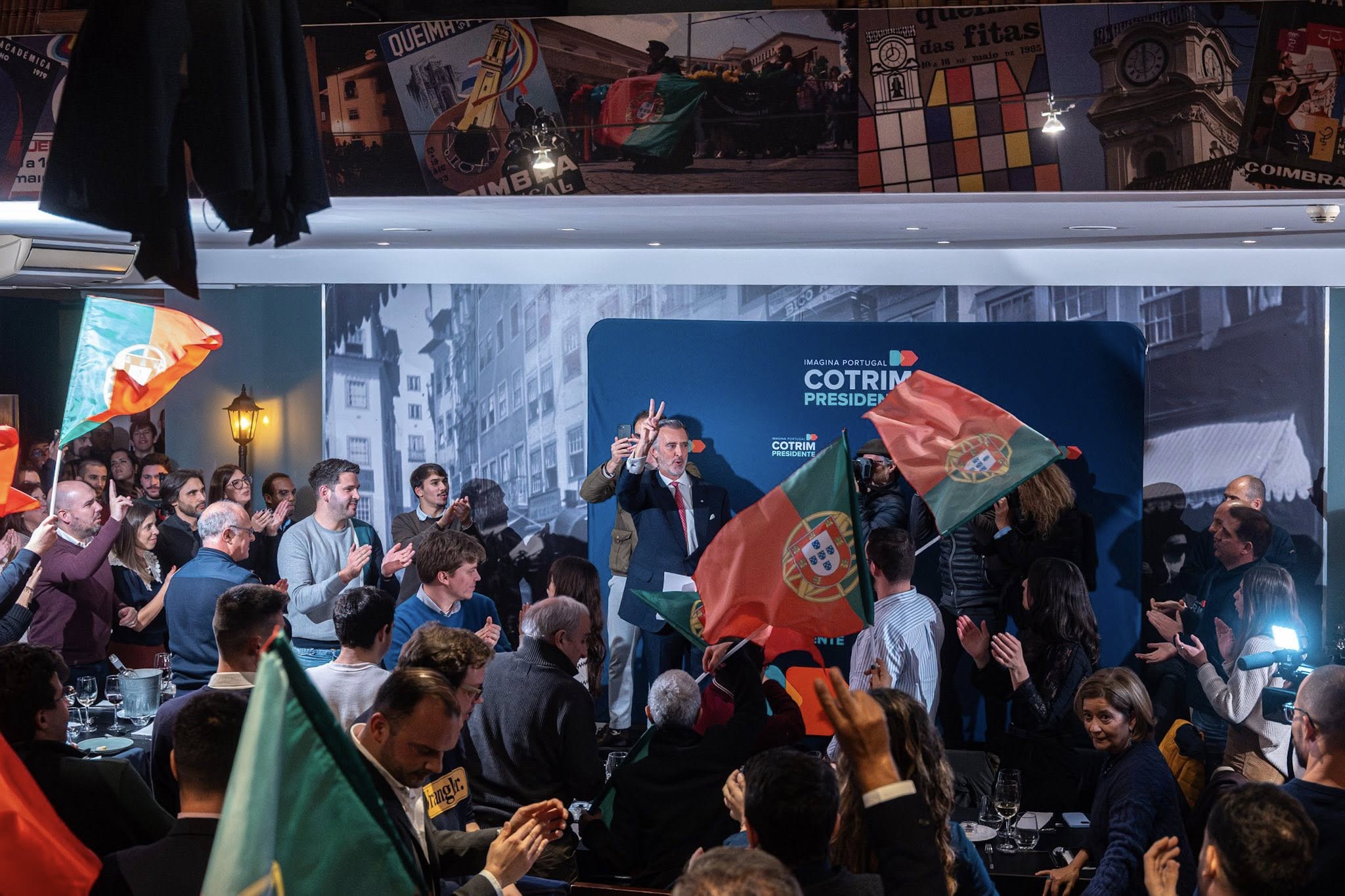
With days to go until Portugal’s presidential election on 18 January, the race is unusually open. João Cotrim de Figueiredo, the liberal candidate backed by Iniciativa Liberal, has moved from afterthought to genuine contender for the runoff.
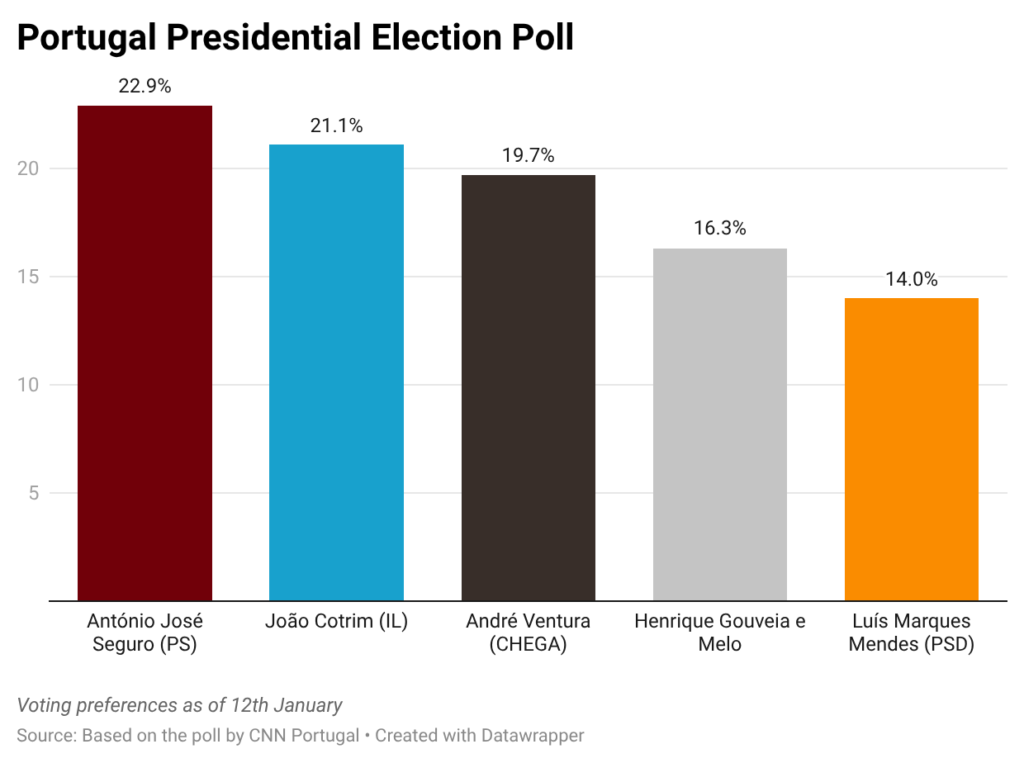
A recent poll for CNN Portugal, TVI, JN and TSF captures the fragmentation: António José Seguro (PS) leads on 22.9%, Cotrim follows on 21.1%, André Ventura (CHEGA) sits on 19.7%, Henrique Gouveia e Melo (not affiliated) on 16.3%, and Luís Marques Mendes (PSD) on 14.0%. In a field this tight, small shifts decide who reaches the second round.
How it began: the admiral, the TV commentator, and an empty centre
The race began before any launch event: Navy admiral Henrique Gouveia e Melo refused to confirm he would run, yet dominated the pre-campaign anyway.
Strategic ambiguity created a vacuum that pundits filled with projection: a supposedly “above party politics” figure, carrying the aura of competence inherited from the COVID vaccination programme, treated as inevitable before he entered the arena.
Against that backdrop, CHEGA’s André Ventura moved first in January 2025, opening the populist lane on the right. He ran seizing every opportunity for attention, turning provocation into a campaign method, even though the presidency’s role as national referee constrains the room for political theatre.
In February 2025, Luís Marques Mendes entered along a familiar path, with the Marcelo Rebelo de Sousa template hanging over him: former PSD leader, prime-time weekly commentator, high name recognition, and a promise of institutional “common sense”. In May 2025, Gouveia e Melo finally confirmed his candidacy and launched formally, becoming the early favourite. In June 2025, António José Seguro provided the partisan anchor as the PS-linked option for voters who prefer stability and moderation.
The result was a centre crowded with familiar names. That is where the liberal candidacy found air: Cotrim signalled availability in July 2025, made it official in August, and was dismissed as a niche urban bid, until the polls began to tell a different story.
Cotrim: from 3% to a credible contender
When Cotrim entered, much of the coverage treated it as symbolic. A November 2025 poll put him on 3% in direct voting intention. By December, tracking polls showed him climbing into the teens; by January, he had entered the leading cluster. For a country where organised political liberalism is still relatively recent, that jump matters beyond this election.
Why it is resonating now?
Three forces explain Cotrim’s rise.
First, the contrast is unusually sharp. With Ventura’s polarisation on one side and continuity candidates on the other, Cotrim has tried to occupy the space of rational reform: a liberal alternative to the PS-PSD duopoly and to populism, focused on institutions and the economy.
Secondly, the incentives for tactical voting are unusually strong. Fragmentation makes votes mobile. Disappointed centre-right voters can see Cotrim as a way to stop Ventura without defaulting to the Socialists; some centre-left voters can see change without rupture. The strategic layer reinforces that logic: Ventura has one of the highest rejection rates in the race at around 70%, so if voters assume he is likely to lose a runoff, a first-round vote for him can start to look like a vote that automatically elects his opponent.
A third is structural: the European context. Portugal is living, in slow motion, the same tension running through several European democracies: worn-out traditional parties, growing populism, and declining trust in institutions. Chega is no longer marginal, and its parliamentary strength has shaped the country’s political atmosphere. In that environment, a candidate promising reforms with a civil tone can grow by contrast.
The moment the game got dirty
When an outsider rises, the campaign changes texture. The joke becomes a threat. These two events happened precisely in the last week of the campaign.
For Cotrim, that shift became visible in a classic trap: the runoff hypothetical, amplified by headline warfare. Asked whom he would support if he did not make the second round, Cotrim said he would not exclude anyone from consideration. Opponents and headlines pushed that into “Cotrim backs Ventura”, even though it was conditional and about a scenario, not an endorsement.
Cotrim walked it back, called the moment “unfortunate”, admitted he had not been clear, and said he did not want Ventura as President. Then the campaign turned uglier: an online accusation of sexual harassment emerged from a former staffer linked to IL’s parliamentary group and currently a PSD government staff, later deleted. Cotrim denies it and says he will file a criminal complaint for defamation. The episode shows how social media can inject allegations into a campaign faster than verification can follow.
What this means for Portuguese liberals
Even if Cotrim does not win, his election breakthrough can have lasting effects.
If he reaches the runoff, liberalism in Portugal stops being treated as an urban niche. It becomes a political language capable of competing for the highest office. That forces opponents to respond to themes that were easy to ignore until now: state reform, regulatory quality, economic opportunity, institutional merit, and limits on party power.
If he does not reach the runoff but comes close, the effect may be similar: the liberal space proves it can grow beyond its party bubble, and that there is an electorate available for a modern reformist option that does not need populism as its engine.
The final stretch: what to watch
The interplay of three dynamics will decide the race.
First, strategic voting. As more voters internalise Ventura’s high rejection and likely runoff defeat, voting for him can start to feel like a vote thrown away, or even a vote delegated to whoever faces him. That can concentrate centre-right and centrist voters behind whichever candidate looks best placed to keep Ventura out of the final.
Second, the fading of early inevitability. Gouveia e Melo and Marques Mendes began with an aura of inevitability. If that aura collapses, late momentum becomes decisive, and Cotrim is the candidate trying to capture it.
Third, noise discipline. In a volatile race, a single sloppy sentence can be weaponised, and personal attacks can be timed to drown out momentum. The next few days will test whether the liberal surge is a spike or a realignment.
Portugal votes on 18 January; and if no one reaches 50%, the second round should follow in February. The central question is whether a liberal can convert a late surge into a place in the final round.
According to the latest Polymarket odds, he has about 18% chance of snatching the presidency.
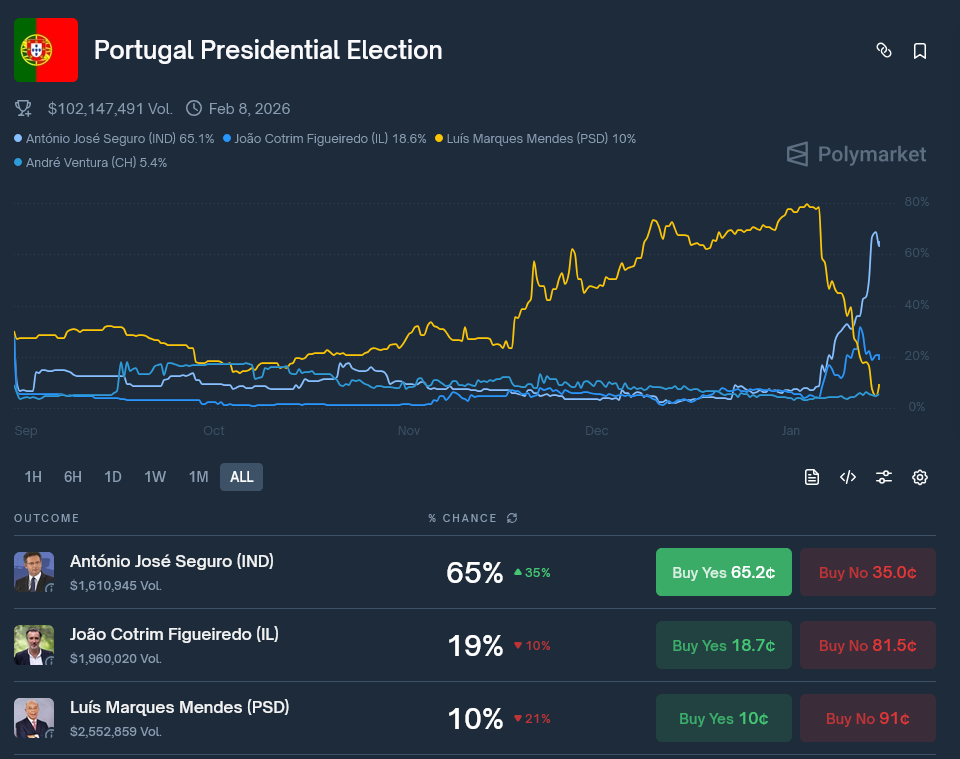
Image Source: João Cotrim Figueiredo Facebook
Not a cent from the state, ever. Keep us stubborn. Donate today!
This piece reflects the author’s views, not necessarily the entire magazine. We welcome a range of pro-liberty perspectives. Send us your pitch or draft.