Written by Filippo Natali
Translated by Nicolas S. Straehl
“On the border between Umbria and the province of Arezzo, on a slight rise that acts as a buttress to the Apennines, stands the village of Cospaia, formerly the capital of the republic or rather of the Free State of this name, which from 1440 to 1826 retained its autonomy and independence, although it was governed without written laws, without leaders, without militias, without taxes.”
This is the book’s second chapter. If you missed chapter one, you can read it here.
Chapter 2: Origin
The area of territory is marked between 43.° 16.’; 42.° 41.’ of longitude and 29.° 40.’; 30.° 3.’ of latitude, and is delimited to the east and to the north by the Apennines, which separate it from the Marche region; to the west it is delimited from the Alpe di Catenaia and the hills that descend from it, which divide it from the province of Arezzo; to the south it is delimited from the fertile Umbertide valley, which distinguishes it from the Perugian territory. This area of territory is called the Upper Tiber Valley and includes cities, hamlets, castles, villages in considerable numbers and is aggregated partly to the province of Umbria, and partly (the smaller part) to that of Arezzo. The level land, where the historic river flows, with irregular stretches on both sides, is uneven on the rest due to a series of hills, rises, undulations of land, and is crossed by many water courses. The nature of the soil, which was an elongated lake from the Pliocene times, with bays and swamps, is made up of clay, sandstone, schists and pebbles.
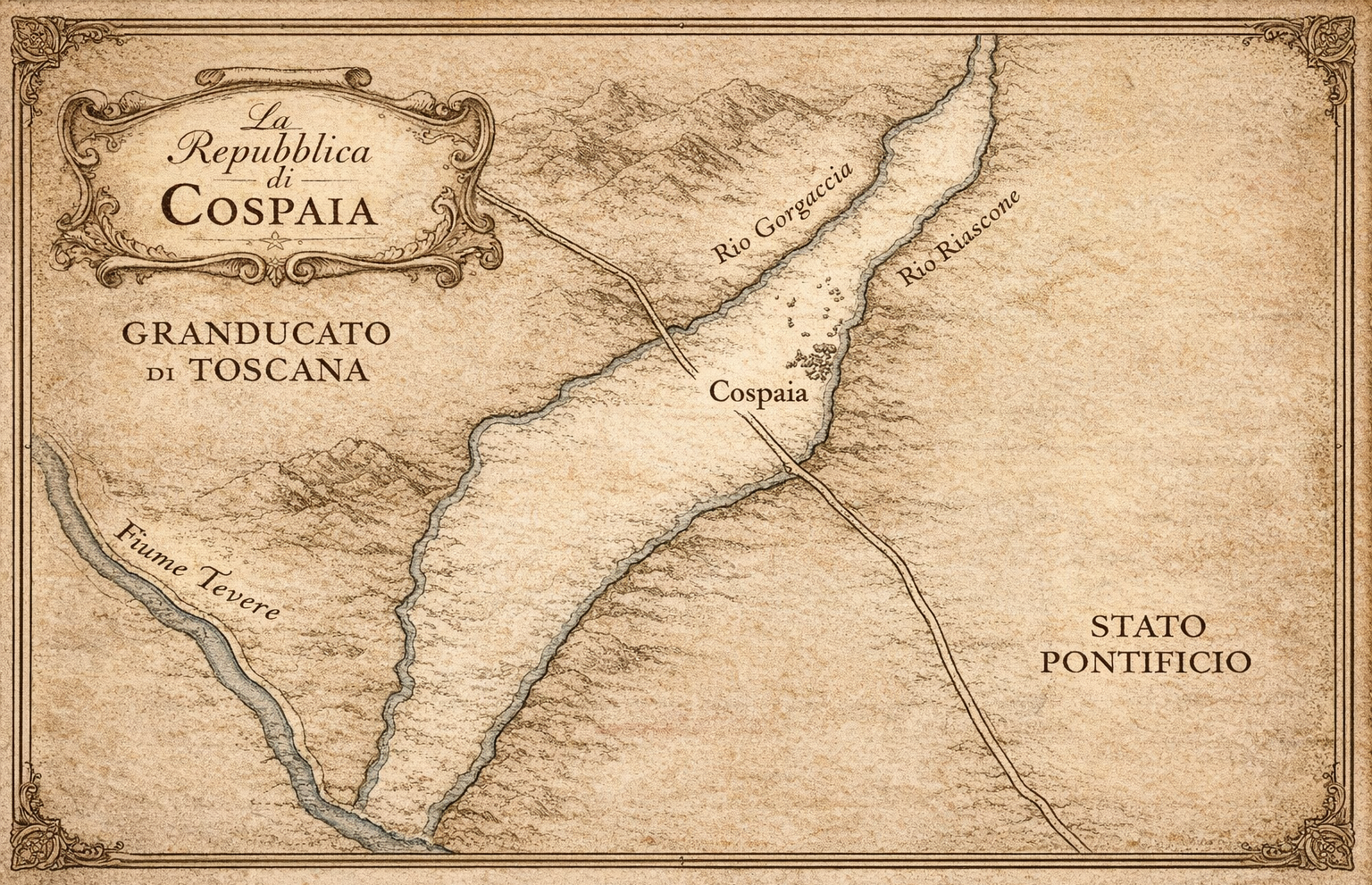
On the border of the two provinces of Perugia and Arezzo, in the most picturesque part of the Upper Tiber Valley, dominated by the Apennines rising to over 1000 meters above sea level, to the east of the city of Borgo S. Sepolcro, and precisely where the ground that leaves the Tiber, after a flat stretch of almost a kilometer, rises almost imperceptibly to a small chain of plateaus, is the village that gave its name to the republic of Cospaia.
Close as it is to Tuscany and Umbria, it shares the customs of both regions, but retains more the ones of the former, because it is just three kilometers from S. Sepolcro. Looking either east or west, you have the view of the Tuscan countryside, of gentle Tuscany, where – it can be said – the most natural and spontaneous feeling of beauty manifests itself, responding to the graces of the language, to the meekness of the air, to the serenity of the late sunsets, to the exultation of the hills covered with vine
leaves, to the joy of the happy valleys, which “Populated with houses and olive groves, / a thousand flowers send incense to Heaven.”
The invasive spirit of innovation and the innate desire in man to imitate those who are, or believe, better than him, caused the styles of clothing or, as they say, the customs of the inhabitants of certain districts and countrysides to disappear. Tuscany, however, is perhaps only the one that shows the greatest attachment to the styles of clothing used in ancient times in its various provinces; and therefore you still see the polite and gentle peasant women in their short dresses, adorned with white or blue braids; dresses that reveal a well-tightened white stocking and a foot shod with flat shoes, with wide straw hats that fall onto their faces and shoulders, swaying with every step they take. These girls despise the unhealthy delicacies of closed rooms and boldly challenge the vibrant open air that bites the cheeks, stirs the blood and that, even on the romantic pallor of the rosy cheeks, makes the bright colors of health bloom. When they take care of the chores in the fields, they mitigate the cruel work with singing, and their melodies and voices bounce back from one hill to another. And these customs are the expression of the feelings of those populations, and also greatly influenced the laws; and yet we see that Tuscany, even in difficult times, preserved the mildest code among the codes of the other Italian states.
It is true that a subtle distinction concerns what we properly call moral customs, different than social and political ones; the former because they depend on morality and religion, the latter on the general condition of civilization, the arts, letters, the nature of the public institutions of a country, although sometimes the three are confused, and religious habits, or political habits, or social ones get defined under the same generic name of customs; but whether we are talking about one or the other, tuscanian customs take a gentle form and are the most acceptable and suited to civilized life.
And now let’s talk about the territory, its configuration, as well as the special habits of this small population. The territory of the ancient republic – Cospaia was designated with this name, and we will later see if it suited it – constitutes an irregular polygon with a sharp shape in the upper part and a parallelogram in the rest. It consists of the plain part, which goes from the provincial road to the Tiber, and the mountainous part, from that to the Apennines on which it gets wedged. The maximum length is approximately two and a half kilometers, the maximum width is approximately 500 meters. It now has 500 inhabitants, including the village; but at the time of its reunion with the States of the Grand Duke and the Pope, it contained just 350.
On the plain, the soil is kept under intensive cultivation and tobacco is planted in most of it, a privilege that remained from 1826 onwards, at the time of the dedication or the submission. In the agreement made between the representatives of the people of Cospaia and the cardinal Fieschi on behalf of the Pope the 28th of June 1826, with the IX § the population of Cospaia has been authorized to continue the undertaken cultivation of tobacco, without restrictions of any kind, as far as the number of plants is concerned. However, over time the plantation was limited to 1,200,000 plants in the entire territory of S. Giustino to which Cospaia had been annexed, and recently (1884) cultivation was granted for an even smaller number of plants; because of this the Municipal Representative of San Giustino sent a complaint to the Ministry of Finances, but with not much success up to today (1890), although in terms of the quality of the product – if we control for the hectares of its cultivation area – the tobacco of this
part of Italy equals the most productive region, which is that of Lecce, and leaves the others on the peninsula far behind.
In fact, tobacco is cultivated in Italy over an area of 4144 hectares. The general average per hectare is 918 kg; however, the various districts in which tobacco cultivation is permitted allow for a very evident alteration of this number. Limiting the observations to the year 1876 (to which our investigations refer) we find that the average product of 1000 plants in the Lecce district is 218 kg, while it oscillates between 126 and 124 in the districts of Cava dei Tirreni, Viterbo, San Sepolcro (including Cospaia); between 90 and 60 kg in the districts of Iesi, Benevento; between 48 and 41 kg in Pontecorvo, Cori, Val di Brenta; it drops to 21 kg in Sassari. In 1875 the harvest per hectare rose to 1509 kg and 1409 kg in the two provinces of Salerno and Arezzo, while in that of Caserta it was 316 kg, in that of Sassari 289 kg. The Municipal Representatives of S. Giustino had therefore every right to be exuberant, and their complaints should also be taken into account, since the government would find an advantage for itself in allowing more extensive tobacco cultivation in that territory.
It is known that Italy annually imports tobacco worth about 12 million lire on average, while the soil and climate of our country lend themselves admirably to the cultivation of tobacco, and free cultivation would provide over 1200 lire per hectare of benefit, greater than with any other cultivation. And almost as if this
weight were not enough on our agriculture and our finances, let’s add smuggling, for whose dishonest prosperity we don’t know whether we should blame bad manufacturing, or the relative expensiveness of our products, and finally that habit of preferring the forbidden fruit.
The Cospaia hill is cultivated with wheat, hemp and corn (zeacorn) and in the mountainous part there are natural pastures and woods. Above rises the Apennines from where, through the S.Antonio pass, with a well-designed road, on reaches the Marche region.
In this place the enormous rocks, stacked on top of each other, rise gigantic like a static and terrible destiny in the midst of the devastated nature. They are traces of that distant era in which the waters had other boundaries, other climates; residues that hitherto unknown cataclysms threw into that site. When this happened man cannot say, because he has existed for too short a time. In front of these Dolomite testimonies of very ancient times, man feels weak and miserable; he calls himself king of nature, yet nature has taken its form long before he existed, nor – no matter how hard he can try to recall – will he ever remember the first day in which these titans made out of stone began the great battle against the wind and the waves.
Stupendous is the landscape that appears, standing on these hills, all around. On one side, gently undulated and scattered with villas, we have green mountains; on the other Anghiari, S. Sepolcro with low pits made out of clay.
We have considered the territory of the small republic from the geological and agricultural point of view, and we have noted how this area, in its extrinsic way of manifestation, is nothing more than a natural consequence of climate phenomena. It is therefore redundant to explain why this kind of industry cannot be exercised throughout the entire Italian peninsula, and how indeed the exercise itself in its means and in its purpose undergoes just as many transformations as there are differences between the climate and the regions in Italy. And we have also noted how nature has lavished its benevolent favors on the Cospaia area.
Now it is time to get into the matter regarding the history of this republic. It is not useless to seek out who owned Cospaia before it became a free territory due to a very singular case. There is news
from the year 1360 in which the community of Città di Castello, to which Cospaia and Borgo S. Sepolcro belonged, ordered the captain of the Borgo to take an oath at the entrance to the office, not to molest the people of Cospaia with taxes. And it must be observed that then Borgo S. Sepolcro was simple land, and since, due to the proximity of Cospaia, the person in charge of that place could easily extort some taxes to the detriment of the community which protected the rights of its people, the representatives of the municipality of Città di Castello found it appropriate to obtain a formal promise from the captain of the Borgo not to harass those of Cospaia; and so in 1367 the Priors of Borgo S. Sepolcro were forbidden to harass the guards of Cospaia, district of Città di Castello, perhaps to corroborate the oath of 1360 or because the pacts were not kept. From this it can be deduced that Cospaia, in that era, belonged to the community of Città di Castello.
It was in 1440 that it freed itself and this is how it happened. When the Venetian Condulmer ascended to the papal throne with the name of Eugene IV in 1431, he found his coffers exhausted and his resources equally diminished, especially due to the scandalous nepotism of his predecessor popes. Eugene IV, accustomed to seeing the opulence of his native city and the luxury of the court of Venice, despite all the sumptuary laws on customs, could not prepare himself to live modestly and, in order to increase the pomp at the papal court, or as others say, in order to support the war against the Malatesta of Rimini, he began to devise every means to make money. The concessions that were made for money by this Pope and the sales of ecclesiastical goods are innumerable, and one cannot read an archive book from that era without finding a legal act of such sales and concessions. But these were small resources that could not serve the pontiff’s intentions. Until then no pope had attempted to throw out there, even if only to test the waters, the words: let’s sell ecclesiastical goods, or let’s mortgage them, considering this as a capitis diminatio and the territory subject to the church was sacred and inalienable. However, Eugene IV also ventured this step and offered the territory of Borgo S. Sepolcro, which – since it was in absolute topographical continuation with that of Arezzo – was coveted by the Florentines, as a pledge to the Magistrate of Florence.
It seems that then, when it was convenient, one could overlook and renounce the rights of the people, and that these rights were enforced only when the will of the popes demanded some personal benefit. The price that the Pope withdrew from this pledge was 25,000 gold florins (florenos auri de sigillo millia viginti quinque [‘twenty-five thousand gold florins from the seal’]), which were given to the Community of Florence by Cosimo Giovanni de’ Medici Domicelli. The Pope then transferred to the Florentines all the rights that the Church had there, and the investiture took place with the formula: mero et mixto imperio gladique potestate [‘by mere and mixed rule and power with the sword’]; being able in this meantime to appoint and depose castellans, demand rights and taxes that are typically imposed in said Land, with the intention of taking it back, as soon as he was able to repay the sum.
[To put a stop to the invasive mania of the popes to make money by any means, even by selling part of the territory of the Church, in the conclave that followed the death of Paul IV, the cardinals made the newly elected Pius V sign some chapters, where to art. 2nd it is said: “that the cities, lands, goods, rights of the Roman Church, either through exchange and with compensation for evident utility and necessity, will not be alienated, nor rented for a long time, nor given as a pledge or in government, nor in another title, beyond the life of the same Pontiff and without the consent of all the cardinals, except pensions, fiefdoms which have no jurisdiction, otherwise the acts of the conclave of Pius IV are null and void.”]
Historians believe that Borgo S. Sepolcro came to Pope Eugene IV from the sale made to him by the Malatesta family, who, defeated in war by the arms of the Church, were forced to stay there to preserve Rimini. Then the pontiff gave it as a fief to Nicolò Fortebracci da Montone, known as Stella, who was
succeeded in the dominion by Francesco Battifolli, count of Poppi. However, Pope Eugene IV took it back, and it was then that he pledged it to the Florentines.
It was at the time in which these events occurred that the free state of Cospaia arose, as we will see in the following chapter.
Good reporting is cheaper than heavy-handed regulation. Support freedom and independent journalism by donating today.
The Piece appeared first on Nicolas’s Substack. Read more here.
This piece reflects the author’s views, not necessarily the entire magazine. We welcome a range of pro-liberty perspectives. Send us your pitch or draft.