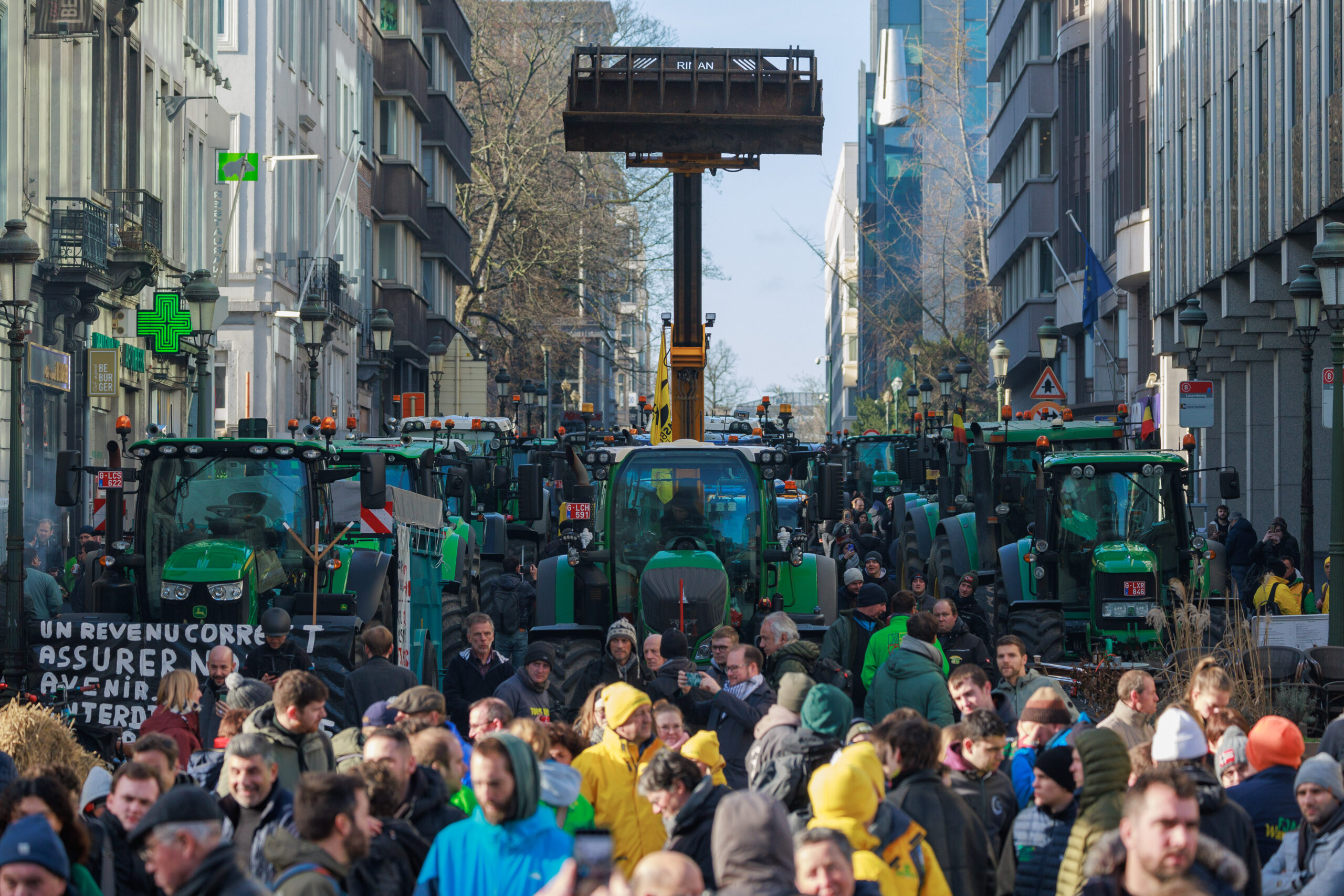
In recent weeks, Europe has been struck by a wave of intense protests by farmers over the EU-Mercosur agreement. The free trade deal that will enable the gradual reduction and in some cases elimination of tariffs on agricultural products such as beef, poultry, and sugar from South America was met with tractor blockades of major roads and streets, dumping manure or slurry on government buildings and police, setting hay bales or tyres on fire, dumping or destroying produce such as potatoes and Spanish wine, and violent clashes with police.
A libertarian will of course, be sympathetic to many of the farmers’ demands, which call for the removal of legislative barriers that increase production costs, so that they can compete on equal terms with South American farmers. We should seek to reduce state restrictions and unleash the productive potential of European farmers.
Still, many more of the farmers’ demands are entirely unreasonable. For example, Greek farmers have asked the government, among other things, to increase by law the prices for which they sell their produce to agricultural goods merchants, a measure known as “revaluation”. As someone raised in the Pieria plain, one of Greece’s deeply agricultural regions, I do not offer this criticism as an outsider. In fact, my family, like many others, makes a living by growing and selling fruit, and I myself am often involved in tending our crops, so why would I not support a policy that appears to be so beneficial for me? While heavy-handed state support has a magnetic short-term allure, these are policies that inevitably harm farmers in the long term.
First, it is necessary to delve into exactly how the “revaluation” measure works. Most farmers grow massive amounts of produce, and can’t sell directly to consumers. Even if farmers could distribute part of their production directly to consumers in order to reap greater profits, bureaucratic and tax restrictions make it practically impossible for them to do so, legally at least. As a result, farmers sell their entire harvest through an intermediary, an agricultural goods merchant. Farmers receiving merchant-set prices (e.g., 1€/kg across a 10-tonne harvest) feel cheated by 4€/kg retail markups, prompting them to lobby the government for a mandated 2€/kg purchase price from merchants. And so they demand that the state artificially raise the price of every agricultural product so that they can earn a more decent living from their harvest. This is the essence of “revaluation”.
It is worth mentioning that many farmers feel cheated by the merchants when they see their products being sold at the local greengrocers at four times the price they sold them originally. The core issue isn’t the free market itself, but its absence; Greece ranks very low (40th out of 44 European countries) in economic freedom. Government-imposed bureaucratic and tax hurdles make it difficult for new entrepreneurs to enter the merchant market. Because new merchants are blocked from entering, existing merchants are protected from competition. This prevents farmers from receiving better offers, locking them into “unjustifiably low” prices.
Additionally, Greek farmers face heavy taxation: ENFIA property tax on owned farmland, income tax reaching 44% above €40k, high indirect taxes that make up about two-thirds of diesel prices, and VAT on fertilisers and animal feed. Although some costs (such as diesel taxes) are meant to be refunded, Greece’s complex tax system makes it difficult to properly document expenses and receive reimbursements. Subsidies are handed out as a lifeline to Greek farmers by the same government that makes them drown. On top of that, people posing as farmers with the help of state officials have recently been caught embezzling EU funds that were supposed to go to actual farmers.
The policy of “revaluation” for agricultural products may initially appear to support farmers, but in practice, it distorts basic market signals and leads to misguided production decisions. When the state administratively increases the price of a product, this increase does not reflect a real increase in demand but rather an artificial signal caused by government intervention. Farmers, seeing higher guaranteed prices, expand their production, believing that the market can absorb larger quantities. In reality, however, consumption does not increase accordingly, resulting in surpluses and unsold harvests. When state support is reduced or stopped, prices adjust sharply downward, causing an income shock to farmers.
At the same time, the constant expectation of government intervention fosters a culture of dependence on political decisions rather than competitiveness and business adaptation. Farmers have less incentive to invest in quality, innovation, product diversification, or export orientation, as their economic viability is based primarily on protected prices rather than the actual market value of the product. In the long term, this leads to productivity lag and loss of the competitive edge compared to countries where agricultural production evolves based on market demand, consumer needs and technological developments.
An additional problem with “revaluation” is that it undermines the link between agricultural products and the real market. When prices are set administratively rather than competitively, processing companies and trading partners often seek cheaper raw materials in other countries, reducing demand for domestic products. Thus, farmers may temporarily enjoy higher prices domestically, but at the same time, they gradually lose access to international markets, a loss that is difficult to reverse even once the program ends.
Furthermore, price increases are often linked to the political cycle rather than to any sort of economic planning. Price increases are the most likely to be implemented during periods of political pressure or before elections, and halt when public finances are strained, creating sharp fluctuations in agricultural income that farmers cannot adjust to like they could to market expectations. Dependence on such decisions makes it difficult to plan long-term investments, renew equipment, and ensure the sustainable development of farms. Instead of a predictable business environment, farmers operate in a context of uncertainty, where their economic prospects depend more on the political climate than on the actual potential of their farm’s production.
An excellent example of this in practice is the now largely abandoned subsidised tobacco cultivation in my home prefecture of Pieria, which for years kept farmers trapped cultivating a crop that was entirely unprofitable. When tobacco subsidies were gradually removed, people’s incomes shrank, many abandoned farming altogether, but some started looking for alternative crops that were profitable without subsidies. Today, most of the farmers cultivate crops such as kiwis and can finally earn honest money in the harvest season. When farmers turn to meet the real needs of consumers, production becomes more sustainable, more outward-looking, and ultimately more profitable without the need for subsidies.
No subsidy, no price guarantees and no state intervention can replace the private initiative, adaptability and the courage of the farmer himself. The rejuvenation of the Greek countryside will not come from directions given by government bureaus, but from people who dare to change, take risks, and evolve. Farmers must realise that their real power lies not in state protection, but in their own initiative. Only when they stop waiting for political saviours and demand to be set free from the state’s “gifts” can they build prosperity for their regions.
Good reporting is cheaper than heavy-handed regulation. Support freedom and independent journalism by donating today.
This piece reflects the author’s views, not necessarily the entire magazine. We welcome a range of pro-liberty perspectives. Send us your pitch or draft.
Image Source: European Commission (Christophe Licoppe), Demonstration of farmers in the European Quarter in Brussels, 1 February 2024, via European Commission Audiovisual Service.