Ecuador has experienced many unfortunate events in recent years. From the pandemic’s disruption to political volatility, and the undeniable increase in criminal organizations and insecurity. The country is at a point where it seeks to rebuild internal stability and investor trust. However, sustainable stability depends on the expansion of the economic sector. Economic expansion in turn depends on productivity, which is directly linked to markets, rules, and international trust.
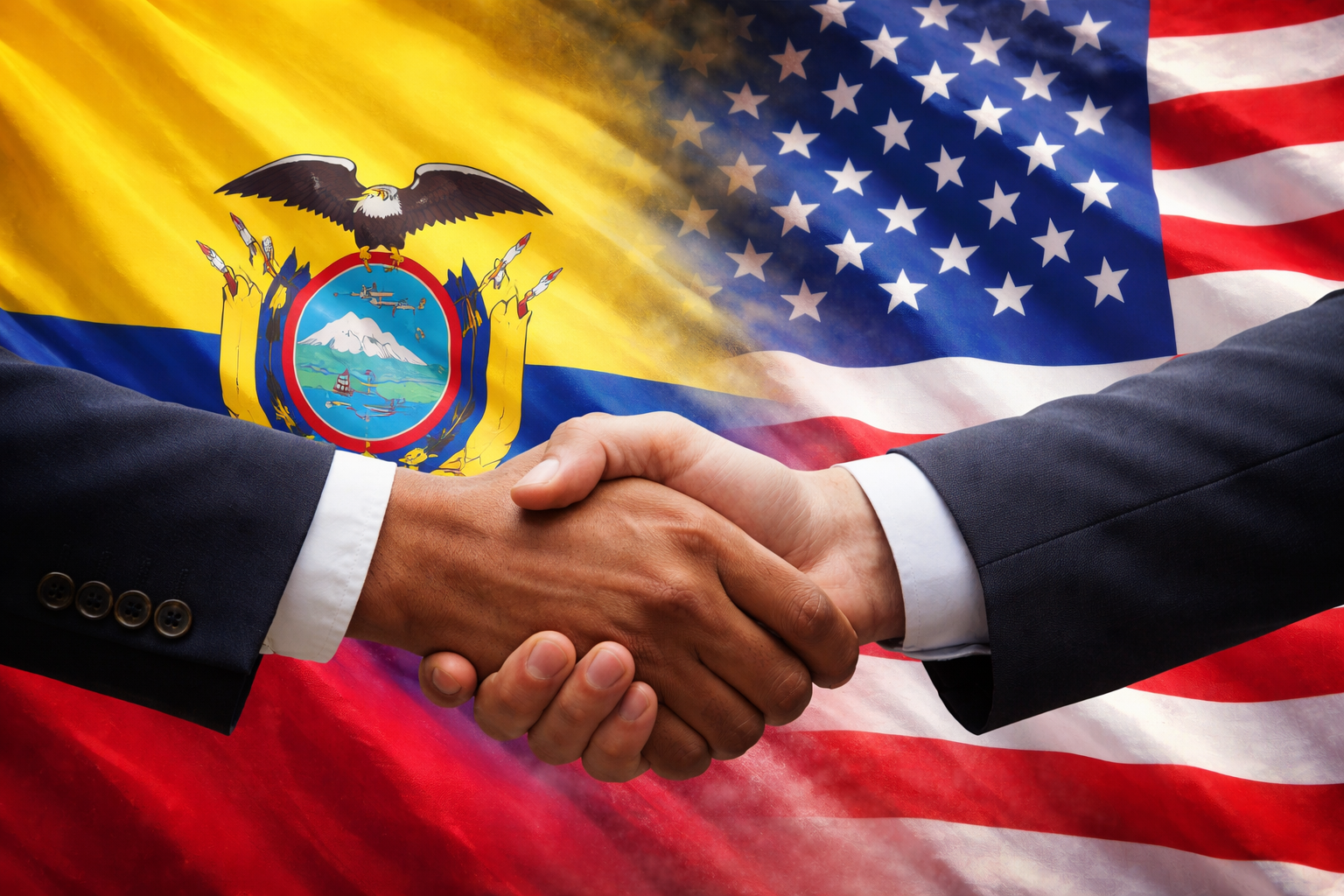
In November 2025, the US and Ecuadorian governments announced a Framework for an Agreement on Reciprocal Trade. Although this framework is not a full Free Trade Agreement(FTA), it does signal both countries’ intentions to improve their trading relationship and reduce the barriers and expand market access.
This development raises an important question: should Ecuador pursue a full trade agreement with its largest trading partner?
A comprehensive Ecuador–United States FTA would not simply be a diplomatic gesture. If properly designed, it could serve as a reform. One that seeks to stabilize investment in the country, stabilize trade, and accelerate Ecuador’s economic modernization.
A Relationship That Already Exists
The economic relationship between Ecuador and the United States is already robust. The United States is Ecuador’s largest trading partner. Bilateral trade in goods and services has reached almost $20 billion annually in recent years.
Ecuador exports large volumes of shrimp, bananas, flowers, and tuna to the American market, while importing machinery, technology, and manufactured goods. These exports reflect Ecuador’s diverse geography, with employment in aquaculture, logistics, and agriculture across the country. In addition, these economic sectors are the main sources of support for thousands of families and their regional economies.
Without a formal trade agreement, exporters remain exposed to tariff uncertainty, regulatory inconsistencies, and procedural delays. Large multinational corporations can often absorb these risks. Small and medium enterprises (SMEs), however, frequently cannot.
An FTA would not create trade from nothing. It would stabilize and protect trade that is already occurring.
Diversification and Structural Modernization
Ecuador’s main exports include oil, shrimp, bananas, and a handful of other agricultural products. This means the export basket is currently limited to one sector which accounts for a large share of revenue. The said limitation makes the exports vulnerable to price volatility and external shocks. Stable access to major markets can encourage diversification. Investors are more likely to finance projects in processing, packaging, branding, and logistics infrastructure when long-term market access is guaranteed.
For instance, Ecuador’s shrimp industry has already become a global leader in production. Greater integration with the U.S. market could accelerate the development of higher-value products, such as processed seafood, premium packaged goods, and ready-to-consume items tailored for American consumers. Similarly, improved trade conditions could stimulate investment in port infrastructure, cold-chain logistics, transportation networks, and digital trade services.
Modern agreements can incorporate digital trade provisions, intellectual property standards, and service frameworks. With transparent rules in place, entrepreneurs in programming, software development, and professional services will be able to secure access to American clients.
Previous Trade Agreements
Ecuador already sustains trade agreements with several other countries in the international community. This highlights the nation’s efforts to modernize its economy and expand with its trading partners. The most significant trade agreement between Ecuador and China was officially signed in May 2024.
Ecuador also benefits from preferential trade arrangements with several partners like the European Union. The EU has secured Ecuador better access to European markets. Thus, improving exports in sectors like agriculture and fishing. Despite recent tensions between Ecuador and Colombia, Ecuador is also part of trade initiatives in the Latin American region, facilitating trade and tariff reductions. An example of this is the Andean Community. These agreements demonstrate Ecuador’s strategic interest in expanding its global economic relationships. Nonetheless, even with an RTA in place, there is still a gap for a comprehensive FTA between Ecuador and its largest trading partner.
International Markets Fragmentation & Uncertainty
Although a Free Trade Agreement would be beneficial for both countries, there is uncertainty given the resurgence of protectionist policies under Trump’s current administration. Since the start of his trade war, the increase in tariffs on major partners like China and the European Union has reshaped the world’s supply chain.
However, instead of this being a reason for discouraging the pursuit of a Free Trade Agreement, it should be the opposite. When fragmentation appears in international markets, small economies are able to benefit from that exclusive access and better options in big markets. Therefore, expanding trade agreements should still remain a primary priority for Ecuador and other smaller economies as well.
On the other hand, we need to comprehend that some bigger economies have the potential to drive out the national industries if they have not been fully developed or are unable to produce enough supply to cover the demand. In order to achieve a comprehensive agreement, these vulnerable areas of the economy must be taken into account. Fully eliminating tariffs should be carried out progressively while giving incentives for technology and machinery that helps increase production.
Ecuador’s Trade Blueprint: Global Partnerships and Regional Integration
Previous agreements with major economies, such as China and the European Union, as well as recent talks with Saudi Arabia on expanding trade agreements demonstrate Ecuador’s willingness to engage with diverse markets.
At the same time, Ecuador’s broader strategy should not be viewed solely through the lens of bilateral agreements. Continuing to develop relationships within the Latin American Region will align with the idea of overall economic expansion and a prosperous America. Presenting unified, strong regional alliances will help strengthen the supply chain, enabling it to bypass bureaucratic procedures and inspections to efficiently move products across countries.
Amid the uncertainty from the current American administration’s global trade war, a full free-trade agreement does not seem likely. However, the expansion of the current reciprocal trade agreement does offer hope for future cooperation and reductions.
Good reporting is cheaper than heavy-handed regulation. Support freedom and independent journalism by donating today.
This piece reflects the author’s views, not necessarily the entire magazine. We welcome a range of pro-liberty perspectives. Send us your pitch or draft.