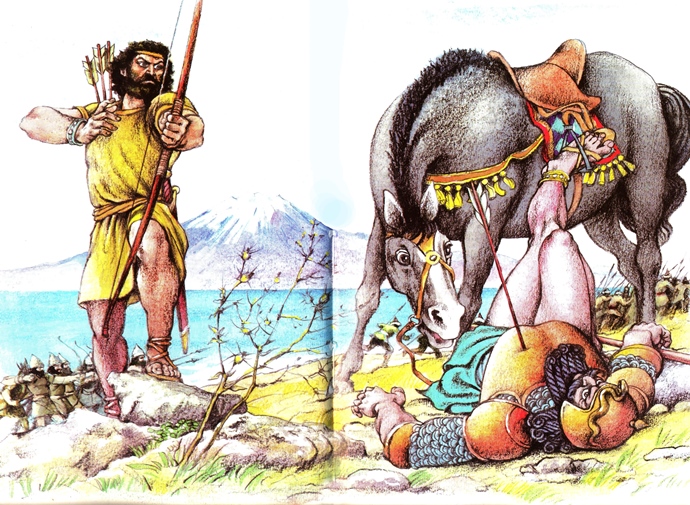
Myths have a peculiar place in cultural discourse in any country. They act as frameworks for imagining community and establishing values. Since they are historical, they may not always appear directly in contemporary policy debates and the day-to-day political discourse. However, their presence remains embedded in how societies understand and situate themselves in the world. For the Armenian people, the myth of Hayk and Bel is not merely a dusty relic of the 5th-century historian, Movses Khorenatsi. It is a national foundation myth of greater importance. In my opinion, it is a symbolic narrative that resonates with some of the core tenets of classical liberalism: the rejection of tyranny and the pursuit of individual and collective freedom.
The Political Power of “Imagined Communities”
To understand why a 4,500-year-old myth matters today, take a look at Benedict Anderson’s concept of the nation as an “imagined community”. Anderson argues that nations are socially constructed and sustained by shared narratives, allowing individuals to feel a deep, horizontal comradeship with millions of others they will never meet.
In this framework, origin myths, one of which is the story of Hayk and Bel, work as essential cultural tools, providing the nation’s “biography” and creating a sense of antiquity. However, as philosopher Arash Abizadeh writes, for a myth to be compatible with a liberal democracy, it must be subject to “public justification” and open to interpretation. The story of Hayk and Bel offers that by showing a narrative of moral and political courage which can also be interpreted through the lens of liberty rather than nationalism.
Hayk vs. Bel: Autonomy Against Authoritarianism
The conflict between Hayk and Bel is regarded by the historian Movses Khorenatsi, who lived in the fifth century, as the pivotal moment in Armenian history. Hayk, a giant with curly hair and “mighty arms”, resided in Babylon during the time of the Tower of Babel. Hayk became the main voice of opposition when the titan Bel (Nimrod) came to power and demanded complete, godlike devotion from all peoples. He assembled his household of 300 men and their families and moved north to the Armenian Highlands, refusing to acknowledge the tyrant’s authority. This act of secession exchanged the pleasures of an empire for the “rugged and cold” independence of a new settlement near Ararat.
Bel marched on the highlands with a huge, steel-clad army because he could not stand such opposition to his dominance. According to Danielyan, the ensuing Battle of Hayots Dzor, which is generally dated to August 11, 2492 BC, was a cosmic conflict between a “predatory empire” and a “self-determined community.” Hayk strategically used a triangular formation near Lake Van to maintain his position despite being outnumbered. During a violent struggle, Hayk fired a three-winged arrow from his longbow, piercing Bel’s breastplate and pinning the despot to the ground. As a result of this triumph, the Babylonian army fell, and the Armenian people gained their independence, making Hayk the epitome of the “immortal spirit” of liberty against despotism.
A Classical Liberal Interpretation
Hayk is an archetype of both individual and collective liberty. His character embodies the notion that people and associations have an inherent right to live free from arbitrary coercion. This could be seen in his refusal to surrender to Bel. By leading his people to the mountains to establish a new society, Hayk also demonstrates the liberal ideas of self-determination and voluntary association. His actions in the story stand as a foundational example and legitimize the Armenian endeavours to govern themselves according to their own values, rather than the dictates of a centralized, absolute power.
Reflections for Today
In the modern world, myths are often viewed with suspicion, and for good reason. They can be misused to fuel exclusion or justify aggressive nationalism. Yet, as Abizadeh argues, myths are indispensable for social integration. The challenge is fostering ethical aspirations instead of dogmatic blindness. The tale of Hayk and Bel is an example of the eternal tension between tyranny and liberty. It challenges us to imagine a society where courage and justice matter more than the “taken-for-grantedness” of state power. Ancient myths may not dictate political truth, but they continue to challenge us to imagine societies where freedom remains the ultimate goal.
Photo Credit: Mocak.am
We roast sacred cows medium-rare. Help fund the habit!
This piece reflects the author’s views, not necessarily the entire magazine. We welcome a range of pro-liberty perspectives. Send us your pitch or draft.