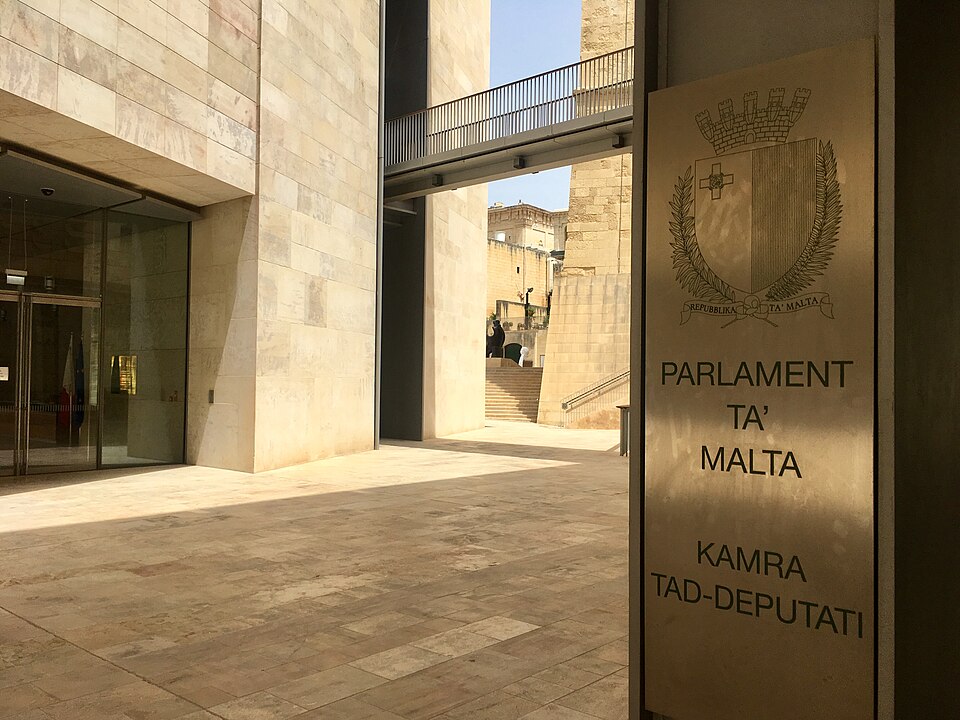
Photo: Malta Parliament complex, June 2018 (11) by No Swan So Fine, via Wikimedia Commons, licensed under CC BY-SA 4.0.
As Malta prepares to head to the polls, the campaign period has once again been overshadowed by the two dominant political forces that have defined Malta’s democratic system for its entire independent history: the Labour Party (PL), looking to leverage its track record of economic growth to secure another term, and the Nationalist Party (PN), attempting to position itself as a necessary change for a country in need of new momentum.
The election has followed a script that is all too familiar. Rather than having a genuine contest between competing visions of governance, voters can choose between a series of trade-offs within a relatively narrow policy spectrum. The core economic model, characterised by heavy-handed state involvement remains a consensus across all major political actors.
In the heat of the race to secure votes both parties unveiled a flurry of promises (with the Labour Party’s manifesto for example containing over 1,000 proposals), pledging to both increase spending and cut taxes across the board.
This does not mean that differences do not exist. They do. But they come down to emphasis, execution, and degree, not fundamentals.
This convergence is not accidental. It reflects a persistent political equilibrium in which electoral success is closely tied to the ability to promise and deliver state-granted benefits.
From the perspective of liberty, this raises a deeper concern, that the elections cannot meaningfully engage with questions of individual freedom, limited government, and the role of the state.
Economist and former Malta Chamber of Commerce President Marisa Xuereb made a similar point, warning that “all that glitters is not gold”. She added “It doesn’t make sense, as a voter, to be bombarded with hundreds of proposals over 33 days, from big parties and even small ones. As a voter, you are still going to work, living your life and being expected to understand this all and make a wise choice. And you will pay the price for those choices.”
Just as Thomas Sowell put it, “there are no solutions, there are only trade-offs”. And perhaps this shows most in this election. With all recent polls suggesting a comfortable margin for the Labour Party, the more relevant question may no longer simply be who will win, but what kind of choice voters are being asked to make.
“To Govern With The Carrot, Not The Stick”
After 13 years in power, the Labour Party has framed the election as a referendum on stability. Prime Minister Robert Abela’s strategy rests on a simple premise: in a world marked by geopolitical uncertainty and economic volatility, only the Labour Party can ensure continued prosperity.
This argument is not without appeal. Malta’s economic indicators remain relatively strong, with steady growth and declining deficit and debt ratios (although growing in absolute terms). Stability then could seem a rational choice.
But despite the desire to position itself as steady and reliable in dangerous times, the Labour Party strategy may also be driven by the fear of getting painted as the stagnant incumbent. Hence the need to come out with over 1,000 proposals dabbling in all sorts of questionable spending from interest-free loans for first time homeowners to 1,000 euro superbonuses for workers.
However, beneath this assumption of enduring economic prosperity lie growing problems with the fundamental pillars of our economy. Much of our growth has been pushed ahead through a heavy reliance on the tourism and construction industry, that rely on labour-intensive work and space availability, two very scarce resources on a 316 km2 island. The result is a great population strain on infrastructure, traffic and everyday life, as Malta’s population has seen a 25% increase in 13 years.
An important part of public debate is how to improve public transport and reduce car dependency on an island, where the stock of licensed motor vehicles increases by a net average of 36 vehicles every day (note that Malta has a population of 500,000). Logistically, it would make sense to discourage car use, whether through parking fees or ceasing to subsidize petrol (which has artificially low prices due to the government’s energy subsidies). Politically though, this would be electoral suicide. Prime Minister Robert Abela is so insistent on “governing with the carrot not the stick”, that rather than halting car use incentives, he has proposed a €5,000–€12,000 grant for families with 3 children to buy a larger car.
Beyond transport, keeping the current government in power would bring its own set of trade-offs. Questions of governance, accountability, and controversies linger in many voter’s minds. They will have to decide whether continuity and stability are worth the risks to institutional integrity and long-term sustainability.
A Breath of Fresh Air?
Not much alternative to the possibly stagnant incumbent can be found in the Nationalist Party, whose electoral slogan “Nifs Ġdid” means “A Breath of Fresh Air”, but has struggled to define itself as a clear alternative. Polling shows that it is anywhere between 6.3% and 11.8% behind the ruling party.
Without much chance for an electoral victory, some voters may motivate their choice of the nationalists just to strengthen the future opposition, and improve government accountability. But even under such a strategy the Nationalist Party has struggled to offer much value.
Despite occupying all the opposition benches, the party began the campaign without timely policy development and its own proposal releases, mostly remaining reactive to the Labour Party’s moves.
Furthermore, the Nationalist Party has remained largely silent in those areas where the government lacks the most credibility. Rather than advancing on the government’s weakest flank (good governance and infrastructural strain), it has largely been stuck in its own status quo often proposing policies that mirror that of the ruling party and only push further the government intervention, paying no attention to the impact on public debt, it otherwise criticizes.
This mirroring appears across almost every policy area: education, with increasing stipends for university students; housing, with loans and grants; transport, with lower licence fees for those who drive less; and so on.
Alternatives and Their Limits
Beyond the two dominant parties, smaller political parties without parliamentary seats are campaigning as well with most of their proposals centred on planning, governance, and institutional reform.
The Momentum Party, a member of the European Democrats, for example, has proposed a real-time public spending ledger, a searchable contract database and stronger disclosure of party financing. However, other aspects of their agenda are harder to defend, for instance their support for public party funding, a social media ban for teenagers younger than 16 and capping supermarket prices for essential goods.
Structural realities remain a significant hurdle for the small parties. Electoral dynamics, media exposure, and long-standing voting patterns all contribute to the little success they have had in gaining representation.
More importantly, even where alternative proposals emerge, they often operate within the same broader assumption, that the state should play a central role in shaping economic and social outcomes. As a result, the pluralism of policy perspectives remains limited.
Choosing Within Constraints
Malta’s democratic system continues to function in procedural terms. Elections are competitive, participation remains relatively high, and political transitions (when they occur) are orderly.
But democracy is not defined solely by its procedures. It also depends on the range and substance of choices available to voters. The problem is not which party secures victory, but whether the political system allows for a meaningful debate about its own direction.
Hence, once again the Maltese electorate has to choose between parties all within a relatively narrow political lane.
In this sense, liberty is not even on the ballot this election season. It is, at best, a peripheral consideration that can be found in independent journalism, select third party proposals, NGO debates and academic circles, but rarely finds way into the political mainstream.