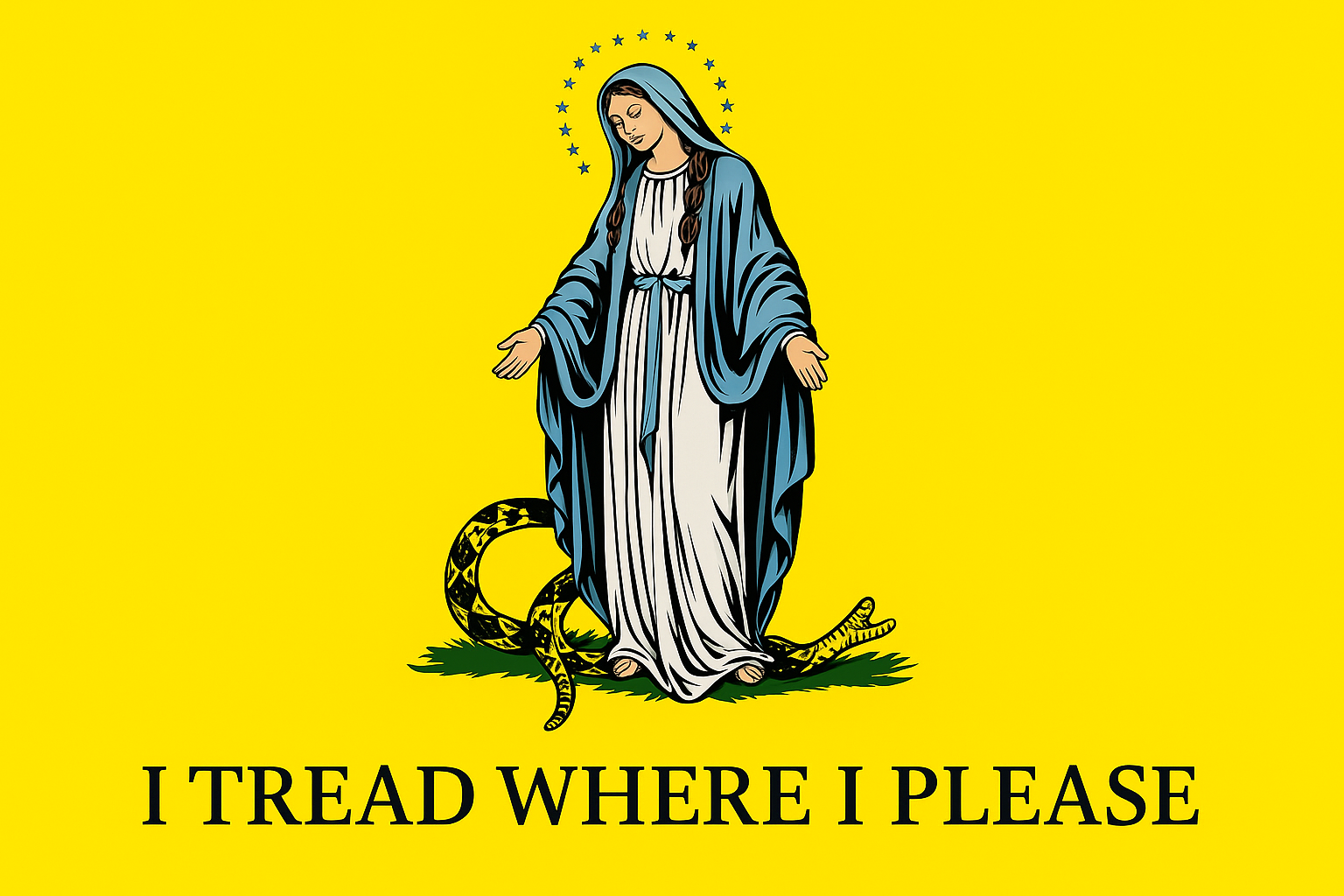
Libertarians have always had a difficult relationship with religion. The modern libertarian movement is, in its noblest strain, an intellectual heir of the Enlightenment, an era marked by a fierce backlash towards religious authority. Our intellectual forefathers led a rebellion against Christianity and its perpetual alliance with the throne. Ayn Rand captured the essence of said defiance when she wrote: “Faith and force are corollaries: every period of history dominated by mysticism, was a period of statism, of dictatorship, of tyranny.”
Even when they still paid lip service to some vague Creator out of habit, every core element of their philosophy was an act of rebellion against the religious status quo. Classical liberals spread the idea that Church-anointed monarchs deserved abolition, not obedience; that the Church should no longer be allowed to strangle science in order to preserve dogma; and that slaves were under no moral duty to follow St. Paul’s command to obey their masters.
It is no coincidence that the loudest and most enduring voice for liberty during some of the darkest days of the twentieth century was H. L. Mencken, an unabashed atheist. As Brian Doherty notes, he was “the leading individualist voice of the 1920s and the last such to achieve popularity and distinction in America before the rise of the modern libertarian movement,” and he regarded organised religion, especially American Protestantism, as a machine for manufacturing conformity, superstition, and moral tyranny over the individual. Between translating Nietzsche and terrorising the pious, Mencken spent his life clearing intellectual space for liberty.
Interestingly enough, religion almost destroyed the libertarian movement in its infancy. As Brian Doherty recounts in Modern Libertarianism, the Volker Fund was an indispensable element of its early growth: it financed and linked key classical-liberal scholars such as Hayek, Mises, and Friedman, backed the early Mont Pèlerin Society, flooded the country with libertarian literature, and bankrolled fledgling institutions like FEE. And yet:
“Just as big Volker money was about to fund Harper’s IHS, Luhnow’s [Volker Fund’s primary manager] growing eccentricities and a sense that he, a deeply religious man, was surrounded by untrustworthy irreligious people led him to abruptly dissolve all the Volker Fund’s ongoing projects and close shop.”
The blow was severe, throttling many of the movement’s early initiatives. Still, it is hard to dispute Luhnow’s basic perception: libertarianism was developing as a predominantly secular project. Most of its figureheads were sceptics or non-believers: Mises, a rationalist non-believer; Hayek, a cool and detached agnostic; Rand, a militant atheist; Rothbard, an irreligious agnostic; Friedman, a thoroughly secular agnostic; and Nozick, a God-curious doubter, with the one exception of deeply religious Reed, who founded FEE.
Richard Ebeling even recounts that he “once spoke to Margit von Mises about Ludwig’s views on religion. She told me that he was an agnostic. Margit said that she had been asked to be God-mother to one of Hans Sennholz’s children. After the ceremony at a church, Ludwig, who had been sitting way back in the church, said to her, “That’s enough religion for one day.” Similarly, one also can’t understand the birth of modern libertarian thought without reading Ayn Rand’s ferocious clashes with papal encyclicals.
This may surprise the modern reader. Over the decades, the atheist roots of the libertarian movement have been quietly buried, helped along by a certain breed of paleo decadents selling a fusion of piety and markets. Part of the puzzle, though, is that the movement kept its eyes fixed on ultra-academic debates, not on the slow, dirty business of cultural change. God may have seemed dead in the 1960s, but the State was ferociously alive, and it claimed almost all the attention of the libertarian intellectual elite.
For many years, the libertarian movement inevitably selected (almost by intelligent design) for the skeptics of both government and divine intervention in people’s lives. One sign of this viewpoint symbiosis was the rise of libertarian science-fiction:
“According to Jeff Riggenbach, in a survey conducted by the Society for Individual Liberty in the 1970s, “one libertarian activist in six had been led to libertarianism by reading the novels and short stories of Robert A. Heinlein.” Dave Nolan, a founder of the Libertarian Party, was one such activist. Nolan was so influenced by Heinlein, says Brian Doherty in Radicals for Capitalism, that he wore a “Heinlein for President” button during the 1960 campaign. (…)
The culture that (…) authors created was one of techno-optimism and a confidence that reason and human ingenuity would save the day. SF’s faith that rational individuals can solve their own problems and plan their own lives, its belief that science and innovation can liberate humanity from the slings and arrows of an unnecessary status quo—these are qualities that set the genre at odds with both progressive and conservative ideologies.”
Libertarian science fiction helped school the first generation of libertarians in a kind of instinctive religious apathy. They took seriously many of Heinlein’s warnings, not least this one:
“It is a truism that almost any sect, cult, or religion will legislate its creed into law if it acquires the political power to do so, and will follow it by suppressing opposition, subverting all education to seize early the minds of the young, and by killing, locking up, or driving underground all heretics. This is equally true whether the faith is Communism or Holy-Rollerism; indeed, it is the bounden duty of the faithful to do so. The custodians of the True Faith cannot logically admit tolerance of heresy to be a virtue.”
I think it is essential to see the connection between the strength of atheism in libertarian circles and the staunch, uncompromising defence of individual rights, going against the deepest religious instincts of society. The Libertarian Party, established in 1971, has openly and proudly championed equal rights since its inception. They called for the repeal of anti-gay laws, endorsed the legalisation of same-sex marriage, and fought to end the “Don’t Ask, Don’t Tell”. This was at a time of anti-sodomy laws in force in most states. Could this heroic position have developed within a deeply religious movement?
The correlation hardly seems accidental.
The fight for the freedom of homosexuals was far easier without the breath of a deity on one’s neck. Advocating for the legalisation of prostitution made far more sense without the weight of Catholic guilt surrounding sex. Legalising drugs appeared an obvious moral cause to those unconcerned with the sinfulness of the devil’s lettuce. And it would be difficult to imagine a Libertarian Party platform declaring that abortion should be left to individual’s conscience, while believing that countless souls were being murdered and cast into the torment of limbo.
Yes, libertarianism was an atheist movement at its very roots. Just as Heinlein remarked, there simply was no space for freedom under the fear of divine wrath. Yet, the atheistic dominance in the movement didn’t last. In the second part of this essay, I will delve into how the libertarian movement was besieged by the mystics, caught up with satanists and conned by astrologers. How it became entangled in rotten compromises and dubious coalitions that led to many of its corruptions. How it lost what it was meant to be. And how it can return to its atheistic origins.