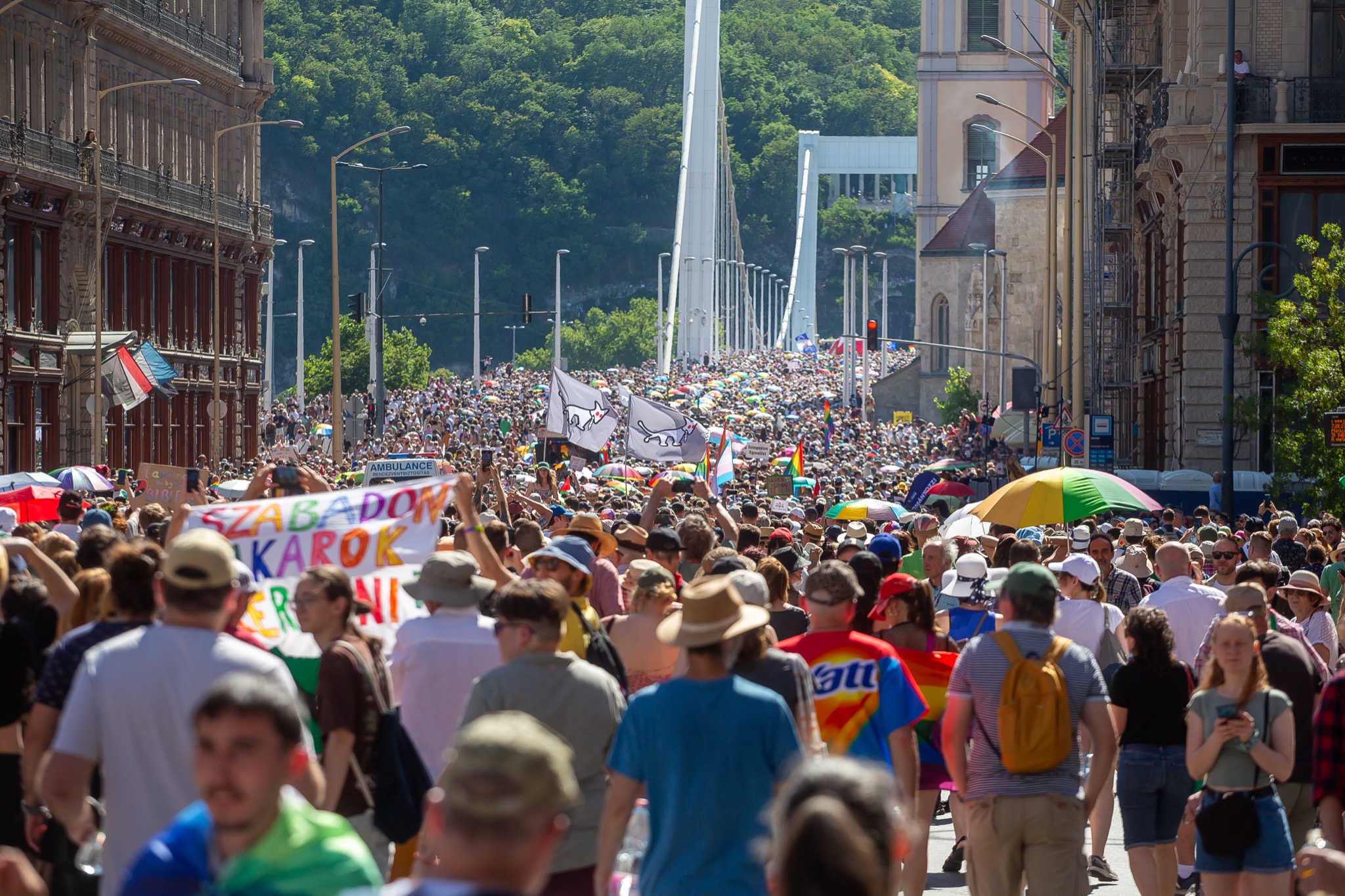
If you want more freedom, you must convince other people of its importance, because our liberties may depend on what people refuse to accept—an important lesson I’ve learned in my country, Hungary, under the leadership of Prime Minister Viktor Orbán. To me, two cases proved this quite clearly: the attempted banning of the Pride marches and the Hungarian authorities’ blocking of 12 Ukrainian news sites.
While these two issues differ in several ways, both government decisions infringe on our liberty and set dangerous precedents. However, while the first measure instigated massive resistance, the latter prompted little visible public reaction. The outcome? The government failed to prevent the biggest Pride march ever organised in the country, but we still can’t access the banned websites without a VPN.
The Failed Pride Ban
This March, Hungary’s parliament—dominated by Orbán’s parties with a two-thirds majority—voted to ban Pride events, which had been held in the country since 1997, on the pretext of child protection (It was later solidified by a constitutional amendment in April). Under the new legislation, participants can be fined up to 200,000 HUF (about €520), while organisers can face up to one year in prison. Additionally, the police can utilize facial recognition software to identify attendees, which, according to Euractiv, constitutes a probable violation of EU data protection and AI laws.
Five months earlier, in October 2024, two Hungarian polling institutes showed the ruling Fidesz–KDNP alliance falling behind the Tisza party for the first time since its emergence, led by Péter Magyar, a former Orbán ally. According to Politico’s Poll of Polls, Tisza has led the aggregated polling average continuously since mid-December 2024. That shift helps explain why the government, which has been in power since 2010, suddenly “realised” that Pride events pose an imminent danger to children.
According to the investigative outlet Direkt36, Antal Rogán, the minister responsible for government communications, and his staff sought to “annoy liberal voters” with “ideologically divisive” issues, aiming to push Magyar — who seeks to broaden his appeal beyond liberal and left-wing opposition voters to include conservatives — onto the same platform as liberal voters. That move was intended to portray him as part of George Soros’s network, long treated as an enemy in the ruling parties’ narrative. Government figures also sought to divert attention from him.
They thought the organisers wouldn’t dare to hold Pride events after the ban had been imposed. They bet on the wrong horse. People protested against the infringement of public assembly rights and the potential use of facial recognition every week, led by an independent opposition MP, Ákos Hadházy. Gergely Karácsony, Budapest’s opposition mayor, stepped in to hold Budapest Pride as a municipality-organised event, arguing it would not fall under the new restrictions. In June, the march drew a groundswell of attendees, setting a new record in the country.
A recurring theme worth highlighting was the protesters in Budapest chanting “Assembly is a fundamental right” (it sounds much catchier in Hungarian). It proved that a lot of people understood: it wasn’t just about the LGBT+ people or one annual event anymore—it was about our liberty. That clarity attracted many people to join the march itself who had never been to a Pride parade before.
Blocking a Dozen Websites
Sadly, that level of public alertness wasn’t widespread when the government curtailed another fundamental freedom. At the end of September, the Hungarian government blocked access from Hungary to 12 Ukrainian news websites as a reciprocal (“tit-for-tat”) response to Kyiv’s earlier blocking of several Hungarian portals, which Ukraine said were disseminating systematic pro-Russian propaganda, and which also affected several Romanian, Moldovan, and Greek websites.
Ukraine’s move can also be debated. However, at least Kyiv justified the blocks by citing the content of the sites. The Hungarian government, by contrast, did not justify its decision by claiming that the blocked Ukrainian outlets posed any concrete danger to the people in Hungary. Instead, the measure was framed as a “mirror measure” in response to what it described as a politically motivated foreign blocking — a practice it has repeatedly condemned.
This distinction matters. In this case, the restriction of access to information was not driven by the nature of the content itself, but by the logic of retaliation. Curtailing citizens’ internet access became a tool of foreign policy. Sanctioning another country by prohibiting something for one’s own citizens is a troubling approach—and it was not even effective: there is no indication that Ukraine has lifted its own restrictions.
What makes this episode particularly alarming is how little public reaction it provoked. The authorities were able to block a dozen news websites on such a thin justification with barely any visible dissent. Aside from a handful of posts and comments, the issue did not cause much of a stir—likely because most Hungarians were unfamiliar with these Ukrainian outlets to begin with. In the absence of public pressure, nothing compelled the government to reconsider its decision, and the websites remain blocked so far.
Why Public Opinion Matters
In my view, these two cases exemplify an important tool available to freedom-loving citizens in a democracy—even a constrained one: raising awareness. When the public clearly rejects something, several factors will make it harder for governments to enforce it at all costs. Given the size of the crowd, it would’ve been challenging for the police to issue fines for Pride attendees.
The police’s official reason for not initiating proceedings against participants was the legal uncertainty caused by the organisers’ contradictory communications and the involvement of the Budapest Municipal Government, leading many to assume they were acting within the law. However, Mayor Karácsony was later questioned as a suspect and booked by police in connection with the organisation, and the case was forwarded to prosecutors with a recommendation to press charges.
I don’t doubt that he sincerely believes in the importance of LGBT+ rights and free assembly. At the same time, I do think that the widespread popularity of this issue in Budapest played a significant role in his involvement. According to two polls conducted by Publicus Intézet, 68% of the capital’s population supported Pride, and 78% opposed the ban.
Every democratically elected politician relies on polls to some extent, even when democratic institutions have been deliberately weakened. That’s why visible public opposition to a freedom-curtailing government decision can attract support from opposing forces, just as it did in this case.
And while politicians like to reframe unpopular issues and deceive voters with false narratives, they’ll occasionally withdraw from the fray. In Hungary, additional examples worth mentioning were the intended introduction of an internet tax and a short-lived mandatory store closing on Sundays. Ultimately, there are public demands that even governments with weakened democratic institutions cannot defy.
There Is No Magic Cure
However, reaching this point is not an easy task. I tried to raise awareness for the aforementioned website-blocking issue with little success. Sometimes politicians avoid issues that seem divisive or controversial. While opposition leader Péter Magyar posted that only a change of government through elections could restore Hungarians’ freedom, and pledged that Tisza would protect every Hungarian citizen’s constitutional right to assembly, he and his party largely stayed away from the protests against the Pride ban, arguing that they did not want to “play according to the government’s playbook”.
Magyar himself was also notably absent from the Pride march, despite Zoltán Tarr, one of Tisza’s MEPs, having spoken months earlier, in a March interview with TVP World, about the risk that restricting assembly rights could later be used against the party’s own political events. After the march, and before it was clear that participants would not face fines, Magyar also promised amnesty for those involved.
And while Attila Péterffy, the opposition mayor of Pécs—currently the only Hungarian city besides Budapest to host an annual Pride march—attended the local Pride march and delivered a speech, the event was organised independently of the municipality. The local organiser, rights campaigner Géza Buzás-Hábel, has been placed under investigation and could face criminal charges for organising and calling for participation in a prohibited assembly, as the banning legislation remains in force.
Ultimately, there is no magic cure for illiberalism. However, in a country like mine, where democratic checks and balances are weak or barely exist, the power gained from the unpopularity of freedom-infringing decisions is crucial. The last remaining checks on an authoritarian government could be its internal polls and popular opposition forces that support the causes linked to freedom.
Both depend on people understanding that an attack on anybody’s freedom is an attack on everyone’s. Ideally, we would live in a country where the rule of law prevails and fundamental liberties are respected, regardless of their popularity. However, when formal remedies fail, people must rely on the few remaining levers of influence. That’s why building a free society begins with countless conversations on these issues.
This piece solely expresses the opinion of the author and not necessarily the magazine as a whole. SpeakFreely is committed to facilitating a broad dialogue for liberty, representing a variety of opinions. Support freedom and independent journalism by donating today.

1 comment
Well written! As I live in Hungary as part of an Anglo-Magyar family, I know how ‘risky’ it is to publish these views.