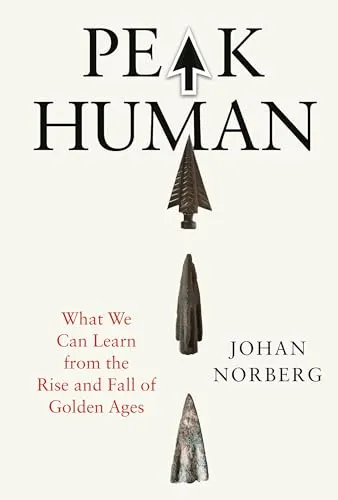
Johan Norberg is an author, lecturer, and documentary filmmaker. He is a Senior Fellow at both the Cato Institute and the European Centre for International Political Economy. He previously wrote for SpeakFreely about Simon’s Paradox. His latest book is called “Peak Human: What We Can Learn From History’s Greatest Civilizations”.
Oscar: Today I’m here speaking with Johan Norberg, historian, writer, academic, all of the above, great speaker as well, also author of the book Open: The Story of Human Progress, the Mirage of Swedish Socialism, the Capitalist Manifesto, In Defence of Global Capitalism, just a titan in the liberty space, so thank you for joining us.
Johan Norberg: Oh, my pleasure, thanks for having me.
OGL: So on Wednesday, the Finnish government introduced about a billion euros in tax cuts. Do you think this is a blow to the mythos of the idea of democratic socialist Nordic welfare states?
JN: I think so. I think the Nordic welfare states have been in transition for a long time, away from what many outsiders still think is some kind of socialist model. It’s not anymore, because we tried it in the 1970s and the 1980s, and it ended in spectacular failure. Just look at my own country, Sweden. We had 25 years without any real wage increases, without creating a single net job in the private sector. That’s a disaster. The big entrepreneurs, big companies like Aikin, Tetra Pak, H&M, they left Sweden during this period, and after that, politicians from all across the spectrum, even on the leftist side, agree that no, we can’t punish innovation, risk-taking, and education in this way anymore. We have to have an open market model. It’s not perfect; we haven’t gone all the way, but it’s certainly a blow to the old perspective of how the welfare states function.
OGL: Absolutely. So obviously you wrote the Mirage of Swedish Socialism for the Realities of Socialism project, and one of the things that I found interesting that you wrote about was that in the 1960s, that Sweden was, as you used James Otteson’s terminology, capitalist-inclined, and that it was doing quite well, economically successful, but then there was the transition in the 1970s and 1980s to a sort of more socialist-inclined way of governing. Why do you think there was that switch, there was the transition, that if everything was going so well, why change?
JN: Yeah, that’s an incredibly important question. So you know, in 1960, Sweden was already one of the richest countries on the planet, and it was based on a free market model, free trade model, with a fairly limited government, relatively speaking. We had lower taxes than the United States and other European countries. That’s how we built wealth in Sweden historically. But then, of course, if you have all that wealth, you think you’re top of the world, you can do anything, you can’t fail, that gives politicians some ideas. They think that they can begin to solve all the problems of society top-down; they don’t have to think about creating wealth, just distributing wealth. So I think that’s what happens, like that old figure of speech, he that has satisfied his thirst turns his back to the well. You forget about what you need to create new wealth, and that’s what happened in Sweden, and it cost us dearly.
OGL: And do you think that happened in other Nordic countries as well?
JN: Oh for sure, I think so. Actually, not just Nordic countries, I think that happened around Europe quite a lot. I think in a way it happened to the United States as well. If you have this long track record of being fairly successful, it seems like, ah, you can do anything. You have to focus minds if you’re in trouble, if the country is in crisis, if you have problems with development, you have to think hard about how do we unleash creativity, innovation and entrepreneurship. But once you have some of that wealth, you start to forget it. That’s why we have to remind people of that intellectually instead.
OGL: Absolutely, and one of the… I feel like my own country, the United Kingdom, is suffering from the same problem you mentioned in the United States. So in the 1990s, you write that Sweden focused its mind and concentrated and managed to downsize its government and was able to return to growth and sort of limit the negative effect that it suffered in the 1970s and 80s. What lessons do you think countries nowadays could learn from that downsizing in the 90s?
JN: Well, first of all, they should learn that it was tremendously successful. Sweden had had 100 years of rapid growth between basically 1870 and 1970. We had the fastest growth in the world after Japan, but they sort of cheated by starting in the Middle Ages. But then, for 25 years, we almost ruined it all, and that was the socialist experiment. After 1992-93, we started to liberalise again. And since then, Sweden has outperformed other countries, other economies. That’s something the rest of the world should learn about. Unfortunately, one of the lessons is that we only did it because we ended up in a terrible crisis. The early 1990s financial crisis, after debt and inflation fuelled a boom, was disastrous. We had mass unemployment, and the banks were collapsing. For a brief moment in time, our central bank had to impose a 500% interest rate. Not 5%, which we think is high nowadays, not 50, but 500%.
JN: To get any country, any capital market to lend us any money, it was absolutely disastrous. So that forced us to focus minds. It led even social democrats to say, okay, let’s liberalise, let’s forget about this. I think the lesson that other countries should take from this is don’t wait until that happens. You don’t know when markets are going to say, we don’t trust them anymore. But when it happens, it’s brutal. And it was very painful, both the crisis and the reforms. It’s much better if you start early, in advance.
OGL: Yes, absolutely. And one of the things that you talked about, that Sweden, that seemed apolitical in the sense that both parties of the social democrats and the centre-right used, was currency devaluation. And I was wondering what effect that you think it had. It seemed from what I understood from your writing that they were quite limited, that they only had currency devaluation in their toolbox. They didn’t think of anything else. What effect do you think it had on the Swedish economy?
JN: That’s right. That’s how we dealt with our competitiveness crisis in the 1970s and 1980s. We just introduced everyday low prices on all our exports by constantly devaluing the Swedish kronor. And yeah, that helped for a while. And so, okay, now we survived another bout of problems and lack of growth. But obviously, we did it not by becoming more competitive, but by having less purchasing power, becoming a less rich economy, and also, in a way, sustaining and protecting some businesses that weren’t really competitive. They didn’t make the hard decisions to become more competitive. It was just that the kronor lost value all the time. And that made us less productive, and it meant that we had less expensive businesses, and we became a foreign country for a bit.
OGL: But ultimately, it helped to take Sweden out of its economic crisis.
Yes, once we did it as a package of all of these other reforms, that’s what made the difference. It started in the early 90s as well, then with this devaluation, which was really more of a market reform. We allowed the currencies to float freely on the market. But then it was combined with dealing with the problems that led to the competitiveness crisis. So we reduced the size of government, we reduced taxes, made the central bank independent, liberalised new markets, electricity, rail, telecoms, and we started to liberalise reformed social security, the pension system, introducing a school voucher system, abolishing taxes on wealth and on gifts and inheritance, and lowering corporate taxes. So that was a huge package that made the currency depreciation a part of a successful relaunch of the Swedish economy.
OGL: Absolutely. So we talked about the things that companies can learn. One of the things I want to ask you about is Milei in Argentina. So I want to talk about what pitfalls he could avoid.
OGL: So one of the tools that he’s using is currency devaluation, as well as liberalisation, and in fact, I believe they’re forecast for 5.5% growth this year, which is excellent. So what pitfalls do you think Milei should try to avoid?
JN: Yeah, no, it’s, I mean, I’m pleasantly surprised by how well it’s been going. Argentina is a mess. It has been a mess for 80 years. It’s such a tragedy, because it’s one of the most beautiful countries on the planet, and with such an amazing culture. Imagine what it would be like if they actually had an economy that functioned, but instead they’ve slowly declined over this time.
They need this kind of rightful reforms that Milei is doing. What are the pitfalls? Well, one obvious one is that after 80 years of stagnation, you build up these debts to the rest of the world, which makes every single moment in time very precarious, very dangerous, because if the markets lose faith in what happens next, it could rapidly go sour. So it’s, they’re by no means out of these difficulties yet. One pitfall then, of course, is to delay reforms. This is what we’ve seen from previous Argentinian reforms. Whenever you do that, and it might be sort of more popular in the short run, the problem is that it doesn’t get the budget back into balance, or even into surplus. It doesn’t help you to show the rest of the world that you’re in control of the situation, so that they will begin to lend to you again. So I think that’s one of the major lessons from Sweden. You have to go far and fast.
OGL: That’s a really good piece of advice that I think lots of countries really need to heed. One of the things that Milei said is that he wouldn’t deal, and he wouldn’t trade with communist China for being communist, I assume, but I still understand that he is trading, or that Argentina is trading with China. One of the things that you have written about a lot is globalisation, and I think a tension between conservatives and libertarians, or Classical liberals, is that they’re worried about where some of their goods comes from.
OGL: So Britain right now is worried where their steel is coming from. They don’t want to get it from China. Do you think this is an issue that countries should be concerned about?
JN: I think countries should be concerned about this, but they shouldn’t overcorrect for the fact that they haven’t been concerned in the past. So why should they be concerned? Well, obviously, we know from, say, Germany’s dependence on natural gas from Russia. It’s not a good thing to be dependent on an actor that might not have your best interest at heart, and might actually want to use that position to coerce you into certain policies or behaviour. And that’s a bad thing. We don’t want to be overly dependent on China for any one particular good that’s incredibly important to us. But the solution is not necessarily, I think, to cover China entirely. Yes, we should vet investments and make sure that they don’t have any chokeholds, but the solution is not to concentrate on supply chains, because that’s even worse. It means that we have more chokepoints and single points of failure. It is to diversify supply chains and make sure that we have more options in various places. I think an important lesson came from how China tried to use trade as a weapon against Australia, shutting off all their exports, basically. And it didn’t help to get Australia to change any policies. This was related to Australia wanting an investigation into Covid’s origins and so on. And why was that? That was because Australia was such a powerful trader. They had so many other routes to turn to and reroute supplies, you know, corn to India and coal to Japan, and I think some Merlot wines to me. So they could rapidly get back all those exports. And in the end, I think they only lost some 0.0001% of GDP, even though this was meant to destroy Australia’s economy. Why? Because they’re such powerful free traders and they have important goods that are needed on the global markets. That’s what we should do as well. Britain and Sweden and Europe, we’re going to have to make sure that we have many different supply chains, invest in many different relationships, free trade with as many as possible. Then in that case, some trade with China only helps us, because they’re more dependent on that than we are on them.
OGL: Exactly. And with Trump’s tariffs coming in on everyone in the world, and Tom Palmer told me last night that the only country he didn’t place tariffs on was Russia.
JN: That’s a joke.
OGL: Do you think that countries should respond with tariffs as retaliatory tariffs? Or do you think that we should just free trade all the way?
JN: Yeah, now it gets tricky, because I know the temptation is there. We want to punch back. But we have to realise that a trade war is a kind of war where we’re standing in line, taking turns punching ourselves in the face as hard as possible. And the key to winning a trade war is not to punch yourself in the face. You can see that now with how the IMF and banks are constantly changing their forecasts for GDP around the world.
The ones that suffer the most are the United States. They suffer the most. And if they deny themselves access to the brains and hard work and goods and services of other countries, should we do the same? I’m not sure. Yes, we should send some kind of signal, but I think it should be more symbolic, because otherwise we just hurt ourselves and our businesses. So perhaps, and I can agree, if you have to do some sort of tariffs, do it on something that we can find easy supplies from elsewhere, rather than anything big and qualitatively important. During the Great Depression, America implemented the Smoot-Hawley tariffs. They were disastrous, not necessarily because of the tariffs themselves, but because Europe responded with the same kind of tariffs. And that ended up in a cycle of retaliatory tariffs, which led to a decline in world trade by some two-thirds in just four years. That was the nightmare. That created mass unemployment and destroyed many democratic governments in Europe. So that’s where we don’t want to end up, in that terrible cycle. Let Trump punch himself in the face again and again, and hopefully then businesses in the US and customers in the US will realise that’s not a good thing and hopefully Trump will, in the end, get some FOMO. So Europe missing out is a great trade that everybody else is doing.
OGL: Exactly. And that’s one of the things that I think a lot of people miss out on, that a tariff is attached on your own people. Because it’s not the US trading, it’s individuals within the US trading with individuals elsewhere. And I think that’s one of the amazing things about globalisation, is that you can trade with people. If you have a shearer of scissors, that people who don’t speak the same language can communicate to get a woollen coat that someone has to find and steal, that someone has to forge the shares, and someone has to transport it. And that’s one of the amazing things that globalisation has brought to us.
JN: Yeah, it’s a miracle of cooperation. We shouldn’t take it for granted. We should actually give it some, lend it some thought and some gratitude.
OGL: Exactly. One of the models that you talked about in the Mirage of Swedish socialism was the three steps. So that people have a really favourable view of socialism, and then there’s the excuses, and then there’s oh that wasn’t real socialism. Do you think this model could be applied to state socialism, that is, the tariffs with Trump’s tariffs? So people say, oh, the US is going to be great again because we’re going to put tariffs in China and we’re going to stop them.
JN: That’s a great point. I haven’t thought of that. But yes, I can see something similar happening. You know how happy they all were, the MAGA crowd initially, now we will be the strongest economy on the planet. Just look at those tariffs. And then obviously they lose some $6 trillion on market capitalisation.
And it’s like, and then the excuses come, some of them being sort of, oh, only the rich people invest in stock markets, and who needs that stuff anyway? And now it’s time for sacrifice. It’s like, what? You said this would make us rich, and now you’re saying… And then other excuses like, you know, it’s other countries cheating, and it’s their retaliatory tariffs. That’s the only reason why it doesn’t work. And some, in disloyalty, even had this from Trump. I think this is the most hilarious. He said, this is the globalist markets who don’t want America to succeed. That’s why they take their money out of the US stock market. Well, you know, they’re actually in it for the money, you know. They thought that this would be successful, so they would invest. So yes, we’re in the excuses phase. So now the question is, eventually, will we end up in a couple of months, and people say, oh, that wasn’t real protectionism. It was done in the wrong way. We used the wrong ChatGPT formula. We can do it again in a new, smarter way. I’m sure that will happen.
OGL: Yes, I’m sure Trump thinks that McKinley didn’t do it, didn’t put his on tariff on correctly.
JN: That’s right, exactly. Exactly. And McKinley actually changed his mind eventually.
OGL: Really?
JN: In his last speech in Buffalo in September 1901, Trump’s great hero, the protectionist President McKinley said, the time for isolation is over. The important thing now is to expand business and trade relationships. And this is the exact quote, “and trade wars are unprofitable”. So if only if Trump had the attention span to see what McKinley did offer his two first years in the White House, he’d get another lesson.
OGL: Exactly. And one of the points that Lord Hannan makes is that the three reasons that Trump gave for protectionism that offered his tariffs, that it’s a negotiating tactic, it will make us richer, and it will make China poorer, is that if you take one of those reasons, the other two reasons don’t work.
JN: Exactly. It’s very confusing to explain that this is a policy that will solve all problems. Then you realise that this is something else entirely, because you can’t do contradictory stuff at the same time.
OGL: Exactly, and that’s one of the main things about globalisation. I don’t believe you claim that globalisation solves all problems, and obviously not everyone wins to the same extent as other people do, but it’s a rising target that it brings most people up. And it’s one of the things that, as we talked about before, the lessons that people can take is that the UK, the US, Sweden, other examples where they liberalised, they deregulated, that they’ve allowed people to invest and start businesses, that’s when they’ve had economic growth, that’s when people are healthier. One of your colleagues, Marion Tupy, says, if you think the past was so much better, how was dentistry?
JN: Yeah, exactly, and you know, 130,000 people were raised out of extreme poverty every day for 25 years during this era of globalisation. I mean, had that been a socialist project, I’m sure it would have been plastered on every T-shirt, every newspaper, every day of the week. But now it just happened because millions and millions of people just looked at ways of trying to make their lives a little bit better by doing things a little bit smarter, faster, or cheaper today than they did yesterday.
That’s what global capitalism is about. It’s wonderful.
OGL: It really is, like, bringing people out to salvation, just giving people electricity, and then with the internet, so much access to materials, to translations. It’s absolutely fantastic. One of the things I wanted to ask you about is what do you think about Mazzucato’s entrepreneurial government. So, do you think it’s a viable method of achieving growth in society?
JN: No, I don’t. I think this is a dead end. I understand why she’s popular with politicians and governments, because they are the heroes of her story. She’s telling them, like, look, you can identify the sectors and the businesses and just hand them lots of money and guide them into the future and create moonshots in every sphere. Sounds wonderful.
I think it underestimates how difficult innovation is. It’s as if innovation can just… There’s a big innovation button, but businesses don’t press it sufficiently often, so let’s just push it more often. I think that’s a complete misunderstanding of how innovation works.
If you look at successful business models, they become successful because they fail, and they learn from that failure. Trial and error, experiments, and constant feedback from the markets, from users, from investors, and adaptation, and eventually find something that you can scale up. Now, if you’re inspired by Mazzucato, what you do is you identify mini-batteries for electric vehicles in Europe. So, let’s invest $15 billion in a battery factory in Skellefteå in northern Sweden. That’s what we did with Northvolt. They had $15 billion, and they had lots of orders from car manufacturers.
Couldn’t fail. The problem was, since they got those resources from governments in Canada and so on, they also needed to build factories in Canada and Germany and Poland and so on, and they had to do fashionable things, so they invested in AI, they needed a lithium refinery because they had to own the entire supply chain, and they invested in new forms of battery for aviation, for wood-based batteries, because that sounded environmentally friendly, right? So they did everything except one tiny detail, and that’s producing batteries for electric vehicles in that factory in northern Sweden. They never got around to creating a successful factory to produce those batteries on time.
So they have now collapsed disastrously after having wasted $15 billion. And that tells me, it’s not a lack of political motivation, goals or taxpayer money or needs or anything, it’s a lack of this insight that you don’t start with $15 billion. You start small-scale with entrepreneurs who try things out and constantly learn and discover how to do things, and then eventually you succeed, and then you scale that up.
The Mazzucato model, I think, is a way of trying to have governments picking winners, but governments are bad at picking winners, and the losers are very good at picking governments. And they know how to tailor their business model and their memos to sound fashionable and great, but then they lose sight on the real business model that they should invest in.
OGL: Well, you’re exactly right. It’s sort of a technocratic fallacy where the governments can pick the winners, but one of the things that they overlook is that 99% of new businesses fail. And that’s exactly right. Entrepreneurs have to try and adapt, and they try different ways until one succeeds.
JN: And that means not even entrepreneurs have any idea what will succeed in the future. And they are in touch with the market constantly and they risk their own money. So why, if they fail most of the time, why would politicians, who don’t have that access to constant market signals and do not risk their own money, but have other motivations, they want to win the next election, they want to do fashionable stuff and so on, how could they see a future that even entrepreneurs and scientists can’t?
OGL: And the other thing is that they don’t know the resources that are available. Even people who are risking their own money, they can’t know what’s going to happen tomorrow. They don’t know all the resources, even though they do have access to the pricing information. And do you think it’s the government’s role to incentivise entrepreneurship or is that something that they should just leave and deregulate? If you understand what I’m trying to say, that entrepreneurs are so important in society and in the capitalist process, but then people think, oh, the government should do something to help them or incentivise them.
JN: Do you know the old ancient philosopher Diogenes? He lived in a sort of shack somewhere.
The story is that he was very sort of stoic-minded and wasn’t interested in material possessions or anything. Didn’t take a bath or anything. And he said that Alexander the Great visited him because he was so impressed. And he was standing there, oh, you’re a fascinating philosopher. What can I do for you? What’s the best thing that I can do? And he said, step away. You’re blocking the sun.
That’s what I thought. And that’s what I think entrepreneurs should say. Yes, entrepreneurship is tremendously important, and that’s why governments should step away from the sun. They should step away from trying to come up with particular incentives that guide them towards a particular way of doing things or a particular sector. Because politicians don’t know that better than the billions and billions of people who are acting with their local knowledge and individual creativity. The best incentive then is to don’t punish them by standing in the way of the sun and of potential revenue, capital markets, and openness.
So deregulation, that’s the best thing politicians can do.
OGL: Yes, and it’s one of those things where businesses are spending so much time on the paperwork and on the licences to run their business. Like licences for florists, for example. It’s absolutely insane. And they’re spending so much money on the bureaucracy, on the paperwork, and they’re not on the actual business. It’s quite incredible to think that people are becoming bureaucrats in themselves rather than entrepreneurs.
JN: You know, it’s difficult enough in itself to create a business model that actually works. But if you also have all those requirements and regulations. It’s like a small business owner I met in Sweden recently who started a new café in a nice location. And he just told me, you know what, if I had known how tricky and difficult it is to get all of this through bureaucracy, I would never have done this. So I’m glad I was ignorant about all of that. Because he was good at making coffee and painting furniture. He’s not good at handling those piles of documents and handling relationships with bureaucrats all the time.
OGL: The important thing is the relationships with your community. That you don’t get people, you sort of get soulless change, rather than there’s nothing wrong with change. But when you have entrepreneurs who know their community, who are there ,and they can serve as a product, they don’t need a big paper on the wall to say that they can pour a cup of coffee for somebody or tie a flower bouquet in a bow. Well, Johan, it’s been an absolute pleasure talking to you. Do you have anything else that you’d like to say?
JN: I’ve actually just written a book about this Peak Human but from a historical perspective. It asks what makes a society “peak.” I look at different cultures and civilisations, starting with ancient Athens and moving forward: what made them flourish, how they produced sudden bursts of creativity and economic growth, and why they eventually declined. And the big question running through it is: what can we learn from those patterns to make sure our own golden age doesn’t end?
OGL: That’s so interesting because one of the things you mentioned in the Mirage of Swedish Socialism was able to withstand so many of the negative effects of their socialist-inclined economy because they had the long-standing preconditions from their huge period of liberalisation that allowed them to survive. Its one of the reasons why the cradle of society is not the centre of civilisation today because there are places like the UK Sweden and the US where they’ve instituted rule of law, free societies that have actually been able to withstand that much longer.
JN: I agree. Taking responsibility and creativity and educating yourself if you want to work and don’t want to live on welfare and so on they’re obviously they don’t just come from nowhere they’re dependent on certain institutions that encourage those traits and they can be around for quite a long time even though incentives and institutions change but after a while they start to decline and they have to be re-generated by having the right kind of incentives and that’s an important lesson from history.
OGL: That’s perfect, that’s a great note to end on. Thank you very much.
JN: Thank you.
You can purchase Johan Norberg’s latest book here.