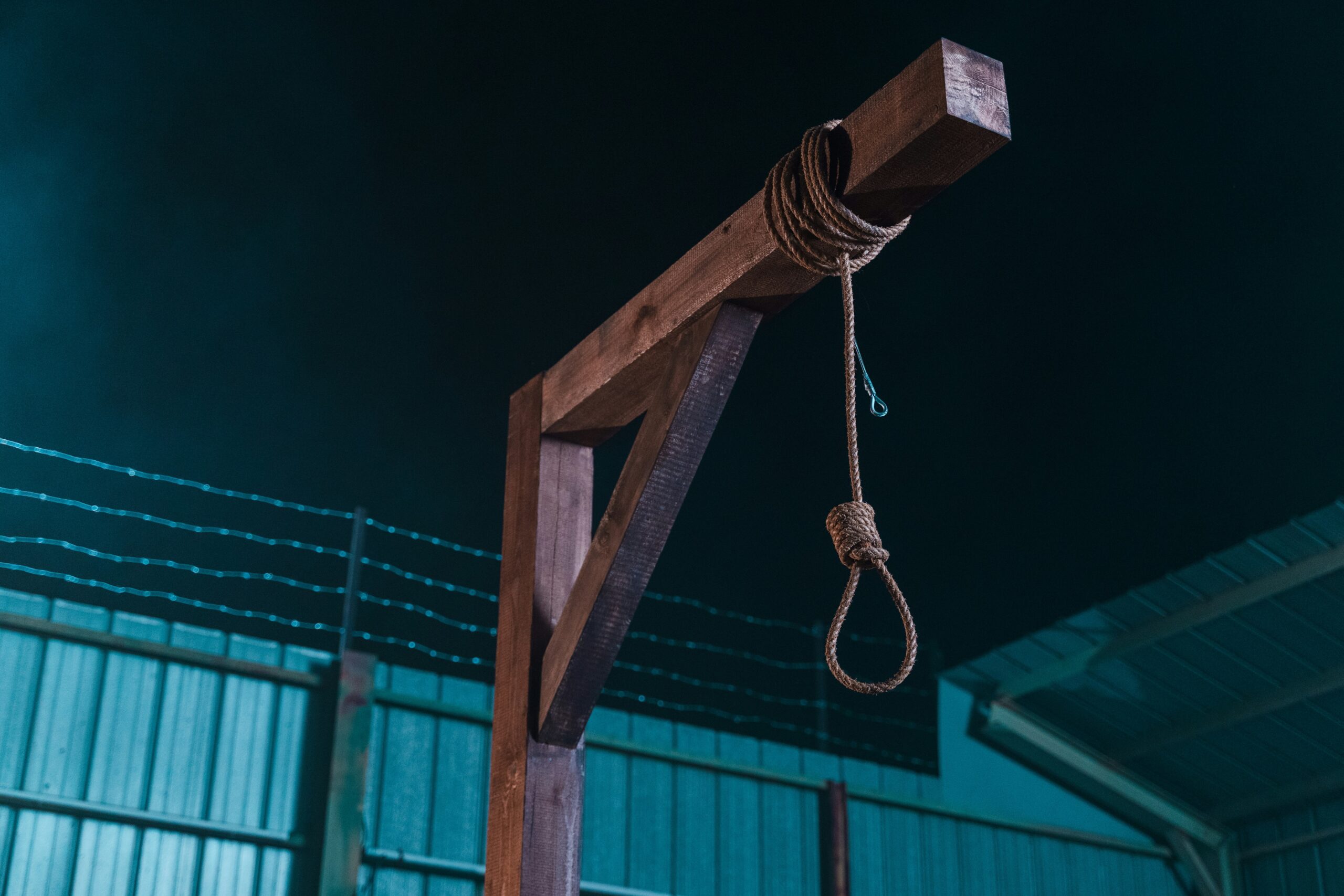
During every protest in Iran, I hear the same words from people: “Perhaps the Islamic Republic will finally change its ways, restrain its violence or treat people better”. Having lived under this regime for most of my life, I know that it will not. Year after year, it has become more aggressive, more shameless and more willing to shed blood to keep power. Executions now serve as punishment for dissent and a warning against the next uprising. Yet while governments negotiate and headlines focus on war, nuclear facilities and regional security, the people being hanged inside Iran are too often pushed out of the story.
Inside the execution campaign
On 28 July, Amirhossein Safari Hosseinabadi and Abolfazl Sepahi Badjani were publicly executed in Isfahan’s Alikhani Square despite a large crowd gathering at the scene in an attempt to stop the executions. Security forces, as usual, responded with tear gas and rubber bullets. Two defendants in the same protest case had been executed nine days earlier. Eight others condemned to death in the same case, face imminent risk of execution: Ali Dashti, Alireza Raisi, Abolfazl Ebrahimi, Alireza Sepahi, Amirhossein Ebrahimi Analoucheh, Amirhossein Maleki, Ghaem Hosseini and Shervin Bagherian.
They were condemned through a grossly unfair mass trial involving dozens of defendants. Detention “confessions” were used against them, lawyers lacked effective access to the case file, and families were denied the full contents of the verdicts. This was not justice conducted in public, but a spectacle of state killing.
The scale extends far beyond the political cases that occasionally reach international headlines. According to Amnesty International, at least 2,159 individuals were executed by the regime in 2025, twice the number recorded the previous year; 998 were for drug offences. By 28 July 2026, Amnesty recorded at least 26 executions linked to the January uprising as well as 26 more politically motivated executions.
The individuals inside the machinery
Shervin Bagherian Jebeli, one of the eight remaining defendants in the Isfahan case, had only recently turned 18 when he was arrested. According to UN and Amnesty experts, he was forcibly disappeared for 21 days, beaten, denied a lawyer during his interrogation and shown “confessing” on state television before any trial.
Saleh Mohammadi was 18 when arrested after the January protests and sentenced to death less than three weeks later for the killing of a security agent, an accusation he denied. He told the court that his confession had been extracted under torture. An informed source reported injuries on his hands from beatings. The court did not investigate his allegation of torture. On 19 March, after turning 19 in prison, he was publicly executed alongside two other Iranian protesters.
Others are murdered in solitude. In late March, four political dissidents were executed secretly within 24 hours, without prior notice to their families or lawyers. At least three bodies were not returned. Public hanging and secret execution serve the same purpose: one terrorises the street; the other terrorises every family waiting beside a silent telephone.
Execution as a method of government
The regime’s Revolutionary Courts turn political charges into death sentences through vaguely defined crimes such as moharebeh, meaning enmity against God, or efsad-e fel-arz, which means corruption on Earth. A sweeping espionage law signed in October 2025 has since been used to criminalise online activity, communication with media organisations and other conduct that authorities portray as collaboration with hostile states. Such elastic charges give the regime the power to redefine dissent as a capital crime.
Human Rights Watch has documented arbitrary arrests, enforced disappearances, severe beatings, sexual violence, food deprivation, denial of medical care and threats of execution. By early February, it had reviewed 139 forced-confession videos. Amnesty has documented secret trials, denial of legal representation, forced self-incrimination and Supreme Court reviews that rubber-stamp death sentences.
A confession obtained by torture is not evidence. A closed hearing without independent legal representation is not due process. A Revolutionary Court serving the regime is not an independent court. A robe, a case number and a religious charge do not convert state terror into law.
Why the world looks away
I have seen some news organisations minimise what is happening in Iran when the facts conflict with their political narratives. But political bias is not the only reason these crimes receive limited attention. The international news cycle is not a moral tribunal. It follows proximity, spectacle and novelty. Aircraft, missiles, uranium enrichment, oil prices, ceasefires and negotiations offer visible drama. The World Cup, national elections, government crises or economic shocks will naturally matter more immediately to many readers than events inside Iran. We cannot expect people to place Iran above every issue that affects their own lives more directly.
But this natural limit on public attention cannot become an excuse for omission when Iran itself is the subject under discussion. If a report claims to explain what is happening inside Iran, it cannot reduce the country to military sites and diplomatic manoeuvres. If a parliament debates Iran, it cannot speak only about sanctions, regional security and nuclear risk while ignoring prisoners being tortured and hanged. If governments negotiate with the Islamic Republic, they cannot treat the lives of Iranians as an unrelated domestic footnote. And when our own communities discuss Iran, the regime’s victims should not disappear from the conversation.
The regime understands distraction and has repeatedly used war as cover for domestic repression. Amnesty reported that following the February 2026 attacks, the authorities used what they called “wartime conditions” to accelerate arrests, political executions and abusive trials. When foreign capitals discuss only regional security, the Islamic Republic learns that it can bargain abroad while killing at home.
Against the state’s power to kill
The death penalty is the most irreversible expression of government power. A prison sentence can be overturned. Property can sometimes be returned. A conviction can be cleared. A person killed by the state cannot be restored by an appeal, apology, reform or future democracy.
This is why opposition to the death penalty should not depend on whether the condemned person is famous, politically sympathetic or internationally recognised. Authoritarian regimes kill people every day whose names we never learn and whose stories we never hear. No government should possess an unchecked power to kill following closed-door proceedings. Under an authoritarian regime that tortures defendants, broadcasts forced confessions and denies access to independent lawyers, that power becomes an administrative weapon.
The world must make repression costly
The response cannot be limited to condemnations issued after prisoners are already dead. Governments worldwide should impose coordinated asset freezes, travel bans and criminal investigations against judges, prosecutors, interrogators, prison officials and security commanders responsible for torture and political executions. The EU, US, Canada, Britain, Australia and other democracies should block financial and travel loopholes that allow regime officials and their networks to enjoy safety abroad.
Executions must carry diplomatic and economic consequences. Governments should recall ambassadors, expel the regime’s intelligence agents working under diplomatic cover, deny the regime access to the technologies and revenue streams that sustain repression, and make sanctions relief or diplomatic normalisation impossible while political prisoners face the gallows. The regime must not be allowed to conduct diplomacy while killing at home. Condemnation without consequence is not pressure, it is permission.
Readers can act before an execution. Write to foreign ministries and members of parliament, circulate verified case information and keep prisoners’ names in public view. Authoritarian systems rely on isolation. Continuous attention can disrupt it.
Refusing to let Iranians disappear
The world cannot be expected to watch Iran every hour. It can be expected not to erase Iranians whenever it chooses to speak about their country.
The Islamic Republic is trying to draw the world’s attention to missiles while it builds gallows below. The world must look at both. Whenever Iran appears in news headlines, negotiations, legislatures or community discussions, the people living under the regime must appear with it. Their deaths are not secondary to the Iran story. They are part of the story.
Photo Credit: Photo by Johannes Blenke on Unsplash
We roast sacred cows medium-rare. Help fund the habit!
This piece reflects the author’s views, not necessarily the entire magazine. We welcome a range of pro-liberty perspectives. Send us your pitch or draft.