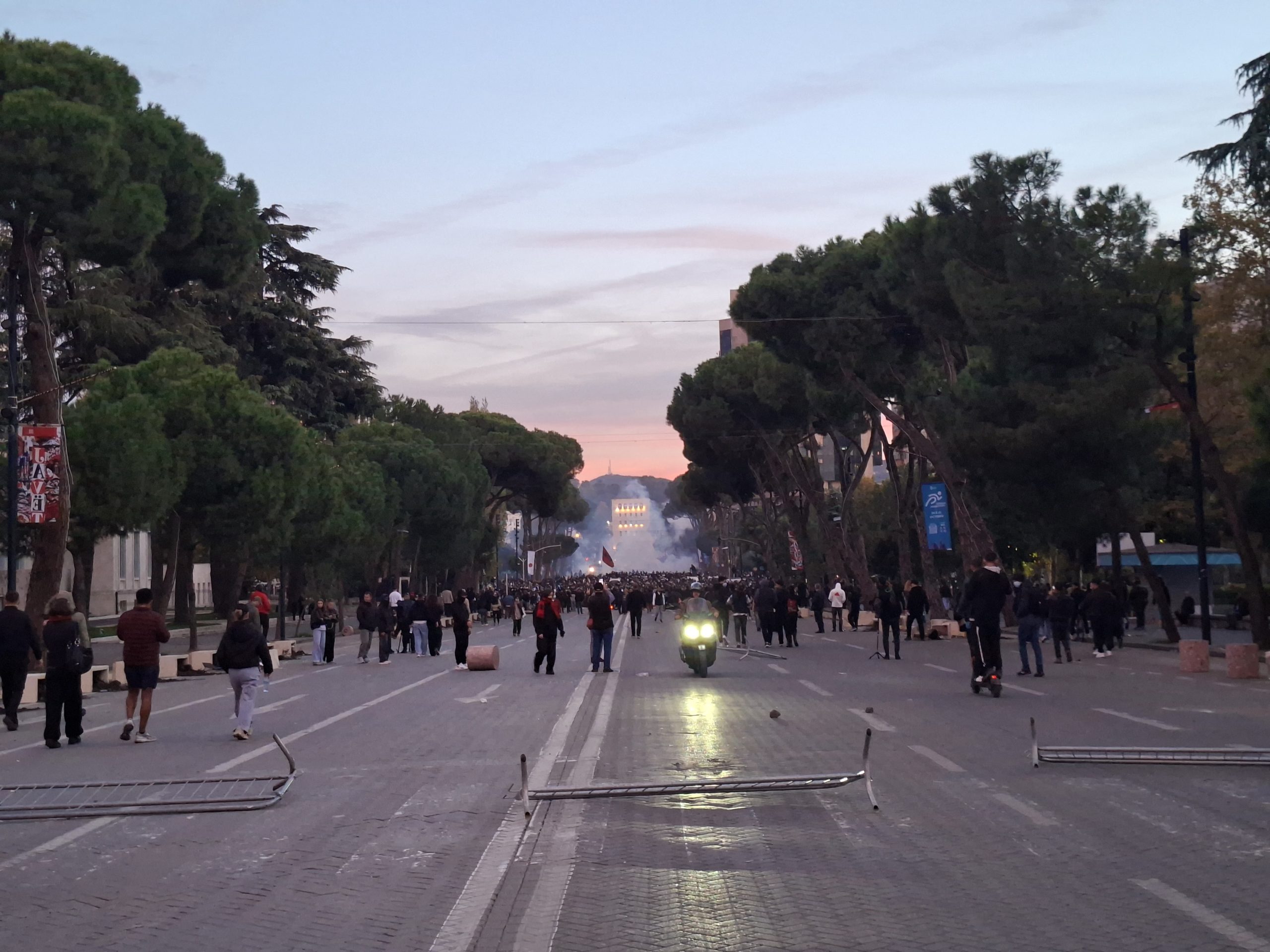
On 28 May, thousands of Albanians took to the streets to march peacefully and demand constitutional changes in the electoral system, a referendum on certain laws and a Prime Minister’s resignation.
Since 2013, Albania has been governed by a single party, the Socialist Party, and its leader, Edi Rama, who holds a majority in Parliament (82 out of 140 seats) and controls most local municipalities. At the same time, the main opposition party, the Democratic Party, led by Sali Berisha, former president and Prime Minister, has lost public trust among Albanians due to internal infighting and corruption scandals involving several of its MPs and its leader. Albania’s electoral system strongly favours the largest political parties, which has contributed to the Socialist Party’s strength and dominance in political institutions.
However, things have not been going well for the Socialist Party and its leader, Edi Rama. In an effort to gain greater lobbying influence in the White House, Congress, and among Republicans in the United States, Rama used investment projects in Zvërnec and Sazan as an opportunity to strengthen his connections with the Trump circle. These projects were reportedly handpicked to be awarded to Jared Kushner and Ivanka Trump. The relevant laws were changed overnight, and the investment was approved without adequately considering unresolved property disputes in the area or obtaining sufficient local support for such a large-scale development.
This has since sparked massive protests. Albanians who came out on the streets are tired of the entire duopoly; the protest organisers rejected any support from the main opposition party, and the crowds chanted, “Rama in jail, Berisha in jail”.
By June, the number of protesters had reportedly exceeded 100,000. Despite the scale of the demonstrations, Edi Rama claimed that the protests had been instigated by foreign intelligence services, including those of Iran and Russia. He did not meaningfully address the protesters’ demands and continued a pattern that had characterised his government for over 13 years: introducing and passing laws without adequately consulting public opinion or respecting constitutional principles.
Fast-forward to September, when a major corruption scandal emerged, this time involving Albania’s intelligence services. The head of the intelligence services was reportedly found to be romantically involved with a criminal who was allegedly using connections within the intelligence service to evade the state police and avoid prosecution. The head of the intelligence services was placed under house arrest and dismissed from her position.
In October, the Socialist Party introduced a new administrative reform intended to address problems arising from the previous reform, which the party itself had designed and approved. The new reform reduced the number of municipalities from 61 to 46 and diminished their powers in decision-making.
After four months of peaceful protests, Edi Rama continued to ignore the demonstrations and their demands. On 13 October, students joined the protests, calling for better conditions at their universities, in dormitories, and in schools. During a demonstration outside the Ministry of Education, tensions escalated, and the situation turned violent. Many protesters faced police brutality, further intensifying the unrest.
Protesters subsequently took to the streets and began vandalising public spaces, damaging pavements and traffic lights, and setting fire to and looting public administration buildings. Private property was also attacked and looted.
Much of this situation could potentially have been prevented if Prime Minister Edi Rama had taken the protesters’ demands seriously when the demonstrations began on 28 May. However, the government’s prolonged indifference contributed to an increasingly volatile environment in which violence eventually erupted. Protests even engulfed private residences and led to the destruction of private property. Banks, mobile phone service providers, private social security companies, and other businesses have been looted or set on fire.
On 14th October 2026, the protests took place near the Prime Minister’s Office, which is located next to the Pyramid of Tirana. Built in the 1980s as a mausoleum dedicated to the communist dictator Enver Hoxha, the Pyramid has since been transformed into a tourist attraction featuring shops, restaurants, and other businesses.
In this area, many businesses require special government permits to operate, and some have connections to the ruling party. During yesterday’s unrest, only three businesses in the area reportedly remained untouched by the protesters: a video game shop, a small fast-food establishment selling pizza, and a small shop selling snacks.
This observation raises an interesting question about how markets function, particularly during times of social and political instability. Despite the violence and apparent irrationality of the mob, the protesters seemingly distinguished between businesses that played fairly in the market and those they perceived differently.
Violence is never the answer, and it never will be. Much of the violence unfolding today in the streets of Tirana might have been prevented if the government had responded to the protesters’ demands when the demonstrations began on 28 May. The indifference of political leaders and bureaucrats helped create the conditions for the current unrest. However, amid political chaos, an interesting question is raised: do people still recognise the difference between those who create value and those they associate with the abuse of power?