By Jessym AYADI and Henri LAGANE
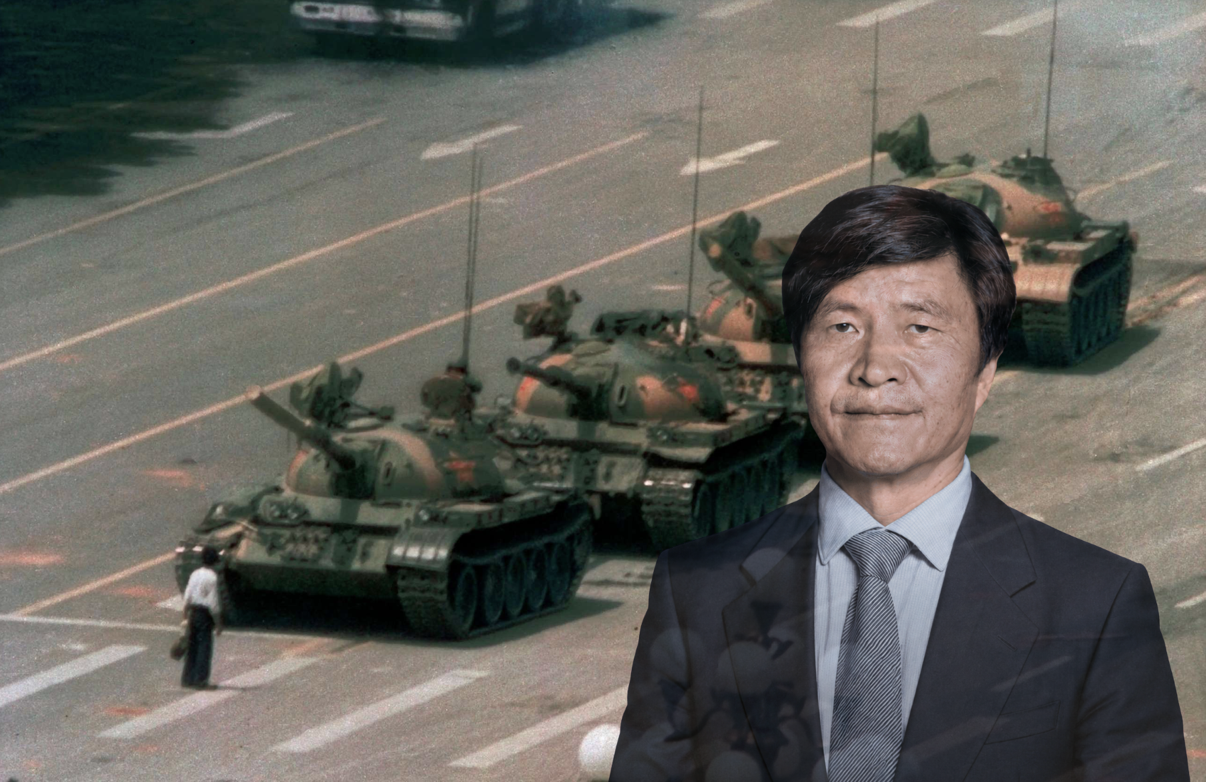
A former student and leader of the Tiananmen Square demonstrations in 1989, Fengsuo Zhou is today an activist for Chinese democracy. For him, the June 1989 massacre was the true turning point in the modern history of the Chinese Communist Party (CCP). Since then, he argues, the regime has not abandoned its political ambitions, but has instead perfected its methods of control.
Thirty-seven years after the Tiananmen demonstrations, Fengsuo Zhou still carries the memory of a movement that called for greater freedom and political reform. For him, the repression of 1989 did more than put an end to a student movement: it permanently altered the trajectory of the CCP.
“There has been no prospect of the Party changing from within since 1989,” he argues. In his view, the turning point became irreversible at that moment: “The coup in 1989 changed the trajectory of the Chinese Communist Party.” Although the regime has since transformed, particularly in economic and technological terms, Zhou believes that its fundamental political nature has remained unchanged.
Today, he describes a regime whose control has even grown stronger. “It is more totalitarian than before,” he argues, while also emphasising that the CCP’s power has expanded on the international stage. What concerns him most, however, is the evolution of its methods of repression. “More advanced technology and greater power allow it to control people at a level that was previously unimaginable.”
According to Zhou, this combination is one of the most distinctive characteristics of contemporary China: “It is a very unusual combination of a totalitarian regime and modern technology.” The authorities now have surveillance and digital control tools that are considerably more sophisticated than those available in 1989. The CCP also maintains tight control over political life, the media, universities, and civil society.
State-Controlled Capitalism
China’s economic evolution, however, has not followed the same trajectory as its political system. Since the reforms introduced after Mao, the country has incorporated numerous market mechanisms and developed a significant private sector. For Fengsuo Zhou, however, this development should not be confused with genuine economic liberalisation.
“It would be more accurate to call it a state economy,” he explains. He acknowledges the existence of competition, which he believes allows the market to adapt, but considers the system to be closer to a form of “state capitalism.”
This combination of market mechanisms and political control allows the regime to benefit from some of the advantages of a market economy without relinquishing political direction over the economy. The Party retains significant influence over strategic sectors and major economic decisions.
“They Blocked the Traditional Paths to Democratisation”
For Zhou, political control also strengthened after 1989 because the leadership understood that there was a desire for change within the population. “They used every means available to block the traditional paths to democratisation,” he argues.
He points in particular to the absence of genuinely independent organisations: “They would not allow an independent civil society to exist.” Trade unions, churches, and associations cannot, in his view, operate independently of Party control. Dissidents are also systematically monitored.
This description is consistent with several documented observations about the functioning of China’s current political system: the CCP maintains its political monopoly, while independent organisations operate within a very narrow space.
The Party does not rely solely on direct coercion. According to Zhou, membership in the CCP also changed meaning after 1989. During the 1980s, some Party members still joined with the belief that they could “change it from within.” After the Tiananmen crackdown, he argues, this motivation gradually disappeared. “That idealism was completely eliminated and replaced by purely utilitarian considerations,” he explains.
Joining the Party thus became, for part of the population, a means of gaining access to positions of responsibility and advancing socially: “For those who want to move forward within the system, it is almost the only path available.”
Xi Jinping: Break or Continuity?
Fengsuo Zhou nevertheless rejects the idea that Xi Jinping alone is responsible for the regime’s current evolution. “Most people personally blame Xi Jinping for the change. I think that is wrong,” he argues. “Xi Jinping is exactly what the Party wants. He represents the will of the Party.”
In his view, Xi is therefore more the outcome of an established trajectory than its original cause. Under Deng Xiaoping, the CCP gradually sought to strengthen its power before eventually reaching a point, under Xi, where it believed it had the means to “challenge the world.”
For Zhou, the real turning point once again goes back to 1989. He believes that the Tiananmen crackdown established a “red line” for successive leaders and contributed to eliminating reformers within the Party. “I don’t think the nature of the government ever changed. Its trajectory was set in 1989. That’s why we have Xi Jinping today.”
This interpretation contrasts with analyses that place greater emphasis on Xi Jinping’s personal concentration of power since he became head of the CCP in 2012. The two phenomena are not necessarily contradictory: Xi has indeed strengthened his personal authority within the Party, while the Chinese system remains based on the CCP’s political monopoly.
Fengsuo Zhou’s testimony therefore portrays a China that has changed profoundly since 1989 without, in his view, changing its fundamental political nature. The economy has opened up to market forces, technology has advanced, and China’s international power has grown. But behind these transformations, Zhou sees the continuity of a system that learned a fundamental lesson from Tiananmen: never again allow political dissent to threaten the Party’s hold on power.