Over the past few years, Russia has seen a great many events that have driven Russians to a level of discontent never seen before. Unfortunately, the war itself is not among them. So what has actually changed Russians’ minds? Why does Putin have such a low approval rating for the first time in years? And what might change in Russia this year?
I’ve been part of the opposition scene in my city since I was young, and I’ve witnessed many events since 2018. I want to tell you, dear reader, how we lost everything, and what we’re doing now to hold on to whatever grain of sanity we have left.
The war in Ukraine began in 2022, and after a handful of protests and a great many arrests, the opposition in Russia died. The authorities got a blank check to jail opposition figures, because from the start of the war they became not just enemies of Putin and his party, but enemies of Russia and its army.
Yet none of this provoked any real resistance in society — and what little resistance there was quickly fizzled out under the weight of repressive mechanisms.
The average Russian, untouched by the war until 2025 (worth remembering that 10% of Russia’s population lives in Moscow and its metro area, which for a long time has remained isolated from the war’s consequences), didn’t care about the deaths of citizens of a neighbouring country, or even about the deaths of their own countrymen. And as extremism legislation and its enforcement expanded, the average Russian didn’t see it as a threat to their own everyday comfort; they didn’t think it was their problem, didn’t think it would ever touch them.
And yet, here we are. By now, the trigger for most citizens hasn’t been a war grinding into its fifth year, or even the bombing of Russian territory itself; it’s the fact that authorities are shutting down the internet in major cities because of drone attacks. Apps that small and medium-sized businesses depend on are being labelled extremist and blocked (Instagram, Telegram, WhatsApp).
And there’s a new development: Russia, which we used to jokingly call “the world’s gas station”, is out of gasoline. Lines form at filling stations, with people waiting up to 40 minutes for 20 litres; many stations aren’t even operating because of the shortage, and retail prices have risen 20%.
Everyday comfort is steadily disappearing from Russians’ lives. People are back to standing in lines like in the USSR, hunting for a new VPN just to scroll through reels, and waiting for the next round of bans from the authorities; all while being pressured to download a national messenger app modelled on China’s WeChat.
Why does all of this matter so much right now? Because every September, Russia holds its unified voting day (which, since the constitutional referendum, now runs three days instead of one). And Putin’s party, United Russia, which functions as a sort of deep-state umbrella party without any clear ideology, has started gearing up for this election. For the first time in a long while, Putin has appeared on the party’s campaign materials.
This is an anomaly, as Putin usually registers as an independent candidate for elections, precisely because of the party’s high disapproval rating, and he tries to avoid being too closely associated with it, to preserve his own image within the classic “good tsar, bad boyars” framing.
So who actually stands against Putin and his party? The last time a new party was successfully registered in Russia was 2020 – a wave of spoiler parties created ahead of the 2021 parliamentary elections, meant to split the opposition vote and keep smaller parties from clearing the 5% threshold.
Launching spoiler parties is a common tactic in the Russian electoral system generally (think of Vishnevsky and his clones); a similar vote-splitting tactic was on display back in 2019 during the St. Petersburg legislature elections.
The parties gearing up for the election can be loosely split into two groups. The first group consists of parties that essentially mirror the ruling party with a slight lean toward their own niche agenda; call them the “untouchables”: The Communist Party (KPRF) won 18.9% in the last Duma election. The KPRF is a party of pensioners rather than “young communists” who resemble their European counterparts: its base leans more toward tankies. The party’s leader does everything he can to tank his own ratings, for example, declaring mid-campaign that “nobody wants a repeat of 1917” (a reference to the 1917 Bolshevik Revolution, which overthrew the Russian monarchy and eventually brought the Communists to power). The KPRF was once a genuine opposition platform, but today it has outlived its purpose and mostly serves the authorities.
The LDPR won 7.5%. Despite its name, the party is illiberal and authoritarian, and it survives almost entirely on the legacy of Russian politics’ greatest meme, the late Vladimir Zhirinovsky, whose image is still used in campaign materials. Its current leader, Slutsky, is a grey, uninteresting, militaristically minded functionary.
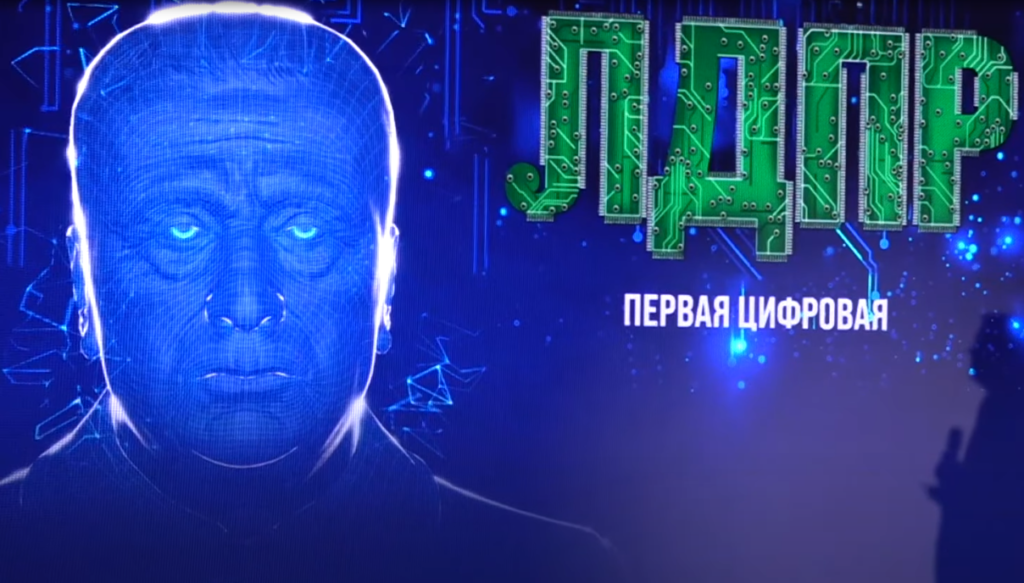
Zhirinovsky AI presented on International Economy forum in 2023
Just Russia won 7.4%. The party has little chance of clearing the 5% threshold, and honestly it’s unclear what’s even keeping it alive at this point; one could loosely call it social democratic-patriotic.
The second group, of the few “respectable” ones, consists of parties that have become a refuge for what’s left of the opposition scene: people who want to change something through elections but, given the repressive climate, have to be extremely careful about how they phrase things.
New People won 5.3%. For the first time in a long while, a liberal “opposition” party won seats in parliament in 2021, and managed to speak out against internet blocks and repression, though it stops short of any direct anti-war statements, sticking instead to calls for “a return to peaceful life.” The party was founded amid the 2020 wave of spoiler parties, but its founder, businessman Andrei Nechaev, managed to recruit popular non-partisan regional politicians at the time, and this year the party is forecast to do reasonably well.
Yabloko won 1.3% in the last Duma election. One of the country’s oldest parties, it has the second-highest disapproval rating in the country, surpassed only by the ruling party. Yabloko openly opposes the war, and pays a steep price for it: its most prominent candidates get labelled “foreign agents,” stripped of their right to run for office, or thrown in prison.
Russians have a choice among five parties if they want to change something, and turnout is expected to be fairly high, since many young people have started to realise that internet blocks and tightening restrictions are genuinely dangerous to their own lifestyles, and have begun thinking ahead.
Some will vote for the “untouchables,” believing the story (which everyone is trying to claim right now, given how hot the topic is) that these parties opposed the internet blocks. More informed voters will go for New People, not believing Yabloko can clear the 5% barrier.
Then there is the very real worry that the genuinely oppositional parties simply won’t meet the election commission’s requirements. Here’s an example of how arbitrary that process really is: one of the official reasons the Libertarian Party of Russia was denied registration was that its charter didn’t comply with legal requirements; even though that charter had been copied almost verbatim from United Russia’s own, the very party the law was ostensibly modelled on.
The flaw, in other words, was never really in the document. Since then, the party has split apart more than once, and in July 2026 it was added to Russia’s “foreign agent” registry; a designation that effectively forced it to suspend its activities altogether.
No election is going to change the nature of a regime that rests not on the rule of law, but on the rule of a man. At best, the “respectable” parties will get a platform without any real power, and voters’ ballots will just become statistics used to legitimise the system.
Registration barriers, criminal cases, and “foreign agent” status aren’t a glitch; they’re a built-in mechanism for weeding out any genuine alternative. As long as the state controls resources, the courts, and the information space, private initiative and personal autonomy will keep shrinking; regardless of who clears 5% in September.
The gasoline shortages and app blocks aren’t an anomaly; they’re the logical outcome of an economy where decisions are made by bureaucrats, not markets. Waiting for salvation from a ballot box is just another way of lying to yourself. The September election will not change anything about Russia’s current course, but it is still the last possible way for Russians to speak out
For safety reasons, this article is published under a pseudonym.
Vladimir Putin votes in the 2018 Russian presidential election, 18 March 2018. Photo: The Presidential Press and Information Office / Kremlin.ru, CC BY 4.0, via Wikimedia Commons.
“Neural Network ‘Zhirinovsky’” (2023), LDPR / LDPR.ru, via Wikimedia Commons, licensed under CC BY 3.0.