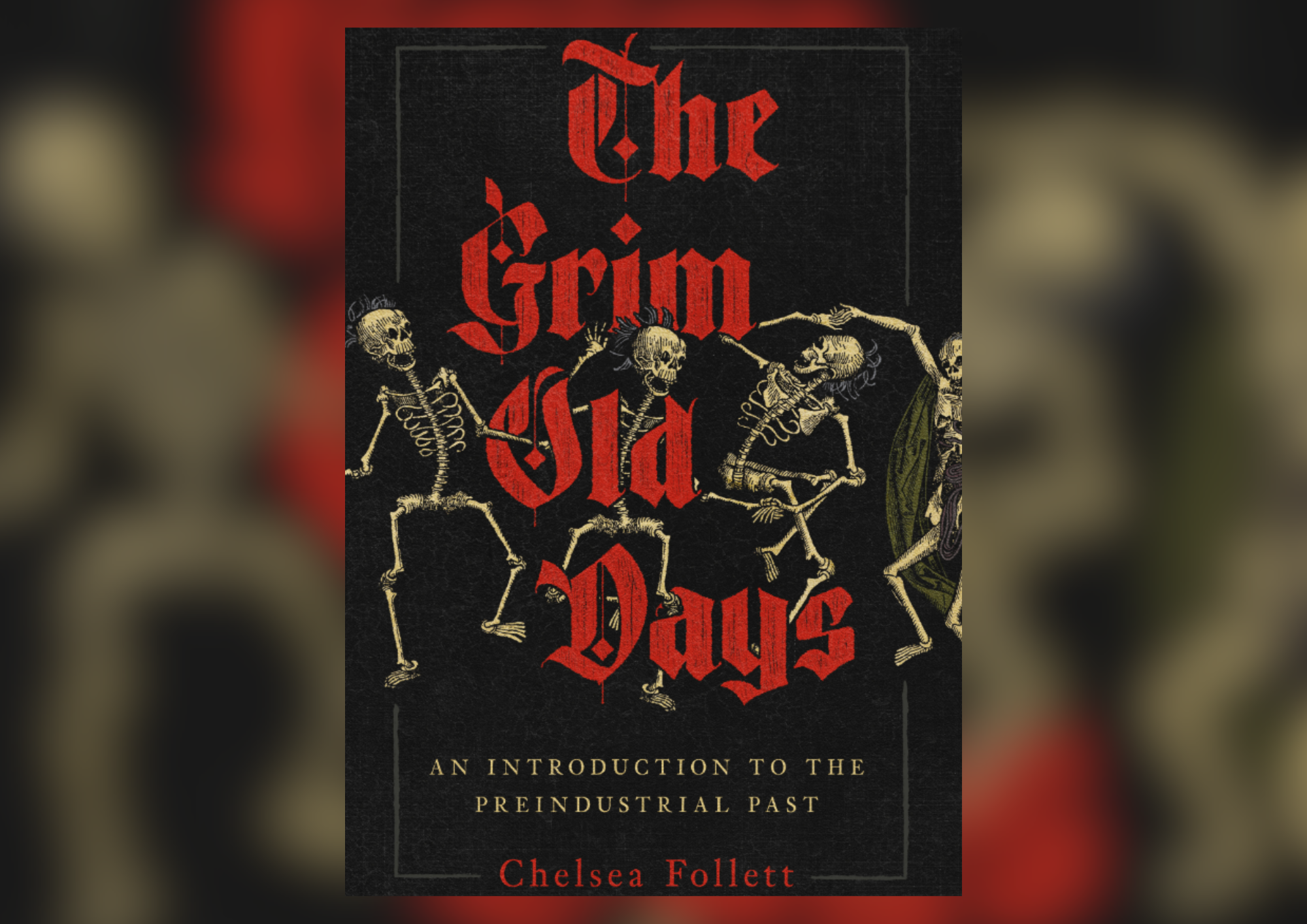
SpeakFreely’s Ian Golan spoke with Chelsea Follett about her new book, The Grim Old Days: An Introduction to the Preindustrial Past, the tendency to romanticise life before industrialisation, and what history tells us about human progress.
Ian Golan: Thanks for joining SpeakFreely. Let’s talk about your newest book, The Grim Old Days: An Introduction to the Preindustrial Past, which gives a fascinating look into the not-so-happy lives our ancestors led.
At the beginning of the book, you write that a popular saying holds that “the past is a foreign country,” but assure the reader that it is not one where they would wish to vacation. Why do you think it is important to deromanticise the past?
Chelsea Follett: Unfortunately, rose-tinted views of the past are very prevalent on both the right and the left.
On the far left, you have degrowthers who actually want to shrink the economy, lower living standards, and return to what they see as a simpler time. On the far right, you have people engaging in a kind of nostalgia for feudalism and wanting to turn back the clock based on very romanticised notions of family life and these loving, warm, tight-knit communities that they imagine were prevalent in the past.
But even if you look beyond those extremes; the degrowth left and the far right with its feudalism fantasies—you see this in the broad political centre as well.
Here in the United States, we’re seeing increased scepticism towards growth. We’re seeing pushback against data centres and self-driving cars. In Europe, my understanding is that technology companies can have a difficult time even getting off the ground because the extent of regulation is so great.
There is this fear of innovation and technology and a tendency to downplay the potential benefits of economic growth.
If the AI revolution has the potential to become a new Industrial Revolution, then the way you view it is going to be coloured very heavily by how you understand the original Industrial Revolution. Do you see industrialisation as essentially a wash? Do you think it helped a few industrialists become wealthy but did little for the living standards of ordinary people? Or do you see the Industrial Revolution, and the enormous acceleration of economic growth that accompanied it, as a transformation; a revolution in living standards?
I very much believe it was the latter. That is what my book tries to show.
IG: Let’s talk about what that past actually looked like. What were birth and childhood like, and what sort of fate awaited infants? Was it just happy children running around in nature, free from smartphones and all these addictive devices that corrupt them today?
CF: It is true that they did not have smartphones. But they were not happily running around enjoying their childhoods. Unfortunately, half or more of children did not even make it to adulthood. The people in the past who had perhaps the worst odds of anyone were infants. It was extremely perilous simply to be a baby.
And no amount of wealth or status could protect you. Even if you were a prince or princess, the state of medical knowledge was so limited that in many cases there was simply nothing anyone could do to help you survive. So many children died from ailments that today are easily preventable or treatable thanks to things like vaccines and antibiotics, which we now take for granted.
Towards the end of writing this book, one of my children, my toddler daughter, suddenly turned red and developed a terrible, splotchy rash across her face. It looked extremely uncomfortable, and I was afraid it was measles because she had not yet received the vaccine for that. But when I took her to the emergency room, I was told that, thankfully, it wasn’t measles. Because of vaccination, measles is now blessedly very rare.
It turned out to be scarlet fever. When I first heard those words, I was horrified because they sound so frightening. We’re used to hearing the term in old works of literature, where it is presented as a deadly ailment. And, of course, it once was. René Descartes’ young daughter died of scarlet fever in the seventeenth century, for example.
But the doctor in the ER told me that my daughter would be just fine after a week of taking a strawberry-flavoured antibiotic.
We too often take for granted the level of medical technology and innovation to which we now have access. Most people today assume that when they have children, those children will make it to adulthood. Most people will never know the pain of losing a child.
In the past, both because birth rates were much higher and because infant and child mortality was catastrophically high, practically everyone with children experienced child loss.
If you read the work of almost any major poet or writer from before industrialisation, chances are that at some point they wrote about losing a child. Even when the account was fictionalised, it was often based on firsthand experience.
For much of human history, the pain of having to bury your own child was practically universal.
We sometimes imagine that people in the pre-industrial past suffered less psychologically or experienced less stress. But that simply isn’t true. People were in mourning far more often. Mortality rates across the board were much higher.
And some people think that only child mortality was higher—that if you happened to survive into adulthood, your chances of reaching old age were roughly the same as today. That isn’t true either.
Life expectancy has risen for every age group. If you were 40 in the pre-industrial world, your chances of making it to 50 were worse than they are today. If you were 70, your chances of reaching 80 were worse. We simply don’t fully appreciate how much mortality has declined and how dramatically life expectancy—especially childhood survival—has improved.
IG: You mention in the book that poets would oftentimes even rhyme “womb” with “tomb.” Child mortality was simply ever-present. Another thing that shocked me was how extensively alcohol was used both as a supposed cure for different ailments and to pacify babies. Parents would actually give beer or other alcohol to infants, with all the health consequences that followed.
CF: Yes. In the past, water was often contaminated and dangerous. As a result, people frequently turned to alcohol, which may in some circumstances have been less likely to expose them to waterborne disease. But one consequence was that enormous amounts of alcohol were consumed throughout society. We don’t fully appreciate what that meant. Children, pregnant women and even infants were drinking alcohol. Often it was watered-down wine or relatively weak “small beer,” but it still added up.
There was a temperance society in Hesse, in what would become Germany, that advocated limiting yourself to only seven glasses of wine per meal, for two meals per day. That meant fourteen glasses of wine a day. And that was the temperance society. That gives you some sense of just how much alcohol people consumed.
Unfortunately, when babies cried, one common response was to give them alcohol or other drugs, including opium. Alexander Hamilton, the American founding father who now has a very popular musical named after him—actually advocated giving weaning infants opium and alcohol to soothe their crying. His position was not some bizarre aberration. It was quite common.
Alcohol was also a source of calories. In an era when many people were malnourished, including nursing mothers and wet nurses who sometimes struggled to produce enough milk, alcohol provided babies with a cheap source of calories while also having the effect of numbing them and making them cry less because they were drugged. It was an unfortunate and widespread practice throughout the pre-industrial era that I think rightly horrifies people today. And when you imagine what this must have done to our ancestors’ ability to reach their full potential, it is devastating. Many children probably suffered from fetal alcohol syndrome or other developmental effects because they were exposed to alcohol from infancy.
IG: One particularly interesting chapter in your book is about work, and it made me think about how good we actually have it with office work today. There seems to be something distorted in the way we talk about work. Blue-collar jobs are often romanticised as more authentic, masculine or socially valuable, while white-collar work is dismissed as unhealthy, soft or somehow less “real.” Do you think that discourse reflects another unhealthy romanticisation of the past?
CF: Absolutely. And again, I think this feeds into anxieties about our digital age, particularly AI and its potential to change the landscape of work. I do think AI will cause disruption, and the jobs of the future might be harder to summarise or explain than jobs that are immediately understandable to all of us. Think of mining coal, chopping wood or farming. Those occupations produce something visible and physical. They are very easy to comprehend.
But that does not mean those jobs were more pleasant to do. In fact, quite the opposite. There is a meme that has spread online, and you hear versions of it even from very educated people: the idea that people in the pre-industrial past had much more leisure time. The claim is that medieval peasants may have been materially poorer, but they worked less because their jobs were easier and they enjoyed far more festival days and holidays than we do today.
That is simply untrue. The myth seems to trace back to the 1991 book The Overworked American by sociologist Juliet Schor. It argued that before capitalism, people worked relatively short hours and enjoyed comparatively leisurely lives. One of the figures cited was an estimate by the historian Gregory Clark suggesting that medieval peasants worked only around 150 days per year.
Clark later revised that estimate to around 300 days per year. Today, even before taking holidays, vacation days and sick leave into account, the average American works around 260 days per year. In many European countries the figure is lower still because workers have more guaranteed vacation and sick leave.
So a modern person works far fewer days than a medieval peasant. The popular story has it exactly backwards. And we also need to remember that even on days that were nominally festivals, the cows did not milk themselves. Wheat did not harvest itself. A peasant still had to perform subsistence agricultural labour day in and day out, including on many so-called festival days. The difference might simply be that the day concluded with a communal meal. It wasn’t like an office job where you can take a week off. Farm work is heavily tied to particular times of day and particular seasons. You cannot simply skip the chores and go on vacation.
And I agree with you that many people today seem to view office jobs or “email jobs” as somehow inferior to jobs where you work with your hands. Unfortunately, this idea has a long history. You saw it in communist ideology, with the romanticisation of the worker and the labourer, combined with hostility towards people who were seen as upper class or as having easier, supposedly “fake” jobs.
You also saw it on the far right, including in Nazi ideology, which contained a romantic vision of peasant life. This is one of those things that extremists on both sides of the political spectrum have often shared: a romanticisation of backbreaking, difficult work and, sometimes, a desire to return to an imagined simpler way of life.
IG: I think it can also translate into bad policy, particularly when it comes to agriculture. We subsidise industries that sometimes make very little economic sense simply because of this idea that there is something uniquely valuable or authentic about them. Personally, I’m quite happy with my cushy office job.
Another subject that gets heavily romanticised is traditional family life and marriage. You devote several chapters to this, and one of the points you make is that people had so little choice in the past that many marriages were profoundly unhappy. The reality differed sharply from the idealised picture of “traditional values” people sometimes invoke today.
CF: Yes. Unfortunately, some people—particularly on the right—imagine that although our ancestors suffered from material deprivation, they enjoyed exceptionally loving and close interpersonal relationships and deeply fulfilling family lives, and that somehow compensated for their poverty. But if you look at how people actually lived in the pre-industrial era, most people never left their own village. Village life was far more isolated than people today can really imagine, before modern transportation and communication.
Your choice of romantic partners was therefore extremely limited. Many people ended up with partners who were far removed from them in age. Many ended up marrying their first cousins, which of course can increase the risk of birth defects when repeated across generations. And many people simply had such limited choices that, partners who were very ill-suited to them.
That problem was made worse by the fact that domestic violence was very normalised and accepted throughout much of human history and across many cultures. Let me give you one particularly vivid example. In sixteenth-century London, there was actually a law that essentially said you could not beat your wife or servant after nine o’clock at night if doing so created enough noise to disturb your neighbours.
It was a noise regulation. It appeared alongside rules against things like using a hammer after nine o’clock. The people writing these laws were not expressing concern for the wife’s well-being. It was simply taken for granted that beating your wife until she screamed was as ordinary an occurrence as using a hammer. The concern was merely that, if you were considerate, you wouldn’t do it so late that your neighbours couldn’t sleep.
Things obviously aren’t perfect today when it comes to interpersonal relationships. People can debate whether modern society is too isolating or whether we have problems with relationship formation. But we have come an enormous way from a past in which so many people were trapped in extremely abusive and physically violent relationships.
Beating children was widely accepted. Animal torture was often given scarcely a thought. It was an incredibly violent world, and I don’t think we fully appreciate just how much violence has declined. Some people will say: “Yes, we’ve made material progress. We’re wealthier than people in the past. But perhaps they were more moral. Perhaps they were purer.” That does not seem to be the case.
If you look at how people actually treated one another, it was often extraordinarily cruel and callous, and their tolerance for violence was much higher than ours. So I would argue that there has not only been material progress. There has also been moral and social progress.
IG: And when it comes to family values, you also mention that pregnancy outside marriage was quite common. Even the supposedly traditional family with the same two parents throughout a child’s upbringing wasn’t necessarily as common as we imagine, because mortality was so high. People often lost spouses, remarried and formed what we would now call blended families.
CF: That’s correct. Families with a stepfather or stepmother were actually much more common in the past than they are today, despite our stereotypes. Mortality rates were simply so much higher across the board. Not only were half or more of children dying, but women faced a very real risk of dying in childbirth. Men also had very high mortality rates.
Again, medical knowledge was appalling. Hygiene and sanitation were terrible. Disease and violence were much greater threats than they are today. So it was very common to lose your spouse prematurely and then remarry and carry on. It was much more common to have lost a child or a sibling. Practically everyone had firsthand experience of a close family member dying.
There is also a very romanticised view of old age in the past. Some people imagine that, in the old days, elderly people were truly respected and spent their final years living happily with their adult children and loving grandchildren in the village. Unfortunately, that also does not seem to have been the case. Because mortality rates were so high, it was much less common to know your grandparents than it is today.
And if you were one of the relatively few people who reached old age, it was quite possible that your own children had already died. Birth rates were higher, but mortality was so high that surviving into old age did not guarantee that you would be surrounded by living children and grandchildren. Some of the people most likely to reach old age were women who had never given birth, because childbirth itself was extraordinarily dangerous. Across repeated pregnancies in unsanitary conditions and without modern medicine, the lifetime risk could be enormous.
And if a childless woman did survive into old age, she was not necessarily treated with respect by her community. Quite the opposite. If you look at witch hunts and witch burnings, elderly women were frequently among the targets. They were often viewed with deep suspicion and portrayed as potentially malevolent figures. Combine that with much higher levels of superstition and belief in things that we now know were mistaken, and you got very real violence against suspected witches.
IG: I think another thing people underestimate about the past is just how much beauty technological progress has brought into everyday life. You have a very interesting chapter about makeup and another one on physical appearance. Tell us more about how ugliness was simply much more common in the past.
CF: Absolutely. For most of history, the average person—often 80 or 90 percent of the population—was a subsistence agricultural labourer. People were not bathing regularly. So they often smelled bad and were frequently filthy. But even if you look at the small elite who actively tried to take care of their appearance, the situation was not necessarily much better.
They also were not especially fond of bathing. At various points in history, bathing was even thought to be unhealthy. Instead, people tried to cover up body odour using animal musks and all sorts of secretions that we would now consider disgusting. In some cases, even animal urine and excrement were used as ingredients in what they called perfume.
Their makeup could be equally hazardous. Face-whitening makeup made with lead may have caused the deaths of some noblewomen. Maria Gunning, the Countess of Coventry, who was famous for her beauty, is often thought to have been poisoned by the lead in her cosmetics. Then there was belladonna—deadly nightshade. The word itself means “beautiful woman” in Italian because women once put drops of it into their eyes to dilate their pupils, which was considered attractive.
We now know that belladonna is extremely toxic. Even if it didn’t kill you, putting a poisonous substance directly into the eyes could obviously have serious consequences. Physical appearance in general was very different. Think about the average person’s skin today. You probably imagine relatively smooth and unblemished skin. If someone has acne, we have all kinds of treatments available.
In the past, because infectious disease was so much more prevalent, it was common even among the nobility to have pockmarks and scars covering the face. So people who imagine our ancestors as healthier, naturally beautiful people untouched by modernity might be quite horrified if they could actually see them.
IG: That ties quite nicely into a recent article you wrote asking whether smartphones might actually be helping romance rather than killing it. We’re extraordinarily lucky in terms of the amount of choice people have in dating today. There’s a similar point in your chapter on fashion. You mention that for something like twelve centuries, people were essentially wearing variations of the same tunics from Roman times into the Middle Ages. Are we blaming technology for problems that have always been difficult? Why are smartphones constantly scapegoated for killing dating?
CF: Absolutely. I think we have not only eliminated many of the problems of the past; we have eliminated the memory of those problems. There are so many forms of everyday abundance that we simply take for granted now.
Clothing is a perfect example. In practically every culture around the world, women spent enormous amounts of their lives spinning. Creating thread and cloth was a constant task. Before mechanisation, everyone from the lowest-ranking woman to the highest-ranking woman in society could be expected to spin. It was considered a symbol of industry. Even queens were expected to do it. It consumed an enormous share of women’s time.
And for all that labour, people still never had enough clothing. For much of history, clothes were so precious that they were passed down across generations. Today, clothing can be so inexpensive that if something tears, it may cost less to replace it than to repair it.
We really do not appreciate how abundant clothing has become. For most of history, genuinely new clothes were something largely reserved for the wealthy. Everyone else made do with hand-me-downs that often did not even fit properly. And on romance and dating, the idea that people in the past simply found someone and lived happily ever after is greatly exaggerated.
Just consider once again the widespread acceptance of domestic violence. There is an old folk ballad called The Cooper of Fife, with versions in Scotland, England and colonial America. It tells the story of a high-born woman who marries a cooper, a barrel maker. She is accustomed to a certain standard of living and refuses to do domestic chores such as carding wool and spinning thread. Her husband beats her for it. He lays a sheepskin over her back and beats her until she submits and performs the housework to his satisfaction. And he is portrayed as the hero. The audience was supposed to be on his side.
You can still find modern recordings of the song. It has a cheerful tune. The whole thing is presented almost comedically. That mindset is difficult for modern people to comprehend, but this kind of violence was normalised throughout much of history.
IG: One more aspect you write about is privacy, or really the lack of it. People often didn’t have separate nightclothes. Village homes might consist of a single room. Even large houses didn’t provide anything like the degree of privacy we expect today, with servants spying on nobility.
It reminds me of an article one of our writers did responding to the book Why Women Have Better Sex Under Socialism. She wrote about growing up in the Soviet Union in a crowded single room with her parents and about what that did to intimacy. I certainly wouldn’t want to return to that kind of past. Before we finish, where can people get The Grim Old Days, and what’s next for Chelsea Follett?
CF: You can pre-order The Grim Old Days online wherever books are sold, including Amazon, Barnes & Noble and the other major retailers. The official launch date is October 20th. So if you pre-order now, you can have it before Halloween, which is a holiday in the United States that I think suits the book’s somewhat spooky cover.
There will also be more podcasts and a book launch event in late October or early November. We’re still finalising the details and the speakers, so I don’t want to announce them prematurely, but I’m very excited about what we have planned. But I also want to come back to your point about privacy, because I think it’s extremely important.
The basic living conditions of ordinary people in the past would be completely unacceptable to almost anyone today. Even the Palace of Versailles did not have anything resembling modern bathrooms, and human waste could accumulate in the corridors. If you were a typical peasant or agricultural labourer, you might live in a single-room home with nothing we would recognise as a proper bed, perhaps just a pile of hay or a sack stuffed with straw.
If you were fortunate enough to own an actual bed, you would probably share it with your entire family. You might have the husband and wife in the middle, the daughters sleeping alongside the mother and the sons alongside the father, all in one bed because that was all the family could afford.
Beds were so valuable that even wealthy people commonly shared them until comparatively recently. You can find many examples from colonial America of this. Even the American Founding Fathers sometimes shared beds while travelling. A modern person might read something sexual into that, but that generally wasn’t what was happening. It was simply necessity. People shared beds because there weren’t enough beds.
For an ordinary peasant, winter nights could also be freezing. You had to extinguish the fire because leaving an unattended hearth burning posed an enormous risk. So one way people kept warm was by bringing farm animals inside at night. Imagine what that did to the smell.
These homes had no bathrooms. Human waste could accumulate in and around the household. Then add the smell and sounds of the animals, the fleas they brought in, and the fact that the entire family was crowded together in one space. It was extraordinarily unhygienic and uncomfortable. From the perspective of a modern person, some of these homes would probably resemble a prison or dungeon more than anything we would now consider acceptable housing.
IG: Thank you so much for joining us. I enjoyed the book tremendously. I had almost thirty questions prepared because there are so many fascinating anecdotes from so many different centuries. An enormous amount of research clearly went into it. Was there one anecdote that shocked you more than any other while you were writing?
CF: Oh my goodness. That’s difficult to say. But one particularly shocking image that stays with you is an event known as the Erfurt latrine disaster. I’m going to let people read about that for themselves in the book rather than describing it, because it is rather disgusting. But I do think it underscores just how many horrific things there are in history that we have thankfully moved beyond.
IG: I think this is also the perfect moment for the book. There are so many people now who romanticise the past or want to revive traditions from it. So this feels like exactly the right time for The Grim Old Days. Thank you for joining us.
CF: Thank you.