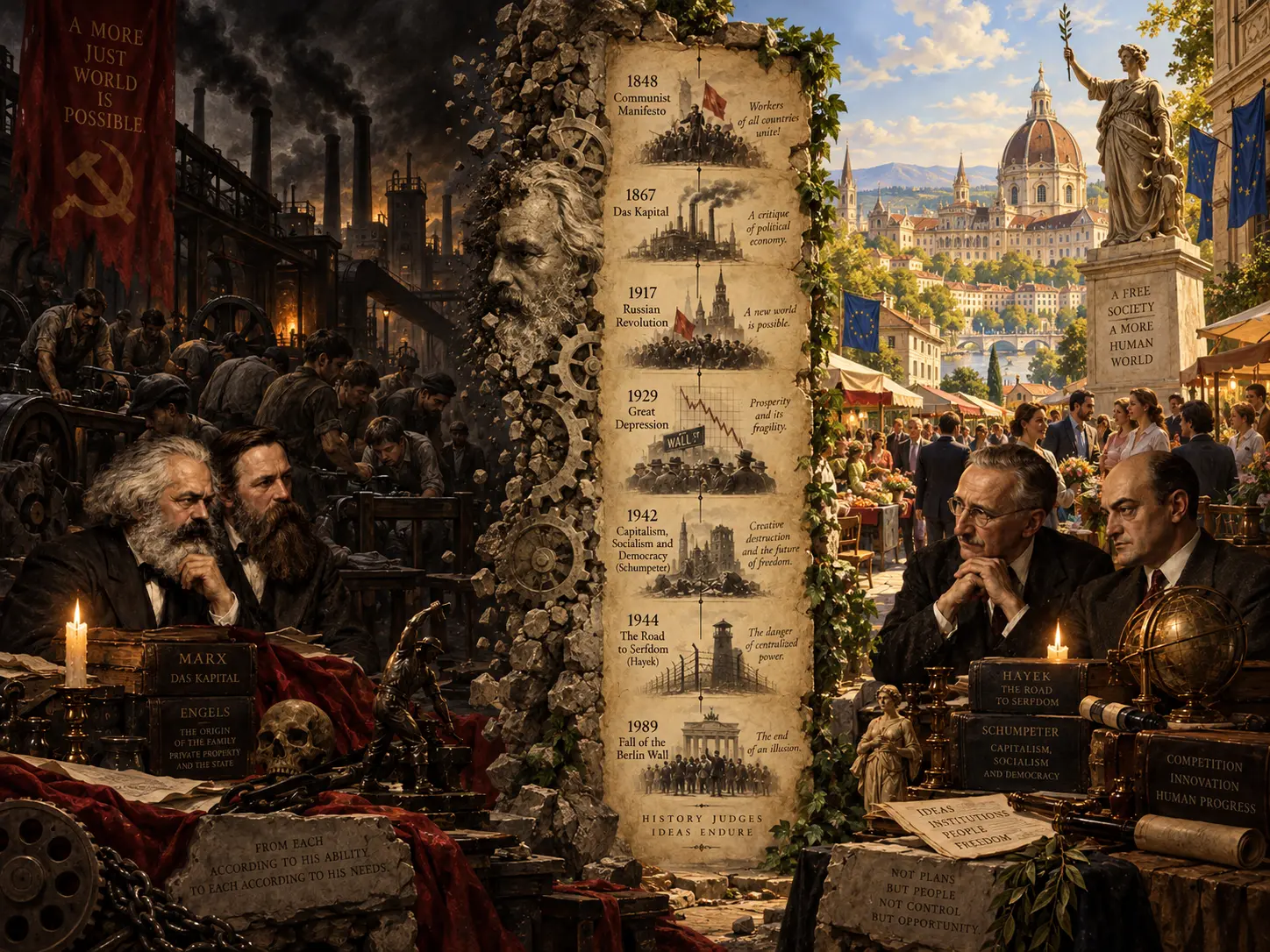
Formulated by Karl Marx and Friedrich Engels, historical materialism argues that rather than ideas, material conditions and class relations are the primary forces driving historical change.
According to this view, every economic system from ancient slavery to feudalism contains internal contradictions that eventually lead to conflict, revolution, and the emergence of a new mode of production.
However, the experience of the past two centuries raises important questions about whether capitalism has followed the path Marx predicted.
So, did capitalism expose contradictions within historical materialism’s own analysis of historical change?
Fundamentally Different
A central assumption of historical materialism is that capitalism will ultimately follow the same historical trajectory as previous modes of production. Because slavery and feudalism were eventually replaced, capitalism will follow the same historical trajectory.
But unlike earlier modes of production, capitalism is organised around economic freedom. Whereas slavery was based on ownership of labour, feudalism tied labour to the land, and historical socialist systems concentrated control of production in the state, capitalism is founded upon private property, voluntary exchange, freedom of contract, and the ability of any individual to enter and leave economic relationships.
This distinction is significantly more important than historical materialism acknowledges. Societies organised around economic freedom will evolve differently from societies organised around economic coercion. The decentralisation of economic power encourages competition not only in markets, but also in institutions, ideas, and civil society.
Here it is important to note that capitalism undoubtedly requires certain freedoms to function, including private property, freedom of contract, legal equality, and labour mobility.
But many of the freedoms that later emerged within capitalist societies, such as freedom of speech, democratic competition, academic freedom, and freedom of association, extend well beyond these minimum economic requirements.
All this questions the assumption that capitalism must inevitably follow the same historical path. If it differs fundamentally from previous modes of production, then historical patterns observed under systems of economic coercion may not apply to a system organised around economic freedom.
An Evolving System
One of the most common criticisms of historical materialism is its failure to anticipate capitalism’s capacity to adapt. The capitalism of the twentieth and twenty-first centuries differs significantly from the industrial capitalism Marx observed.
Rather than collapsing under their internal contradictions, many capitalist societies evolved through the emergence of welfare states, expanded labour protections, democratic reforms, and rapid technological innovation.
This adaptability also reflects Friedrich Hayek’s argument that dispersed knowledge and decentralised decision-making allow societies to evolve through continuous experimentation and adaptation, rather than according to a predetermined historical sequence.
Furthermore, capitalism has coincided with an unprecedented expansion of personal freedom. Historically, market economies have been the principal setting in which freedom of speech, freedom of association, religious liberty, universal suffrage, women’s rights, LGBTQ+ rights, and broader civil liberties have developed and endured.
A Marxist, however, would argue that this proves their point further, as these changes occurred without replacing capitalism, and in that sense benefitted the existing ruling class at the expense of true liberation for the working class. Hence the saying “social democracy is merely capitalism with guardrails”.
Yet this raises a deeper question. If the capitalist superstructure exists primarily to preserve the capitalist mode of production, why has it given rise to and protected institutions such as free speech, freedom of association, democratic competition, and independent universities that permit organised opposition to capitalism itself?
Certainly, Marxists may argue that economic power influences media ownership, political discourse, and public opinion. However, criticism of capitalism remains commonplace in public discourse, while political parties and movements advocating greater state ownership or socialist alternatives continue to compete in democratic elections, and sometimes win them.
Unlike previous modes of production, capitalism has institutionalised mechanisms that enable sustained criticism of its own economic foundations. If the superstructure primarily exists to reinforce the economic base, then explaining why capitalism preserves institutions capable of democratically challenging capitalism itself becomes considerably more difficult.
However, this tolerance becomes more complicated when considering foreign intervention. States with a more capitalist economic system sometimes intervened to prevent or overthrow governments pursuing socialist policies, as seen in Guatemala in 1954 and Chile in 1973. A Marxist could therefore argue that capitalism tolerates socialist opposition only while it does not seriously threaten existing property relations. Yet this also suggests that political institutions and state action can actively shape economic systems, making the relationship between the economic base and superstructure less one-directional than historical materialism suggests.
This difficulty is also reflected in Max Weber’s Protestant Ethic thesis. Rather than treating ideas as mere products of the economic base, Weber argued that religious and cultural beliefs themselves helped shape the emergence of modern capitalism.
If ideas can influence the development of economic systems, rather than simply reflecting them, then the relationship between the economic base and the superstructure may be far less one-directional than historical materialism suggests.
From Material Insecurity to Prosperous Discontent
A fundamental premise of historical materialism is that capitalism contains inherent contradictions which, over time, will increase absolute material insecurity (the inability to meet basic needs), and intensify class conflict, ultimately culminating in capitalism’s collapse.
This has not occurred. Quite the opposite. Rather than producing increasing absolute material insecurity, capitalism has dramatically reduced it. Productivity, wealth, life expectancy, educational attainment, and technological progress have all risen substantially over the past two centuries, lifting billions of people to living standards unprecedented in human history.
Joseph Schumpeter argued that capitalism’s greatest contradiction was not its failure, but its success. By generating unprecedented wealth, expanding higher education, and protecting freedom of speech and intellectual inquiry, capitalism created the very conditions in which criticism of capitalism could flourish. As societies became wealthier, they produced a growing class of intellectuals, academics, journalists, and public commentators whose role was increasingly to analyse and critique existing institutions.
This is not to suggest that insecurity no longer exists, or that it has not increased for some people in recent years. However, much of this contemporary insecurity is better understood as relative deprivation than as material poverty.
Dissatisfaction increasingly stems from the perception that one’s standard of living, opportunities, or economic prospects are worse than those of previous generations or one’s peers, rather than from an inability to satisfy basic material needs.
Unlike Marx, who expected anti-capitalist sentiment to emerge primarily from an increasingly impoverished working class, Schumpeter believed it would emerge from the prosperity capitalism itself had created.
This argument is reinforced by Ronald Inglehart’s theory of post-materialism. As basic material needs become increasingly satisfied, political priorities shift away from survival and towards self-expression, identity, equality, environmental concerns, and quality of life. Prosperity therefore changes not only living standards but also values.
If this is true, then capitalism may generate an entirely different mechanism of historical change from the one Marx envisaged. Rather than producing revolutionary pressure through increasing material insecurity, capitalism breeds many of its own critics through economic success. Relative deprivation then provides the mechanism through which these ideas resonate beyond intellectual circles and gain broader political support.
Conclusion
Historical materialism remains a powerful framework for understanding the relationship between economic structures and society. Yet the experience of the past two centuries suggests that capitalism has developed in ways that its founders did not anticipate.
Rather than generating ever-increasing material insecurity and revolutionary pressure, capitalism has repeatedly adapted, expanded prosperity, transformed values, and fostered institutions capable of challenging the system itself.
This does not mean that capitalism is free from contradictions, nor does it diminish the importance of material conditions in shaping history. It does, however, call into question the assumption that history follows a predetermined sequence of modes of production driven primarily by their internal economic contradictions.
Rather than viewing history as progressing through fixed historical stages, Hayek saw societies as evolving through a decentralised process of experimentation, competition, and institutional adaptation. Social change, in this view, is not the product of an inevitable historical logic, but of countless individuals, ideas, and institutions interacting over time.
Capitalism, then, may not have simply disproved Marx’s predictions. It may instead have demonstrated that historical development is more evolutionary, decentralised, and contingent than historical materialism allows.
Good reporting is cheaper than heavy-handed regulation. Support freedom and independent journalism by donating today.
This piece reflects the author’s views, not necessarily the entire magazine. We welcome a range of pro-liberty perspectives. Send us your pitch or draft.