The heroism of Nasrin Yousef, Inbal Lieberman, and Amit Mann on October 7th were not acts of blind self-sacrifice but a supreme demonstration of rational heroism: the exercise of independent judgment, resourcefulness, and unwavering courage born from a profound commitment to the value of life.
On October 7, 2023, Hamas terrorists murdered more than 1,200 people in southern Israel and took approximately 250 hostage in the deadliest day for Jewish people since the Holocaust. The attack was designed not merely to kill but to disorient: to strip ordinary people of the capacity to think, to react, and to defend themselves. For many, it succeeded. For a few, it did not.
The Day the Silence Broke
October 7 began as a quiet Shabbat morning. For the residents of the Negev—the arid southern region of Israel that borders the Gaza Strip—it was also Simchat Torah, one of the most joyful holidays on the Jewish calendar. The silence ended at 6:29 a.m. when a massive rocket barrage, coordinated to provide cover for a simultaneous ground invasion, struck communities across the region.
Approximately three thousand Hamas terrorists breached Israel’s southern border fence at dozens of points, descending on kibbutzim (small, often agricultural collective communities), towns, and a music festival with methodical violence. The IDF, caught entirely off guard by the scale and simultaneity of the assault, required many hours to mount an effective response and reach the affected communities. In that terrible interval—hours during which there was no rescue arriving from over the horizon—the residents of these communities had only themselves and each other.
Heroes among those residents chose to think.
The Intellect of Readiness: Inbal Lieberman
On the morning of October 7, Inbal Lieberman, a twenty-five-year-old security coordinator (Ravshatz) of Kibbutz Nir Am, was already sprinting toward the command centre when she crossed paths with the kibbutz’s maintenance man.
“I’m going to kick on the generator,” he told her. “The power is out.”
She stopped him without hesitation. People don’t have electricity, he tried to argue. The impulse was a natural one: restore normality, restore comfort, restore the reassuring hum of ordinary life in a moment of terror. Lieberman cut through it. The power being out, she told him, was “exactly what is saving us right now.”
She was correct. The terrorists’ vehicles, laden with weapons and soldiers intent on slaughter, were stopped at Nir Am’s perimeter by the kibbutz’s electronic gates, which could not open without power. The maintenance man was the first of many that morning who would follow her word over his own impulse.
To understand the magnitude of what followed, it helps to understand what a Ravshatz is designed to do. A kibbutz security coordinator is responsible for daily security protocols and commands a volunteer rapid-response squad—one with enough capability, in normal circumstances, to hold a community’s perimeter for the brief window until IDF reinforcements arrive. On October 7, those reinforcements didn’t arrive. The voice on the Division radio, connecting her to the IDF’s regional command centre, gave Lieberman the same answer throughout the long hours of the assault: There were no reinforcements to send. She was on her own. Trained and equipped to hold for minutes, she held for half a day.
The team she assembled in those opening moments was not the one she had trained with. Many of her regular squad members were away for the weekend. Those who answered the call were drawn from wherever they happened to be—a patchwork of kibbutz residents, some of them fathers of young children whose families were calling their phones, begging them to leave the line and return to their shelters. Lieberman did not ask why they had come; there was no time for that. “I just said ‘thank you,’” she recalled, “handed them a weapon, and we got to work.”
In the chaos of a community under siege, authority consolidates quickly around whoever is still thinking. Everyone present understood that there needed to be one person in charge, and they deferred to Lieberman without dispute. “In the end,” she said, “it was my voice that made the calls.” This was not simply a matter of her title. The people under fire recognised that one person among them had not stopped reasoning. She led these men with full awareness of their humanity—knowing they were fathers, knowing what they stood to lose—while holding the line firm. “If we don’t guard this fence,” she told them, “no one is guarding the fence.”
What she was holding the fence against was relentless. Lieberman watched terrorists open fire from a hatchery just one hundred meters from the kibbutz perimeter. She watched a Namer—a heavily armoured Israeli personnel carrier—become disabled by a grenade hit, trapping its crew inside. She watched a tank neutralised by an RPG. She coordinated defence against all of this with eleven rifles—wielded by a civilian rapid-response team, not a military unit—against what amounted to a small invading army, all while managing the tactical, but also psychological needs of the men beside her.
Throughout those hours, her closest friend, Ziv “Pappe” Shapira, was at the Nova music festival several kilometres away. As the scale of the attack became clear to her, he was the first person she called—before the military, before anyone official—to warn him. It was too late. Two days later, on her birthday, she received word that he had been murdered.
She does not account for what she did that day in the language of sacrifice or of summoning strength she did not know she possessed. “The strength wasn’t something I ‘found,’” she has said. “It was just there, inside me. It has always been there.” The crisis did not create her capacity; it called upon one that she had long been cultivating and that she had long cultivated.
And then there is this, perhaps the most philosophically precise thing Lieberman has said about October 7: “I was terrified. But if I hadn’t been afraid, I would have thought something was wrong. The fact that I was scared actually calmed me down.” Fear, as a justified response to a serious threat to one’s values, is not the enemy of clear thinking—it is reinforcement of one’s accurate perception of danger and serves as motivation to act accordingly. Facing facts as they are, no matter how catastrophic, is a capacity a rational mind must cultivate. For Lieberman, this long-cultivated awareness prevented the next step that fear tries to take: the displacement of judgment by panic. “I just didn’t let that fear run the show.”
Lieberman measured every decision she made that day against one standard: the survival of the people inside those gates. At nightfall, she was told the kibbutz was being evacuated. Her team had held. Not a single resident of Nir Am was killed on October 7.
The Voice of Resourcefulness: Nasrin Yousef
For seventeen years, Nasrin Yousef—a forty-seven-year-old mother of four—built her life in Moshav Yated, a small cooperative agricultural community in the Gaza envelope region of southern Israel. She was born on Mount Carmel, in the heart of the Druze community that has called northern Israel home for centuries.
The Druze are an Arabic-speaking religious minority—followers of a distinct faith that diverged from Islam roughly a thousand years ago and is largely secretive and non-proselytising—who have, uniquely among Israel’s Arab citizens, embraced a deep tradition of civic loyalty expressed through military service. Druze men serve in the IDF under a longstanding arrangement that Druze leaders sought, and Druze people have created an environment that inspires an exceptionally high rate of service and leadership, fully embracing the heavy sacrifice that has left a disproportionately high number of them as decorated officers and fallen heroes.
The Druze call this commitment their “Covenant of Life”—a term that captures something more than political loyalty: a recognition, proudly maintained from one generation to the next, that the fate of their community is bound to the fate of the state they serve. Yousef embodies this covenant as a lived reality. Her identity, as she has described it, is a bridge between worlds—between Druze people and Israel, between Arabic and Hebrew, between the northern mountain community where she was born and the southern moshav where she chose to raise her family. On October 7, that bridge became a fortress.
At 6:29 a.m., the rockets began to fall. “The first boom, the first ‘Red Colour’ siren,” Yousef recalls. “I didn’t understand what was happening.” By 8:00 a.m., the power was cut, and the air had grown heavy with the smell of smoke. It was her daughter, Shiran, who broke through the confusion with a sentence that marked the end of the ordinary world: “Mom, Dad, there are terrorists outside.”
Her husband—a career military man—donned his uniform to go out and meet the threat. Yousef’s response required no deliberation. “He said he was going out,” she recalls. “I told him: ‘I’m going out, too.’”
At a neighbour’s gate, she came face-to-face with a terrorist attempting to breach the home. The terrorist had just been intercepted and held at gunpoint by the community’s armed rapid-response team, which included Yousef’s husband. With the physical threat temporarily contained by the men behind her, Yousef stepped forward to take control of the interrogation. Speaking in Arabic, she held his gaze and refused to release it. “Look me in the eyes,” she told him. “I’m not afraid of you. Where did you come from?” The terrorist, confronted with a woman who offered him neither fear nor flight, pointed toward the greenhouses some fifty meters away. “We entered from there.”
With that answer, Yousef knew where the threat originated and in which direction it moved. The intelligence she extracted in that exchange was immediately relayed to the armed squad beside her, directly guiding them and arriving IDF forces to the militants concealed in the nearby greenhouses, leading to their neutralisation.
She was not finished. When a captured terrorist’s phone began to ring in the chaos of the yard, Yousef answered it.. “It’s not Muhammad, it’s not Wadiya—it’s Nasrin,” she told the handler who was calling from Rafah. Keeping her voice low and urgent, she spun a web of false reassurance: “Don’t worry, I’m one of you. . . . I have a safe house, and all your guys are here with me.” Playing the role of collaborator with total composure, she kept the operative talking—and as he talked, she drew out the locations of hundreds of Nukhba fighters (Hamas’s elite special forces, the unit that planned and led the October 7 ground invasion) converging on the area near the Kerem Shalom crossing. “I’m one of you—just tell me where you are,” she pressed, relaying it all to the IDF officers standing at her side.
The victory was, in her own account, bittersweet. Even as she saved her moshav, she learned that two close friends had been murdered in the attack. She drove her children—some of them barefoot—through fields still littered with the day’s horrors, making for safety. As she drove, something happened that she had not anticipated: she found herself repeating the Shema Yisrael—the most ancient declaration of Jewish faith… She later recalled that the prayer rose to her lips and would not leave them. “Shema Yisrael didn’t stop coming out of my mouth,” she has said, “until we reached Ofakim.”
A Druze woman, born on the Carmel, praying in the language of her neighbours as she drove her children to safety through a battlefield: The image defies every category that outside observers reach for when they try to narrate this conflict.
The “Lioness” spirit invoked by Israel’s female combat soldiers—the ethos of bringing one’s particular capacities to bear with total purposefulness in service of what one values—is nowhere better embodied than in this forty-seven-year-old mother who answered a terrorist’s phone and turned it into a weapon.
The Covenant of Purpose: Amit Mann
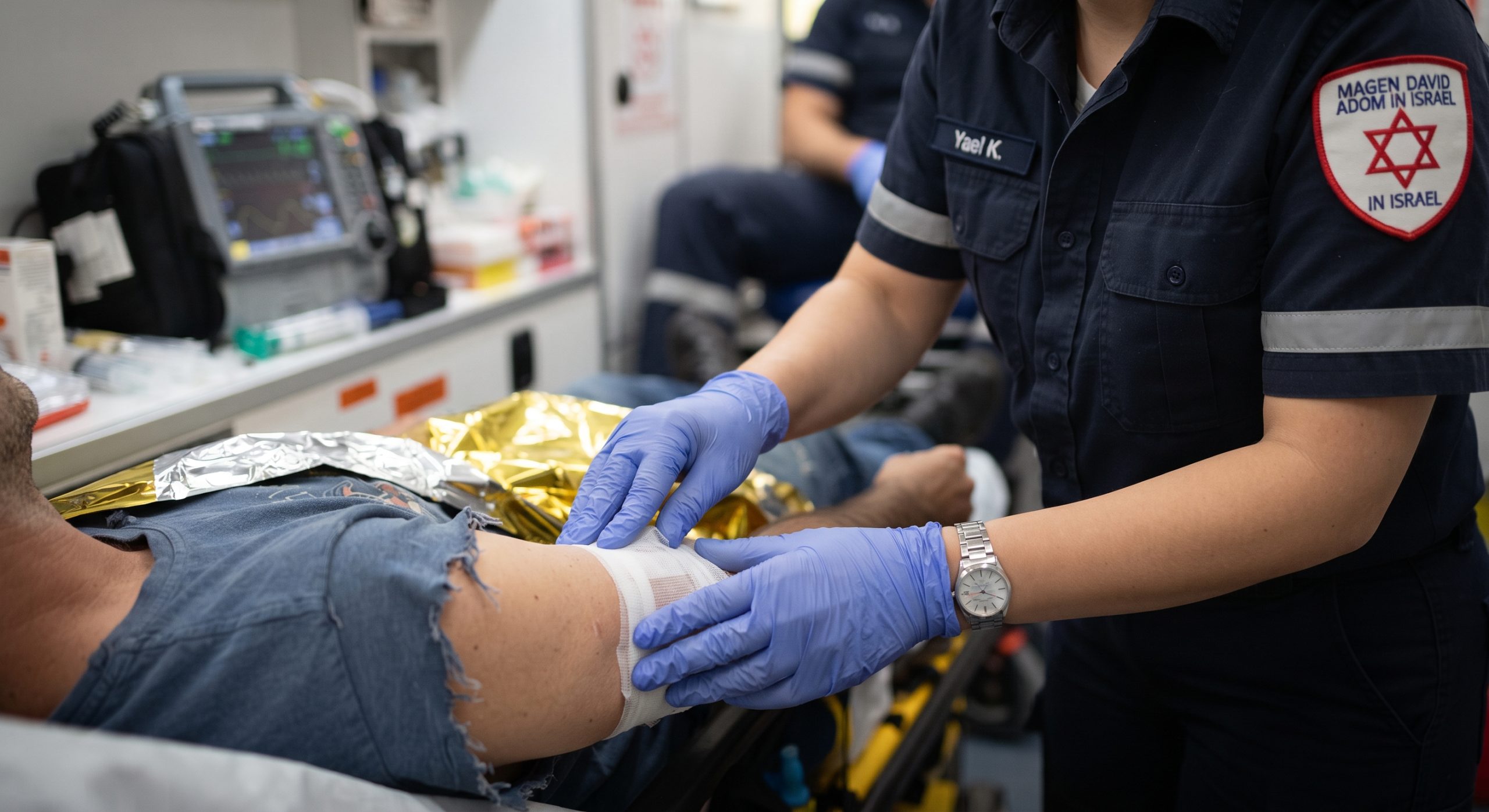
Amit Mann was twenty-two years old and working as a paramedic on call at Kibbutz Be’eri on the morning of October 7. Her partner had left for a shift in another city. Mann chose to stay.
When the rockets began, she was summoned to the kibbutz’s dental clinic to treat security team members wounded in the opening exchange. On her way there, she stopped repeatedly along the kibbutz paths to treat victims she found in the open, pulling them toward the clinic. For the next seven hours, working alongside a nurse and a physician, she provided continuous trauma care while Be’eri remained under siege. Emergency services informed her that no reinforcements could reach them; the kibbutz had been designated an active war zone. No ambulances were coming. She was told directly: There would be no rescue, because there could not be—Hamas soldiers were shooting at ambulances.
Her family, watching the catastrophe unfold from a distance, did not yet understand what she already understood. “We believed one thousand percent that they would get her out,” her sister Chaviva later recalled. “It was clear to me that our strong army would arrive.” What they could not know was that Amit, inside the clinic, could smell the smoke from the burning houses of her kibbutz. She knew exactly what was happening.
As the hours passed and medical supplies ran low, Mann shifted from physical treatment to something harder: sustained human presence. She stroked the wounded. She spoke to them. She stayed with them on the floor—there were no beds—placing soft objects beneath them, tucking a helmet under one man’s head for comfort. When she could no longer treat the most critically injured—according to Yair Avital, a survivor who described these hours afterwards—she simply remained beside him. She gave him water. She encouraged him. As Chaviva recounted his testimony: “In the darkest place that could exist, she just stayed true to herself. Not once did she say to us, ‘Get me out of here, I’m afraid.’”
At the same time, Mann texted instructions to kibbutz members barricaded in their homes, guiding them through emergency medical procedures in real time while managing a trauma clinic under fire. These individuals were non-combatants who had nevertheless been injured in the attack. She was conducting two operations simultaneously—one physical, one digital—and she paused from both, periodically, to send her family messages designed to reassure them. “She was always trying to broadcast to us that she was okay,” Chaviva recalled. At one point, Chaviva asked her to send a photograph—she simply wanted to see her. Amit sent a selfie from the clinic. Behind her, the floor was covered in blood. She was wearing medical gloves and trying to smile. “You could see in her eyes,” Chaviva said, “that they were extinguished.”
At 1:50 p.m., Amit wrote to her family that the clinic’s two security team members had run out of ammunition: “I don’t think we’re getting out of here. Pray for us.” Minutes later, those who survived heard her voice in an audio message that has since become widely known—screaming a name, a soldier’s name, the moment the terrorists breached the room.
What followed lasted perhaps a minute. Amit spoke to her brother-in-law. She spoke to her mother, crying out “I’m sorry, Mom”—though her sister, recounting this, said she did not know what Amit was apologising for. “Maybe,” Chaviva said, “because she simply knew she was going.” Then Amit answered one more call—her sister’s. It was eight seconds. “Amit, did they shoot you?” Chaviva asked. “Yes,” Amit said. “I won’t survive this. They murdered everyone.”
Then: “They’re on me.” Arabic shouting. Noise. The call went dead. It was 2:15 p.m..
The officer who later found her reported that she had been shot in the leg with a Kalashnikov round—not an ordinary bullet but one that tears through bone—and then shot in the head at close range. On her left leg was a makeshift tourniquet she had applied to herself with whatever was at hand: a last, deliberate act of a paramedic who had not stopped trying to preserve a life, even her own, until the final moment. She lived fully with purpose, until the very last second.
“In Their Death, They Commanded Us to Live”
There is a Hebrew phrase—Be’motam tzivu lanu et hachayim, “In their death, they commanded us to live”—recited at Israeli memorials and funerals. Heard one way, it sounds like the imposition of a burden: The dead have placed an obligation on the living. But that reading misses something essential about what the phrase actually conveys.
Those who died defending what they loved did not die for a disembodied ideal, but for the concrete lives and values they loved. They died—or risked dying—as a direct consequence of acting fully in accordance with what they valued. Lieberman, Yousef, and Mann each acted from a clear and specific sense of what mattered to her and why. They did not surrender themselves; they expressed themselves at the highest possible level of commitment and clarity. The phrase is better understood not as a commandment but as an inspiration. These women showed us what it looks like to act in full alignment with one’s values under conditions designed to make such alignment impossible. They invite us, to take seriously the things worth living for, and to live for them with the same purposeful clarity they brought to defending them.
This is the deepest challenge these three women’s stories pose to the standard moral narrative. The prevailing cultural view holds that true virtue is essentially sacrificial—that the measure of moral worth is what a person is willing to give up for others. But Lieberman did not give herself up; she used herself, with precision and effect. Yousef did not surrender her capabilities; she deployed them at the moment of greatest need. Mann did not abandon her identity to serve others; she served others as the fullest possible expression of her identity. Their heroism was not the negation of the self. It was the self at its most complete—most purposeful, most deliberate, most fully realised.