A review by Serge Schweitzer, Aix-Marseille Université
The scholar, the academic, the man of action
On 1 December 2023, Dean Gérard Bramoullé passed away.
Gérard Bramoullé had an impressive academic career. He held the French agrégation in economics. He wrote two Précis Dalloz textbooks, taking over from his thesis supervisor Henri Guitton. The second became Économie Monétaire, written with his partner Dominique Augey (we shall come back to this). In 1976, he became the youngest dean in France, at the Faculty of Applied Economics in Aix-en-Provence. He founded the Centre for Economic Analysis in the same institution. He twice sat on the jury of the national agrégation competition in economics. And he held many other titles.
But we must not forget that he was also an extraordinary teacher. In the lecture hall, he was an inspired soloist. His intelligence was truly out of the ordinary, and it elevated his teaching.
The other passion of his life was his city, Aix-en-Provence. He was the city’s finance chief for nearly thirty years. Thanks to him, the city was recognised several times for its fiscal stability. Yet he was obviously not a professional politician, still less a political operator.
One could stop at the first-rate academic and the rigorous, inventive municipal manager. But that would leave out a great deal, and it would be a pity: the unfailing loyalty of the friend, the loving father, his courage, and honour as a cardinal virtue. To tell and bring to life all these dimensions, two of our colleagues, among his closest friends, have put together a Liber Amicorum in his honour, rich and varied.
A Liber Amicorum in his honour
The book runs to 301 pages. The scholarly contributions hold the central place, but a well-judged section is also devoted to personal testimonies. Reviewing such a book is a difficult and perilous task. One can choose to recount every contribution, treating each one equally. But such an inventory quickly becomes tedious. One can also choose to highlight the essentials. That does not mean the rest is secondary or mediocre.
The book is organised around the themes that occupied the honoree’s scholarly life and public action. After a foreword by the editors, it begins with methodology and epistemology, then ethics and liberalism. Next come contributions on free trade, growth and progress; then on property rights, the economy and the environment; on free banking and monetary freedom; and finally on local liberties. A series of testimonies closes the volume. It is a brilliant and varied book. As always with a Festschrift, each reader can browse here and there and make honey from whatever suits his taste.
The standout contributions
The first section deals with methodology and epistemology (pp. 17-51). Angelo Maria Petroni’s contribution, Science and Liberalism, is important. It is regrettable that four articles, among the most important, were not translated from English. One can indeed imagine that a significant share of buyers will be from Aix. Gérard Bramoullé was the city’s finance chief for nearly thirty years, and also its first deputy mayor for nearly ten.
Sylvain Trifillio’s paper makes no concessions. It firmly challenges an idea put forward by a few hasty minds: that Aristotle was a forerunner of modern formalised economics. For reasons that are easy to understand, we cannot comment on our own article. It draws a parallel between Gérard Bramoullé and Daniel Villey, when the latter held the chair of economic philosophy at the Paris faculty. That chair had been created for him, and it disappeared with him.
The section “Ethics and Liberalism” (pp. 53 ff.) is brilliantly illustrated by Jean-Yves Naudet’s article. The founder of the Centre for Economic Ethics retraces eight talks given by Gérard Bramoullé at the Centre’s annual conference. Naudet had the happy idea of grouping them under three themes: ethics and ecology, ethics and money, ethics and economic analysis. What is striking is the consistency of Gérard Bramoullé’s positions.
Whatever the topic, he always builds his reasoning on two criteria: respect for liberty, and conformity with the unchanging nature with which human beings have been endowed. His reasoning is scientifically impeccable and always consistent with his philosophical positions. Rawls does not emerge unscathed on the question of “justice,” and Tobin is severely “taxed.”
Father Coulange offers a stimulating paper on the School of Salamanca, whose recommendations are grounded in human nature as it is, not as one dreams it to be. The Catholic Church indeed has unsurpassed experience of the truth about human beings. This is the same furrow ploughed tirelessly for half a century by Jacques Garello. Jacques Garello died in January 2025. He and Gérard were Siamese twins in brotherhood and twins in economic analysis. The day before his death, Jacques Garello gave a lecture entitled Liberalism and Catholicism: Discord or Convergence? The editors of the volume chose to reproduce the notes of this final talk.
This posthumous article opens the third part, entitled “Institutions and Liberty.” Hervé Magnouloux continues to deepen his research on James Buchanan. Dean Centi, for his part, offers a profound and remarkable reflection in a contribution entitled “Competitive Federalism in an Open-Ended World.” He reflects on decentralisation in an open and pluralist order, developing the idea step by step: from the “simple” exit option, through the intermediate stage of the club as theorised by Buchanan, to the possibility of secession.
The next part is entitled “Free Trade, Growth and Progress” (pp. 139 ff.). It opens with a genuine research article written by one of Gérard Bramoullé’s oldest friends, from the days when Bramoullé was cutting his teeth in Paris before Aix. We are in the years after 1968. In the Albert Aftalion economics seminar at Paris 1, the discussions are “robust” between Morrisson, Vitry, Bramoullé, Hénin, “Zag” and a few other fine minds. Moderate in form, they are appalled in substance by the madness sweeping Censier and the Latin Quarter. On the other side stands a cohort of socialist-Marxists. All of them, however, ended up as mandarins, university rectors and ministry advisers; in short, as “established people.”
“Zag” is the eminent Professor Paul Zagamé of Paris 1. He recounts three decades of developments in growth theory in relation to technical progress. An unbreakable friendship united these two true scholars. Yet an almost uncrossable line separated them: one believes in models (Paul Zagamé), the other did not (Bramoullé).
Emmanuel Martin’s lively contribution moves between two registers: Africa and its development through globalised market exchange, and personal testimony. That is what makes it original, and charming too.
Guido Hülsmann’s article, Trade, Finance, and Permissive Interventionism, is of a high standard.
The section “Property Rights, the Economy and the Environment” (pp. 172 ff.) is carried by a powerful article by Henri Lepage. Once again, he returns convincingly to the decisive role of property in the search for a harmonious social order. How, for example, can one show whether or not one is exercising one’s responsibility properly, if one cannot provide proof of that responsibility? Such proof requires ownership of the means of production, or of some simple property. Henri Lepage once more displays exemplary teaching skill. He shows that one need not be obscure to be learned.
The following part (pp. 199 ff.) deals with “Free Banking and Monetary Freedom.” One fact is almost never pointed out: the four musketeers (B.C.G.N., that is Bramoullé, Centi, Garello and Naudet) all place monetary theory at the summit of standard economic analysis. Money was Jacques Garello’s great analytical passion. As a thesis supervisor, he led Jean-Yves Naudet to Friedman’s automatic monetary policy, and Jean-Pierre Centi to currency competition. (Less than a year before his death, Jacques Garello made a troubling remark to me, almost in confidence. He explained that Jean-Pierre Centi had been his guide in discovering the possible relevance of the denationalisation of money, proposed by Hayek in his short 1976 book published by the Institute of Economic Affairs.)
As for Gérard Bramoullé, he was a true virtuoso of monetary analysis. His second-year undergraduate course, Monetary Analysis, taught for 39 years, was truly unforgettable. It seems to me that no one has pointed this out: the four musketeers’ centre of excellence was the study of money.
Is that so surprising, once one has grasped the true meaning of Jacques Rueff’s sentence: “Today as yesterday, man’s freedom is decided by money”? As a distant echo, one finds Lenin’s penetrating remark: “The best way to destroy the bourgeois system is to debauch its currency.” And Keynes confirms the idea, for once agreeing with Rueff, his relentless critic in the 1930s controversy over unemployment insurance as a cause of permanent unemployment. In The Economic Consequences of the Peace (1919), the master of Cambridge writes: “There is no subtler, no surer means of overturning the existing basis of society than to debauch the currency.”
The articles on money are by Antoine Gentier, Helmi Hamdi, Philippe Maître and Gilbert Bougi, the last of whom looks at cryptocurrencies.
The final part before the testimonies holds a special place in the book. It is entitled “Local Liberties” (pp. 237 ff.). Professor Pierre Dussol first recalls the years when Gérard Bramoullé was deputy mayor for finance, and he himself was deputy mayor for urban planning in Aix-en-Provence. Through his talent and intelligence, Bramoullé first mastered the technicalities of local finance. But he soon went beyond that stage to implement a genuine financial and fiscal strategy. He made Aix-en-Provence a model of sound management, crowned moreover by many distinctions, prizes and awards.
The next article, by Dominique Augey, is entitled “Finance and Local Liberties.” Gérard Bramoullé and Dominique Augey were forever Orestes and Pylades: they never ended up as Eteocles and Polynices. From the Précis Dalloz Économie Monétaire to their inseparable partnership at Aix city hall, nothing and no circumstance ever separated this “academic and political” pair. After Dean Gérard Bramoullé’s death, it seemed perfectly legitimate and natural to everyone that Professor Dominique Augey should succeed him as the city’s finance chief.
The final article before the testimonies comes from the pen of Pierre Garello, who needs no introduction, particularly here and now. We are grateful to him for presenting and summarising, with elegance and clarity, Gérard Bramoullé’s book Métropolis 2017. Le scénario de la Métropole Aix-Marseille Provence. One learns a great deal about how discontent is manufactured, and about how large entities are manipulated by smaller ones. These processes have long been identified in mathematics, economics, classical sociology and political science. But they had never before been applied to local processes.
The testimonies
The book ends with testimonies. I shall single out two. First, the very brief but intense one by his son, our colleague Yann Bramoullé, research director at the CNRS and scientific director of the Aix-Marseille School of Economics. Second, the testimony of his first wife, Françoise Largier. She is an eminent specialist of the political business cycle, and her thesis on the subject remains the best 45 years on. With restraint, but with supreme elegance, she gives us almost all the keys to the man to whom this book is posthumously dedicated. Her testimony, “Being 20… in 1964,” is heartbreaking. It is an unusual word in a review, but here it is the only one that fits.
A final word
This book is unusual in kind: a blend of scholarly articles, some worthy of the best journals, interwoven with testimonies, the shorter of which are grouped at the end. The structure is clear, logical and harmonious. The foreword is solid enough to guide us. The publisher’s work is flawless. It is a fitting tribute to a man so just, and so brilliant. Thanks are due to the two architects of the volume, Jean-Pierre Centi and Jean-Yves Naudet, for conceiving and completing such a well-deserved tribute. They have also made good a deeply regrettable omission.
For that omission says something, and more, about the current state of the Alma Mater. When Gérard Bramoullé retired, the Faculty of Economics and Management (FEG), reunified in 2012, saw neither the need nor the use for a Festschrift. Yet he was one of the most eminent, original and complete academics of his generation. In truth, perhaps the most gifted. In any case, he was the one who, instead of losing himself in ideological dead ends, showed that in the intellectual realm too, “the fruit can keep the promise of the blossom.”
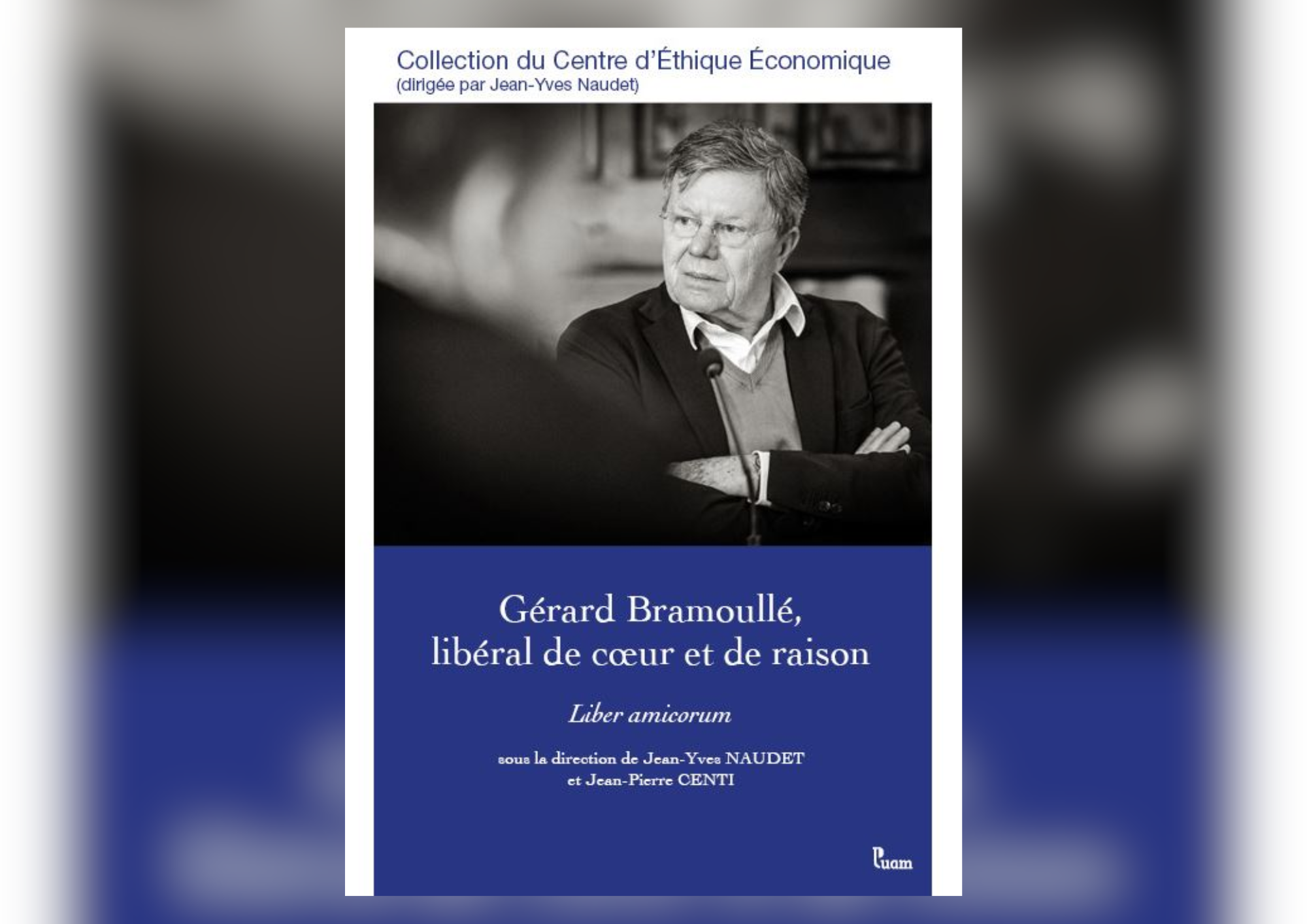
Gérard Bramoullé, libéral de cœur et de raison. Liber amicorum. Edited by Jean-Pierre Centi and Jean-Yves Naudet. Presses Universitaires d’Aix-Marseille, Collection du Centre d’Éthique Économique, 2026. ISBN 978-2-7314-1360-1.
Translator’s notes
“Liberal” is used throughout in its classical, European sense: a defender of individual liberty, property and free markets.
The quotations from Rueff and Lenin are translated from the French. The Keynes quotation is given in its original English wording; The Economic Consequences of the Peace was first published in December 1919 (the French text gives 1920, the date of the French edition).