
A reply to “Animal ‘Rights’,” in The Ethics of Liberty, and “Could Market Welfare Replace Animal Rights?” first published on our Spanish edition, SpeakLibre.
This short article sets out a refutation of the main arguments underpinning the libertarian theory of animals as items of property. To that end, it takes as its reference point for that theory the chapter on “Animal ‘Rights'” in Murray N. Rothbard’s The Ethics of Liberty. It also examines the soundness of the animals-as-property-rights model defended by Nicolás Sánchez Cominero in his article Could Market Welfare Replace Animal Rights?. For now, however, we will only pull up the intellectual weeds, with the aim of sowing coherent doubts about the traditional conception of animals in libertarian ethics. It will not be until future articles—for reasons of length and practicality—that we set out an ethics dialectically superior to the current one.
The Ethics of Liberty
Rothbard opens his chapter by shrewdly attacking a serious epistemological problem: can we, and should we, incorporate all animals into our society? As he rightly observes immediately after raising the dilemma, it is impossible for human survival to encompass every living being (bacteria and plants included) within our theory of rights, unless we intend to hasten our own extinction. There is, however, a simple answer to this: grant rights to those animals with which we collaborate, provided it is realistic to practise a system of negative rights with them—that is, provided they do not obstruct the course of our lives to the point of endangering human survival.
Rothbard does not, however, sustain this level of good sense throughout the chapter, for in his view animals are incapable of “reason, to make conscious choices, to transform their environment in order to prosper, or to collaborate consciously in society and the division of labor.” He even argues for granting rights to Martians if they possess these qualities: being conscious, rational, able to communicate with us and to participate in our division of labour—with the caveat that rights would not be extended to this hypothetical Martian model if it were in its nature to kill us in order to survive. That being so, the next four paragraphs are a thorough demonstration that, by Rothbard’s own criteria, many animals would have rights (he never put it that way, owing to his manifest ignorance of biology and zoology).
As for the supposed irrationality of animals, this is a myth. The intellectual difference is one of degree: animals are intelligent, just less so than humans. Moreover, they have demonstrated the capacity to form societies in which a given hierarchy or social order is respected (as among corvids, hyenas, primates, orcas, “eusocial” hymenopterans, and a long list besides) and, on the other hand, the capacity to take on obligations. If not, how are they able to urinate and defecate within the spaces marked out by their human owner? It hardly needs saying that they do not grasp these notions at a deep, abstract level, nor reflect critically upon them, but their faculties are more than sufficient for them to count as rational beings capable of observing basic rules of coexistence.
As regards animals’ alleged failure to contribute to the division of labour, this is disproved by symbiosis (mutualism, commensalism and parasitism—the last of these much replicated by politicians) with other species, humans included. Consider dogs that perform real professions: drug-detection dogs, rescue dogs, guide dogs for the blind. The purpose of these examples is not to equate animal intelligence with human intelligence, but to show that animals can adapt to society even with their limited intelligence, and can collaborate with humans to satisfy needs. In other words, that it is realistic and workable to live in hybrid societies of animals and humans.
It is likewise obvious that animals can “transform their environment in order to prosper.” Consider Penduline Tits, which build nests with false entrances to protect their eggs from snakes slithering along the branches: the snakes come upon empty chambers and see no eggs anywhere, even though the eggs lie right beside them, hidden behind a thin partition. And what of beavers, which build artificial ponds out of the trees they fell in order to store water? If the reader is not persuaded by these examples, perhaps leafcutter ants will prove more convincing: they cut tonnes of leaves to use as compost for a fungus that grows in their underground colonies and on which they feed. They even build ventilation systems with chimneys to regulate temperature and carbon dioxide. They are, literally, farmers.
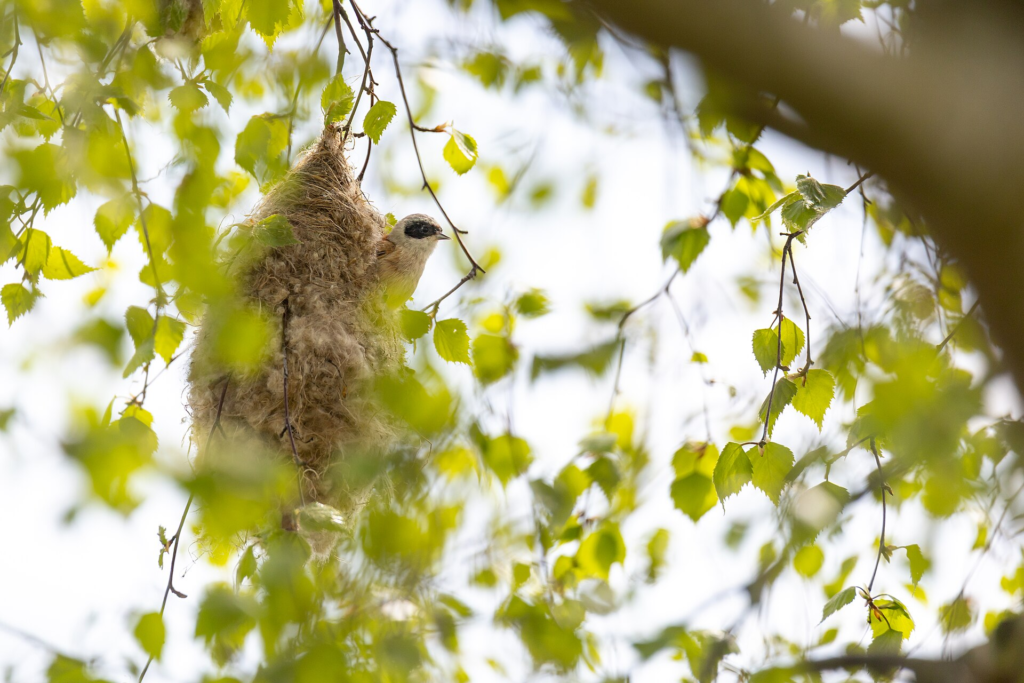
Penduline Tit sitting in the nest, which is attached to a birch tree.
Photo: Matthes Jacobs / Wikimedia Commons, CC BY-SA 4.0.
So easy to dismantle is the claim that animals cannot communicate—that is, cannot use abstract systems to interpret and exchange information. I will not dwell on bottlenose dolphins, competent at arithmetic and capable of recognising themselves in a mirror, but on sperm whales. These animals use clicks both for echolocation and to communicate with one another. The complexity of this communication is on a par with that of humans. Some even claim that “sperm whales have a language as sophisticated as that of humans“.
Rothbard goes on to assert that animals cannot make such claims on behalf of their “rights,” which explains why “they are clearly not equivalent to, and do not possess the rights of, human beings.” Before the reader points to babies as a counterexample, I also share this line from the same chapter: if it is objected that babies cannot do so either, the reply is that the day will come when they will—when they will be adult human persons—whereas animals will not. Rothbard nevertheless overlooks another segment of the population that does constitute an exception to his argument: people with cognitive impairments, who enjoy rights despite being unable to claim them.
Thus, if we push to its extreme the conclusion that animals lack rights because they are less intelligent, then people with cognitive impairments would have no rights either. This would imply the non-existence of the right against aggression and, therefore, that this category of subjects could be tortured or even killed without legal consequence. If, on the other hand, we accept that they receive rights through guardianship, then we are conceding that the conferral of rights does not depend on that supposed rational capacity for abstract thought. I also doubt, for that matter, that all humans understand the institution of law to the same depth. That is to say, intellectual differences operate even among those members for whom comprehension of law was taken for granted.
Rothbard then raises a biblical argument: that man has been given dominion over all the species of the earth. Yet the first Homo sapiens did not reign over the Earth, nor did they come close. It was through small conquests over time that the threat of dying at the hands of another animal was eradicated.
These advances, however, were not the work of every human being, and even today the credit does not rest on the superiority of the population as a whole. The achievement of dominating this planet must be attributed to those individuals of singular genius who developed effective inventions for subjugating other species (complex infrastructure, pharmaceuticals, weapons, advanced technology, and so on), not to the entire population. In other words, not only is it false that the human race innately outpaces all other animals; it is also the case that only a minuscule percentage of humans has managed to reverse our inferiority relative to other species.
If we were to set down any person or group of people at random in a wild region teeming with fierce animals (the African jungle, say), it would not take long to establish that this supposed dominion—so poetic, and so typical of the limited imagination of the arrogant Christian who ignores science—granted to man by the hand of God is rather more fictitious than real. Present-day proof that the human species does not hold dominion over all other species by divine grace can be found in the human tribes that survive today in certain underdeveloped regions and are not exempt from the danger of being killed by an animal predator.
To my surprise, Rothbard offers no further arguments in his chapter.
Could Market Welfare Replace Animal Rights?
Nicolás Sánchez Cominero writes that animals (or the natural spaces that house them) have an identifiable owner who has direct incentives to keep them healthy, safe and productive—note the emphasis on “productive.” He himself concedes that animals not used for the owner’s own benefit are excluded from better treatment (domestic animals, for example, with which we simply form affective bonds): the fact that an activity generates no profit, he acknowledges, does not guarantee better management or better conditions for the animals.
These claims also omit the bad practices and self-serving uses that do not align with animal welfare. Empirically, reducing a living being to a thing by legal means has always ended in social failure; take just Roman slaves or women subordinated to their husband’s will (in some Islamic countries, or in older Western societies). Likewise, the article suspiciously sidesteps the examples of intensive agriculture and livestock farming. In the former, natural habitats are destroyed; in the latter, animals are subjected to unbearable conditions.
It is worth recalling that a rational economic agent seeks to maximise gains and minimise costs, but when resources (space, time, veterinary care) come at the expense of animal welfare, the result is the all-too-familiar industrial livestock farm. In this way, property becomes a vehicle for institutionalising the torture of animals. This example does not suggest that farm animals ought to have rights, but that property rights do not guarantee their welfare.
There are also clandestine businesses in which an animal—usually an exotic one—is violently captured in order to be trafficked. Here the drive for enrichment leads a person to remove an animal from its natural habitat and sell it, perhaps for another profit-yielding activity that likewise brings no improvement in the animal’s situation.
Later in the article, Nicolás advances the following argument: that a recent survey found that 64% of Spanish consumers consider animal welfare very or extremely important when making a purchase, and that 71% state they are more likely to choose a product with third-party animal-welfare certification.
But what people think or consider is irrelevant if they act contrary to their beliefs, and this shows up in a far higher consumption of meat without the certifications in question. If we ran a survey on the desire to end world poverty, everyone would declare themselves in solidarity. And yet almost nobody lavishes their wealth on the beggars in the streets and on public transport—least of all when there is nothing to spare.
It is further suggested that if consumers value animal welfare, the market will supply products matching that benign desire; but human action reveals that we are highly price-sensitive and that declared intentions rarely coincide with demonstrated ones. In short, talk is cheap—especially when the talk is about virtue.
He then offers the example of zoos: a historical case, he notes, is how private zoological societies in the nineteenth century helped conserve exotic species by creating zoos and parks that are today centres of research and captive breeding. While what he says is true, it is worth pointing out some of this system’s defects.
Removing an animal from its natural habitat has serious effects on its capacity for ecological reintroduction. Moreover, many animal species suffer in the captivity of a zoo because of their migratory nature: birds and cetaceans, for example. Primates, in addition, endure a great deal of stress in confinement (let us recall that humans are primates too, and that empathy comes easily after the episode of COVID-19).
As the icing on the cake, Nicolás offers the following argument: that in the wild, animals are exposed to predators, disease, hunger and extreme weather, whereas in a zoo they are assured food, veterinary care and protection from danger—which, he argues, already amounts to a substantial improvement in their physical welfare, even in an artificial environment.
Very well, then: let us put every individual in society inside an airtight box fitted with an automatic food dispenser, to protect them from external danger and guarantee their supply of food (note the irony). To argue that an animal in a zoo is better off than in nature because nature contains predators and disease is to renounce our freedom, in Hobbesian fashion, in exchange for greater security. This argument justifies, for instance, the State stripping parents of their children in order to offer them “better conditions”; after all, the State will never run short of arguments for why it can grant the minor greater security. It also subordinates liberty entirely to “welfare” (which welfare: emotional? material?). And what, moreover, of the will? This looks almost like a communist argument. Liberty, free will, must and should be the ethical priority for every libertarian.
If, then, property rights applied to animals are defective, what is the solution? For now, we will leave the reader in suspense. He may, however, provisionally adopt the thesis that animals, like children, are living beings with minimal rights who depend on a guardian or owner. Here there are no proprietors and no inert goods, but rather a person who oversees the animal’s proper adaptation to society and respects its right against aggression (they may not inflict harm on it, cause it undue suffering, or kill it). Even so, I suspect this theory remains insufficient. Insufficient, but substantially better. If there is one edifying thing the reader can take from this short piece, it is this: animals are not objects. Some of them are our companions.