This article is the first part of Nicolás Sánchez’s reply to Matías Margallo, in defence of a social order without animal rights.
A few weeks ago, Matías Margallo published his article Why Animals Are Not Property, in which he raises several criticisms both of my position — a defence of the market as a protector of animals — and of Rothbard’s — a moral critique of animal rights — set out in The Ethics of Liberty. In this first part, I will begin by answering his objections to Rothbard’s reasoning, since Rothbard’s work devotes only a few pages to the animal question, and his claims can therefore easily be misread when taken in isolation.
Rothbard’s Moral Critique of Animal Rights
Rothbard’s argument is essentially that animals should not have rights, but this does not imply that animals cannot matter morally to human beings; the point is that not every moral consideration amounts to a right. One may hold that cruelty to animals is morally objectionable, that a community may establish private animal-protection norms restricting how humans treat them, or that an animal’s owner has duties arising from property, contracts, or communal rules. But none of that yet shows that the animal is a bearer of negative rights in the strict sense.
Negative Rights for Animals
The first problem arises with the claim that it would suffice to grant rights to those animals with which we cooperate, provided it is realistic to practice with them a system of negative rights that does not endanger human survival. At first glance this solution seems reasonable, but it conflates several distinct questions.
In the first place, negative rights do not consist in extending protection to those who are useful, close, or cooperative toward us. Negative rights are demands of non-interference derived from a general rule: no one may initiate aggression against the person or the property of another. Their structure does not depend on sympathy, on utility, or on cooperation, but on the possibility of establishing a legal norm that is general, abstract, predictable, and reciprocal among subjects.
Legal norms should aspire to be general, abstract, predictable, and symmetrical. Generality prevents rules from being designed for particular cases; abstraction allows them to be applied to new situations; predictability yields probable outcomes that avoid legal uncertainty; and symmetry prevents one party from being subjected to obligations that the other could never acknowledge or respect.
Rights are entitlements enforceable against third parties. If someone holds a right against another, that other bears a correlative duty. In the case of negative rights, that duty does not consist in handing something over, but in refraining from interference: not killing, not injuring, not stealing, not trespassing, not enslaving, not attacking. The central question, therefore, is not whether we like animals, whether they suffer, whether they can cooperate with us, or whether they deserve some kind of moral consideration. The question is whether a system of negative rights in the legal sense can be established with them. Following this basic legal theory, Rothbard explains that it is not enough for us to decide not to aggress against them; there would also have to exist a minimally reciprocal structure of duties running from them toward us.
A dog cannot recognise my property, cannot assume a legal obligation of non-aggression, cannot answer before a court for trespassing on an estate, cannot enter into contracts, cannot make restitution for damages according to an abstract rule, and cannot grasp that the very principle protecting him also limits his own conduct toward others. He can be domesticated, trained, or controlled by his owner, but that is not the same as forming part of a reciprocal legal order. To compare any of these duties and obligations — which are what animals would actually be required to understand within a society — with a dog knowing where it is supposed to urinate is absurd.
The Capacities of Animals
It is true that some animals possess intelligence, but the difference in degree from humans is absolutely enormous. Animal behaviour (following patterns on the basis of human approval or disapproval) cannot be compared with the legal conduct demanded of human beings. Moreover, granting negative rights to the animals with which we cooperate is problematic. If the criterion is cooperation, then we are not properly speaking of negative rights, but of selective protection based on our own valuation of the animal. The animal does not appear as an equivalent legal subject, but as the object of a human policy of protection.
The same applies to the supposed social contribution of animals to the division of labour. That a dog can be used as a guide, a drug detector, a rescue animal, or a helper in certain tasks does not mean that it participates autonomously in the division of labour as a legal subject. It means that human beings have discovered a useful capacity in that animal, trained it, and integrated it into their own ends. We are the ones who put them to social use, who design the function, who assume the responsibility, and who insert them into a human structure of cooperation. Otherwise, the same reasoning would have to be extended to any tool that expands our capacities: a tractor contributes to agricultural production, a drone can assist in a rescue, and a metal detector helps find objects, yet no one would say that they participate legally in the division of labour. Usefulness does not turn a being — much less an instrument — into a bearer of rights.
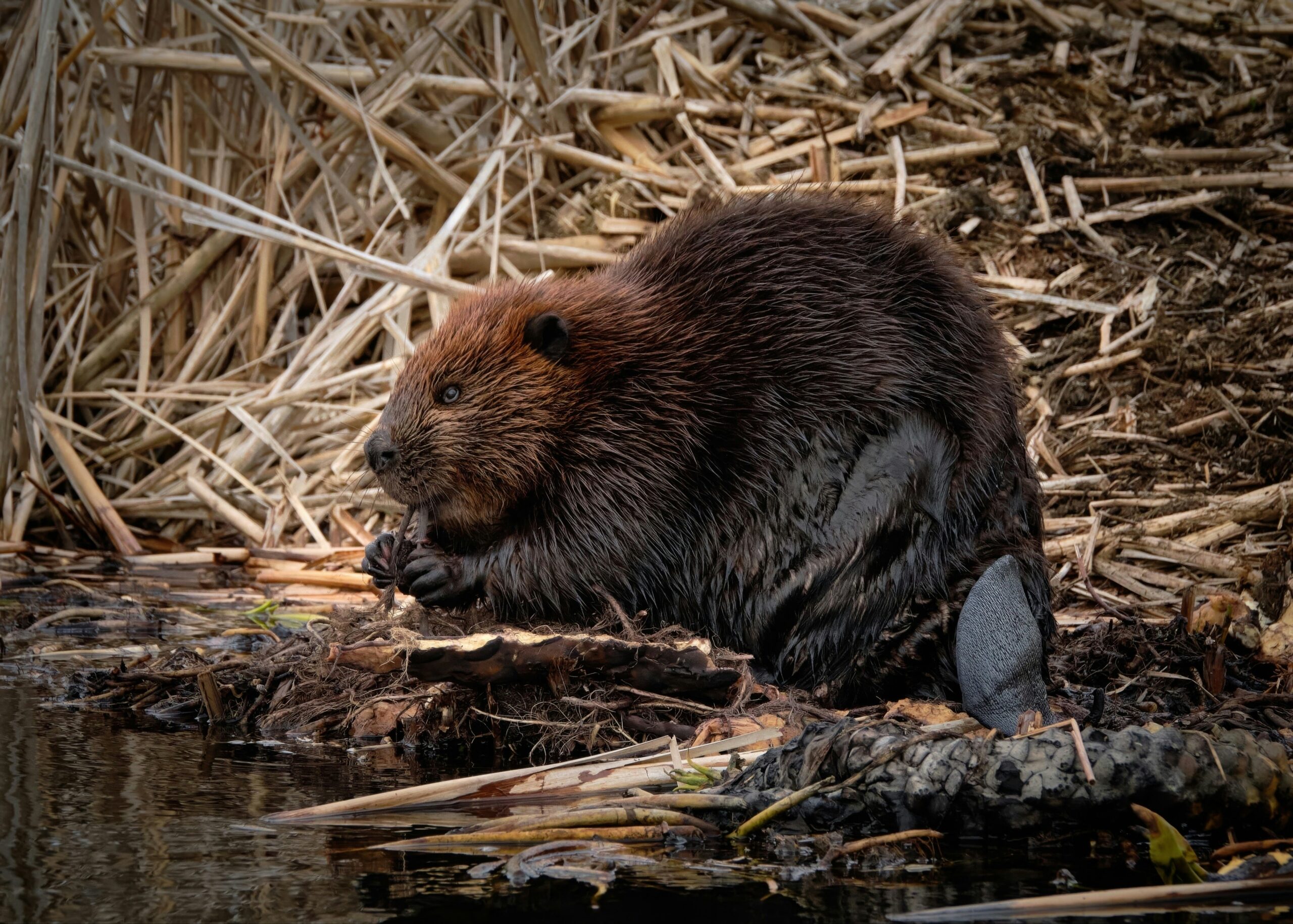
Pointing out that some animals transform their environment is not a particularly strong argument for their rights either. It is true that beavers build dams, ants farm fungi, and many birds construct complex nests. But this does not show that they are bearers of rights. In reality, every living thing alters its environment in its own favour in one way or another: animals, plants, bacteria, and fungi compete for resources, occupy space, modify ecosystems, and displace other organisms. If transforming the environment were enough to warrant rights, we would have to start speaking of the rights of trees, of reefs, or of bacteria. The question, therefore, is not whether a living being modifies the world, but whether it can be integrated into a reciprocal legal order. A beaver can alter a river, but it cannot legally acquire riparian land, agree to a water easement, answer to third parties for damages, or claim before an arbitrator that its dam has been invaded. Its activity may be complex from a biological standpoint, but it still belongs to the plane of natural adaptation, not to the plane of law.
The same holds for animal communication. That sperm whales, dolphins, primates, or bees use complex signals does not mean that they can demand rights. Nature contains countless forms of communication: signals for mating, alarm, cooperation, threat, hunting, or defence. But conveying information is not the same as formulating a legal claim. Rothbard does not necessarily deny that animals can communicate among themselves; what matters is that they cannot request, justify, uphold, and respect rights within a shared system of rules.
This is why the example of infants or of people with severe cognitive impairments does not destroy the Rothbardian thesis either. In infants, there is an ordinary biological trajectory toward full legal capacity. And in people with severe disabilities there is membership in the legal community, because one can never rule out the possibility that they might at some point rejoin normal social life. In both cases, the legal order provides for their protection through representation and guardianship by responsible third parties, until infants attain full legal capacity or people with cognitive impairments manage to overcome them.
With animals, by contrast, there is today no realistic path toward that threshold. It is more plausible that a person with a currently incurable illness will recover their faculties thanks to medical progress than that we should imagine a fly signing a contractual agreement over its excrement, or a wolf answering in law for killing a sheep. The point is not to ridicule the animal, but to expose the category error: having intelligence, sensibility, or signalling systems is one thing; being a subject of legal imputation is quite another.
In the biological world, there is cooperation, competition, symbiosis, and predation, but no respect for rights. A wolf that kills a sheep commits no crime; it acts according to its nature. What is legally relevant, if that sheep and that wolf belong to someone, will be to determine responsibilities among humans: whether the owner was negligent, what the insurance covered, what obligations existed in the custody contract, or who was supposed to protect the flock. Effective protection is achieved by assigning titles and duties to those who can answer for them, not by projecting rights onto beings that can neither claim them nor bear their correlative burdens.
Even so, I do think Rothbard is not entirely right about the conditions animals would have to meet in order to be legal subjects. I do not believe that granting them rights should require them to be capable of contributing to the division of labour or of transforming the environment: in the first case because not all humans do so and are nonetheless part of the system of norms, and in the second because, as explained, every living being transforms the environment in its favour in one way or another. In any case, the fact that Rothbard may be mistaken on these two postulates does not mean that his mere refusal is a sufficient condition for granting rights to animals; animals cannot have rights, but for other reasons. The minimum threshold for law to exist demands a certain functionality, and this translates into the fundamental quality required to be a legal subject: the operative understanding of rules. It is true that not all human beings meet this condition (as explained in the case of infants or of people with severe dysfunctions), but a guardian can be given the capacity to supply that quality on behalf of a subject who lacks it. An animal never has a reasonable expectation of coming to satisfy the operative understanding of rules, which is why guardianship makes no sense in its case. Moreover, some animals would be placed under guardianship while others exactly like them would not, because they would be living free in nature, surviving on their own. Humans who receive guardianship normally do so because they are incapable of living without it; animals, by contrast, ordinarily live without it.
Human Dominion
Rothbard makes a reference to human dominion over other species, but this should not be read as a theological argument, but as a functional observation: the human species, through intelligence, language, capital accumulation, technology, and the division of labour, has managed to place itself in a position of practical superiority over the rest of the animals. That the first humans did not immediately dominate the planet refutes nothing; on the contrary, it confirms the point. Human dominion is the historical result of our capacity to learn, transmit knowledge, make tools, cooperate on a large scale, and accumulate improvements generation after generation. All species aim to modify the environment in their favour, and human beings are the best at doing exactly that.
Nor does it make sense to say that, because not every human has invented weapons, medicines, or infrastructure, the human species is therefore not superior. No isolated individual contains the whole of civilisation by himself, but that is precisely the human advantage: taking part in a network of cooperation and accumulated knowledge that no animal has managed to build. A man abandoned in the jungle may die attacked by a predator, just as an isolated lion may die from an infection that any modern human cures with antibiotics. The point is not to compare naked individuals under artificial conditions, but species in their real capacity to transform the environment, cooperate, transmit knowledge, and reduce natural threats. On that plane, human functional superiority is evident.
Law Is Not Speciesist
In the liberal position proposed by Rothbard, rights are not denied to animals out of mere speciesism. He does not say: “humans have rights because they are human, and animals do not because they are animals.” The criterion is not biological but functional and legal. If an artificial intelligence, an extraterrestrial species, or even an animal modified through some kind of future implant were to come to understand abstract rules, claim rights, assume obligations, respect the property of others, and answer to a shared system of norms, then it would have to be recognised as a legal subject. Not for belonging to a particular species, but for meeting the conditions that make law possible.
I am confident that, framed this way, Rothbard would have no objection to admitting any entity truly capable of participating in a reciprocal legal order. What he rejects is not that a non-human being could have rights by definition, but that present-day animals should have them without being able to understand them, claim them, respect them, or assume the correlative duties that every right entails. Therefore, so long as that capacity does not exist, animals may and should be objects of moral consideration and institutional protection, but not bearers of negative rights in the strict sense.
Rights are rational, legal, and human constructs that serve to order coexistence among subjects capable of taking part, at least minimally, in a system of reciprocal rules. Animals cannot have rights because they cannot participate in a system of norms they do not understand.