Populism and violence thrive when liberty starts being treated as a luxury
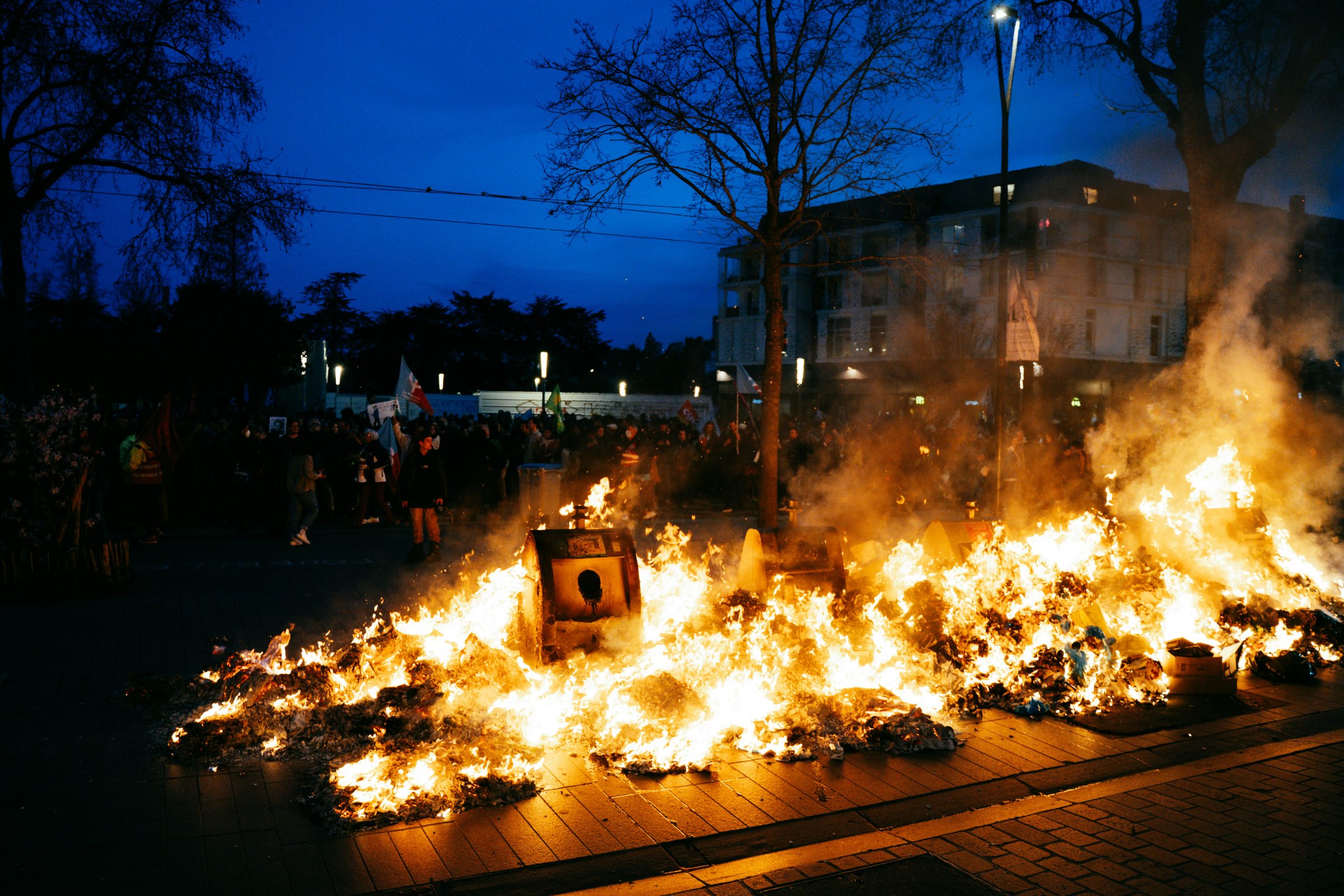
In early October, students across France took to the streets to voice legitimate concerns about school conditions, with some demonstrations turning violent. While students at the prestigious Lycée Henri IV in Paris built barricades out of dumpsters, clashes with police broke out at other high schools. Seeing unrest at such an elite school was surprising, but the broader violence had a familiar quality: much like clashes after soccer matches or during other protests, such incidents often make headlines, only to slip from public attention a few days later.
This time, however, the fallout was substantial: according to the Interior Ministry, arsonists attacked a police station, a school was ransacked, and a student covered a teacher in oil. In less than a week, the protests have already caused an estimated €30 million in damage.
How did dissatisfaction become permission to use violence?
Overcrowded classrooms can explain anger, but they don’t make an attack inevitable. Most frustrated people never turn violent. Somewhere between grievance and aggression, another line must have been crossed: the point at which force begins to seem justified, or even necessary, though it’s not.
We can’t assign a single motive to everyone involved, and some demonstrators might even not have a clear one in mind, but the violence should make us look closely at the political language around it. When institutions are no longer seen as legitimate and opponents are viewed as threats, what room is left for restraint and debate? If losing means chaos, compromise starts to look like betrayal.
France’s Jacobin tradition gives this temptation unusually fertile ground. In a country where politics shapes too much of a person’s life: from education to working life to pensions, elections take on the emotional stakes of a battle for survival. The political opponent stops being just someone with different opinions and becomes someone who must never be allowed to govern. In this kind of tribal climate, classical liberalism, with its instinctive preference for discussion, debate and competition over force, can seem outdated.
About a century ago, Carl Schmitt gave this logic its most concise form: to him, the essence of politics was the distinction between the friend and the enemy. He criticised classical liberalism for believing that discussion and competition could avoid conflicts that, in the end, demanded a strong and clear decision. In his view, the sovereign’s role wasn’t to respect the rule of law, or the institutional order, but to decide on the exception: to determine when ordinary rules no longer applied.
Together, these ideas form a dangerous mix. If an enemy threatens our existence, limits on power start to look irresponsible, and those who defend them can themselves come under suspicion. Schmitt’s later support for Nazism gives that temptation a historical weight that should not be dismissed as a mere intellectual provocation.
This doesn’t make every violent protester a disciple of Schmitt, but it points to a visible trend: once a struggle is declared existential, almost any means can be presented as necessary. The attacker will claim to be resisting, and the advocate of repression will claim that he’s restoring order. Each side can say that the emergency leaves no alternative, and that one must “pick a side”.
Governments around the world face their own version of this temptation. 9/11, the 2008 financial crisis, and the pandemic have all prompted extraordinary measures. These were very real crises, yet they confronted citizens again and again with a too familiar argument: “let’s deal with the danger first, it’s a matter of survival, then we’ll return to normal”. Their spectre over contemporary politics has instilled in people the belief that liberty is a luxury we can no longer afford.
2027 Election
In France, the stakes are about to rise. As the 2027 presidential election is approaching, Marine Le Pen and Jean-Luc Mélenchon are both polling very high, particularly among young voters. Their programs differ, but they share a message: the system is rigged. Neither offers a serious answer to France’s economic problems. Instead, they lean on magical thinking: Mélenchon has flirted with the idea of simply erasing the roughly 18% of French public debt held by the central bank, while Le Pen wants big market interventions, like lowering the retirement age to 60 for some and undoing the pension reforms, claiming she can fund these promises through “protectionist” policies and vague administrative cuts, in a country whose public debt is already around 119% of GDP.
For many young people, however, anger seems to matter more than cold arithmetic, and this anger does not necessarily come from things getting worse. In The Old Regime and the Revolution, Alexis de Tocqueville observed that societies often revolted not when conditions were at their worst, but when they started to improve. Progress raises expectations faster than reality can meet them, and then the problems that remain become much harder to bear.
Today’s young people illustrate the point: they have access to technologies that would have seemed like science fiction a few years ago. With AI tools, one person can write software, design a product or launch a business that once required a whole team. There may never have been a better time in history to start a business. Yet this same generation looks at a rigid job market, heavy taxes and slow institutions, and concludes that the system is holding it back. On that count, they’re not wrong. But the more possibilities open up, the more the obstacles stand out.
Tocqueville also described a quieter danger: a protective state that gradually relieves citizens of the habit of managing their own lives. Paradoxically, the more people resent the state’s failures, the more convinced they become that only a stronger state can fix them.
That paradox could explain a curious trend on social media: “Chinamaxxing”. Much of it is a harmless mix of humour, travel videos and strange TikTok-inspired lifestyle tips, but at a deeper level it also reflects a growing wish for an alternative to Western institutions that seem to have stopped delivering. Images of high-speed trains and futuristic cities answer the feeling that our own countries are no longer capable of building anything, and are stuck in endless political debates.
The problem is the conclusion some draw from these images: that unchecked power explains China’s achievements, and that copying that would bring about the same results. A working railway is easy to film. The cost of silencing criticism isn’t. An honest comparison must ask what happens when a system’s leaders are plain wrong. For classical liberals, efficiency isn’t an end in itself: a government that’s efficient in its most benevolent functions may very well be just as efficient at its most malevolent.
Ultimately, the barricades outside French Lycées will be cleared away, but the question they raise won’t. If young people are told that politics is a war, they’ll look for a general. If they’re told that the state is the only way out, they’ll ask for a stronger one.
Classical liberalism has a different answer. It doesn’t ask citizens to pick a side: it asks them to keep the rules that protect everyone, including their opponents, and to keep the power of any government limited, whoever holds it. It also offers what this generation wants, and what technology now makes easier than ever: the freedom to start something, to build, to ship and to grow. What’s missing is the confidence to defend liberty as the solution, not as a luxury we can no longer afford. Freedom can’t wait for quieter times!