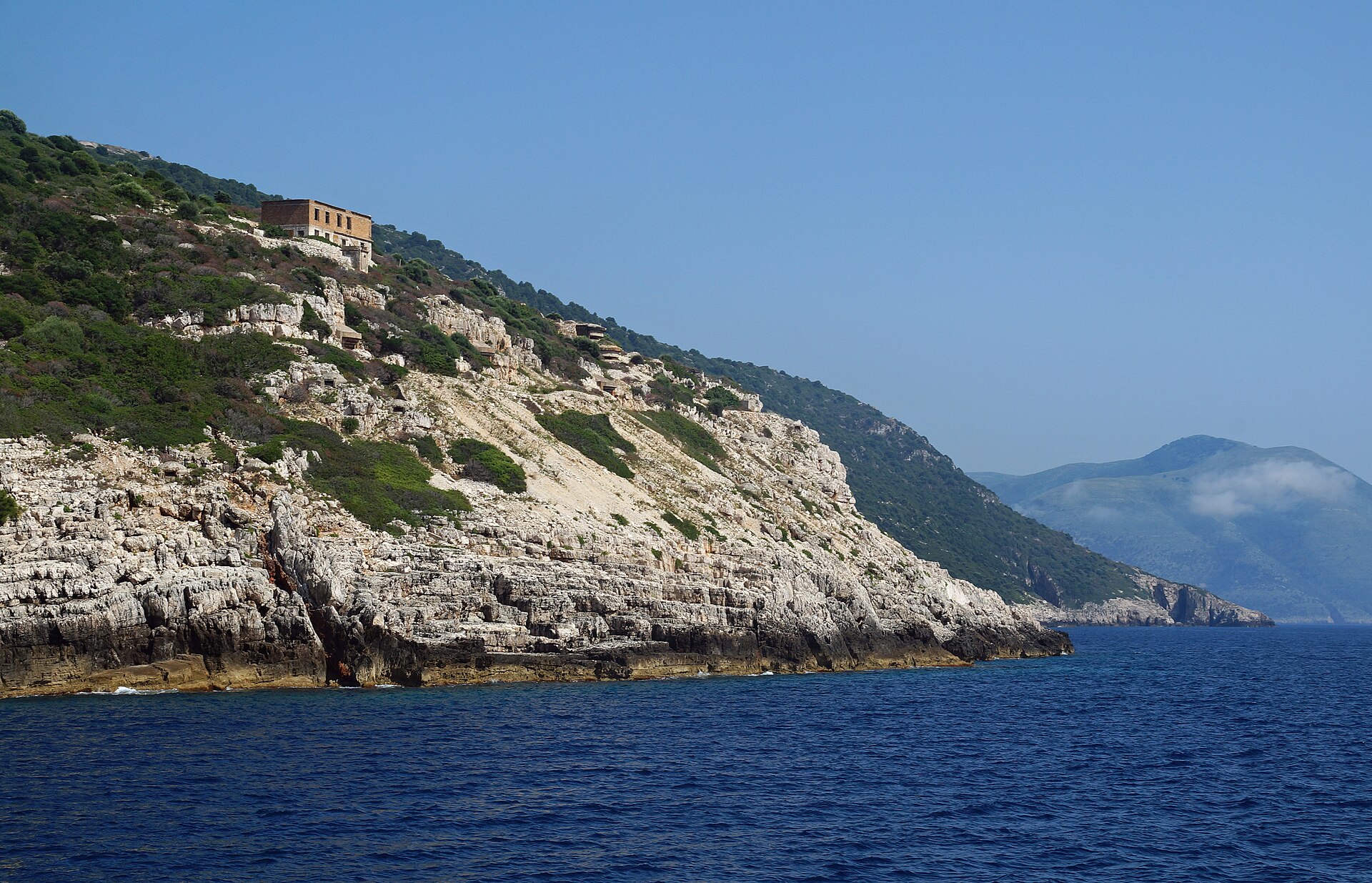
For many visiting Albania, the first things that come to mind are its stunning beaches, crystal-clear waters, pristine coastline, and breathtaking landscapes. Few people would ever imagine that this country, now one of Europe’s fastest-growing tourist destinations, was once one of the most militarised and isolated places on Earth. Guarding its coastline and nation was an island located where the Adriatic Sea meets the Ionian Sea.
That island is Sazan, Albania’s largest island and the greatest symbol of the country’s Cold War paranoia. Located just 5 kilometres from the Albanian mainland and 16 kilometers from Albania’s fourth-largest city, Vlora – City of Independence, Sazan occupies one of the most strategic locations in the Adriatic.
For decades, Sazan Island was a top-secret military stronghold, completely closed to civilians. It was heavily fortified with hundreds of bunkers, underground tunnels, military installations, and chemical warfare defence facilities, all built to withstand an invasion that never came.
Today, this very same island has become the center of a completely different story. It is the island that the Trump family has proposed developing in partnership with the Albanian government, a project that became one of the issues fueling the Flamingo Revolution protests across the country. During the Cold War, the island was home to hundreds of military personnel and their families. It had a hospital, a school, a cinema, shops, and all the necessities of everyday life. Yet everything on the island revolved around a single purpose: preparing for the “Great Invasion” that everyone believed was inevitable.
Under the dictatorship of Enver Hoxha, Albania became one of the most isolated countries in the world. Obsessed with defending socialism, the regime launched a policy known as “bunkerization,” constructing more than 170,000 bunkers across the country. Sazan Island became the crown jewel of this massive military project and one of the clearest symbols of the paranoia that dominated Albania for more than 45 years.
The people who lived in Sazan, like thousands across Albania, were raised in a climate of constant fear. They spent decades preparing for enemies who never arrived. It is a reality remarkably similar to the one described by Dino Buzzati’s novel “The Tartar Steppe”, an entire nation waiting for an invasion that would never come.
When communism collapsed in the early 1990s, so did the fear that had defined life on the island. The military families left, and Sazan gradually transformed into a ghost town. Today, walking through the abandoned settlement feels like stepping back in time. Empty homes, forgotten furniture, abandoned books, military infrastructure, and decaying buildings remain almost untouched, preserving a unique snapshot of life under one of Europe’s most isolated communist regimes.
Ironically, Sazan has once again become the focus of political debate. The Albanian government, led by Socialist Prime Minister Edi Rama, together with opposition leader and former Prime Minister and President Sali Berisha, supported legal changes that made it easier for Jared Kushner’s investment company, backed by the Trump family, to develop a luxury resort on the island.
The contrast is striking. The very island that was once consumed by fear, paranoia, and military preparedness may soon become an exclusive tourist destination for the world’s wealthy. Sazan tells a much deeper story than most visitors realise. It is a reminder of how destructive centralised planning can be. For decades, enormous resources were diverted away from productive economic activity and
peaceful exchange to prepare for a fictional war that never happened.
Today, the island raises a different question: should governments decide who gets access to valuable
public land based on political connections and influence? Few places capture Albania’s modern history as powerfully as Sazan Island. Its abandoned villages, underground tunnels, endless bunkers, and decaying naval port tell a story that goes far beyond tourism. It is a place where history, politics, and ideology collide; a destination well worth visiting while it still remains a monument to Albania’s past, before it is transformed into something entirely different.
Contribution by: Pëllumb Tusuni, Social Media Coordinator for SFL Albania
Pëllumb holds a BSc in Business and an MA in Media Studies. His main interests include philosophy, economics, history, and culture.
LinkedIn: https://www.linkedin.com/in/pëllumb-tusuni-799a4a24b
Substack: https://columbaenotebook.substack.com
Photo: Albinfo, via Wikimedia Commons, licensed under CC BY 4.0. (commons.wikimedia.org)
Send us your own forgotten place where the history of liberty can still be found. And explore more in the map below: