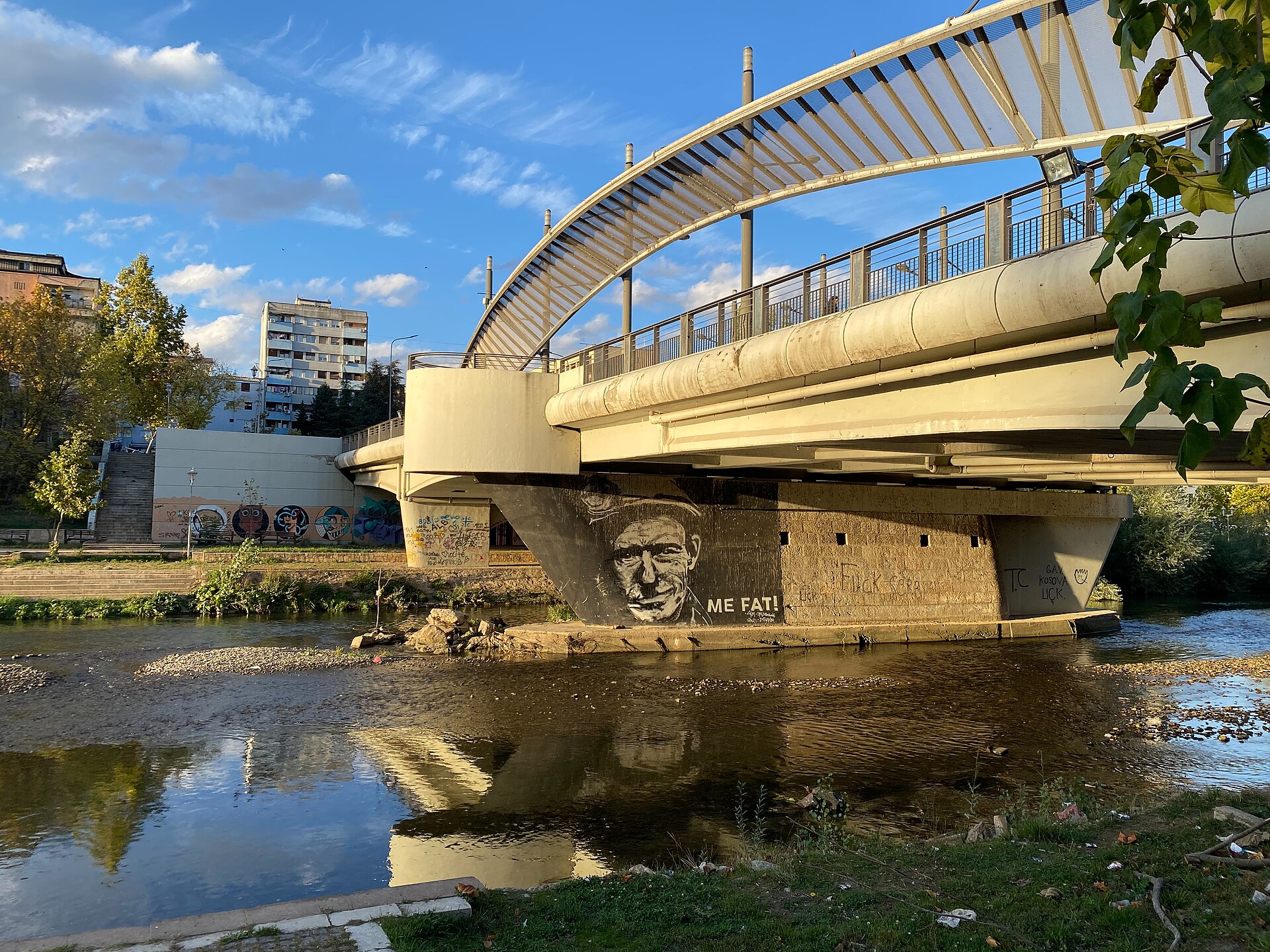
The bridge over the Ibar River is not like other bridges. Usually, bridges are built to connect people, facilitate movement, and create spaces where life unfolds. In Mitrovica, however, the bridge over the Ibar has become a symbol of division. It physically connects the two parts of the city, but for decades it has also symbolized the boundary between two communities and has remained a sensitive security point, monitored by international forces.
While I was working at the Food and Veterinary Agency in Mitrovica, I decided to go to the bridge to see it up close. Some children told me, “Don’t go, you might be killed.” Those words immediately brought back memories of my childhood during the war and made me realize that even generations who did not experience the war continue to live under its shadow.
However, this bridge tells more than the story of conflict. It also tells the story of a city that was once one of the most important industrial centers in the Balkans. For decades, Mitrovica developed around the Trepça mine, where thousands of people worked regardless of ethnicity. Economic cooperation was part of everyday life, and the city attracted workers, traders, and investment from across the region.
The wars in the Balkans, and especially the war in Kosovo, fundamentally changed this reality. The Ibar Bridge transformed from a physical connection into a symbolic border, while both the economy and trust between communities weakened. Trepça, once the economic engine of the city, also lost the role it had held for decades.
For this reason, the Ibar Bridge is an important place for anyone who wants to understand how political conflicts affect everyday life. It shows that restrictions on movement, the weakening of economic cooperation, and the loss of trust between people are not only consequences of war, but also of divisions that continue to exist long after it ends. However, Mitrovica has not remained frozen in the past. Sport, music, civic organizations, and cultural initiatives continue to create spaces where people meet and cooperate.
The Ibar Bridge, the Trepça complex, the Isa Boletini Museum, the monumental letters of the Kosovo Liberation Army (KLA), photographs, and memorials scattered throughout the city are all part of a memory that cannot be avoided. Each place tells a part of Mitrovica’s history. A visitor coming to Mitrovica should walk on both sides of the bridge to understand the city as a whole.
The bridge that once connected the city now carries the memory of division; the presence of KFOR soldiers still maintains a sense of both security and tension; the Trepça complex reflects the industrial past and economic cooperation without ethnic distinction; the artificial reservoir in Mitrovica serves as a recreational space and brings life to the urban environment; while the Isa Boletini Museum, the monumental KLA letters, and city memorials keep historical memory alive.
Only by passing through these places does Mitrovica appear not as a single image, but as a city of many layers, where the past, conflict, and efforts toward coexistence exist simultaneously.
Mitrovica also has a distinctive tradition of jazz music, which continues to be part of the city’s cultural identity. In recent years, concerts and musical events have brought people together in public spaces, creating moments where music replaces the silence of conflict. For a brief moment, the bridge is no longer a symbol of division, and the city remembers that culture can build bridges that politics cannot.
7Arte, a cultural association based in the center of Mitrovica, plays an important role in the city’s cultural life. It is also the main organiser of the Green Fest, an annual summer festival usually held in August. The festival brings together music, art, and environmental awareness, and features a variety of live performances, including jazz music. Through these events, jazz has become part of Mitrovica’s contemporary cultural identity, creating moments where people come together beyond social and political divisions. At 7Arte, I experienced what it truly means to be from Mitrovica: a culture determined to live and survive within a quiet yet familiar chaos. In this city, both the bridge and places share the same truth—that resilience remains their strongest form of resistance.
However, as a woman from Mitrovica, I often want to enjoy these achievements and leave the past behind. But the continued presence of KFOR soldiers near the bridge reminds me that history has not fully disappeared. Sometimes I ask myself: what if something happens? If not today, then tomorrow? These are questions many residents of this city ask themselves in silence.
To live here means to stand facing the past while trying to keep your eyes on the future. This is the strength that we, the people of Mitrovica, must find every day in order to move forward. This is a city that has seen so much, lost so much, and still speaks a language that very few fully understand.
A city is not destroyed when politics withdraws from it. A city begins to decline when its citizens abandon it. For us, as residents, this constant sense of vigilance has become as natural as the air we breathe. On one side, you hear the sounds of cafés; on the other, people continue their everyday rhythm. Yet the presence of KFOR and the memory of tensions give the bridge an atmosphere unlike any other. Below it, the Ibar River flows quietly, indifferent to the histories that have passed over it. It continues its course, while people still try to rebuild bridges of trust.
“The bridge over the Ibar River today unites the city… its blue light reflecting on both sides.”
Contribution by: Ferdane Azemi
Picture: “Ibar Bridge in Mitrovica, Kosovo” by GentiBehramaj, via Wikimedia Commons, licensed under CC BY-SA 4.0.
Send us your own forgotten place where the history of liberty can still be found. And explore more in the map below: