After 4 years in power, the reign of the Mises Caucus at the helm of the Libertarian Party is at last over. On the 4th day of the Libertarian National Convention in Grand Rapids, Michigan, the old guard has lost the last remnants of its power in the Libertarian National Committee.
As one of the new delegates we talked to recounts:
“My experience from talking to people, it seems like mostly the delegates were looking for leaders who are going to be more mature and grown up and more respectable than previous leadership. My read of the situation is that a lot of the leadership was not taken seriously. We’ve got to actually get things on track again because the party’s been a mess for years.”
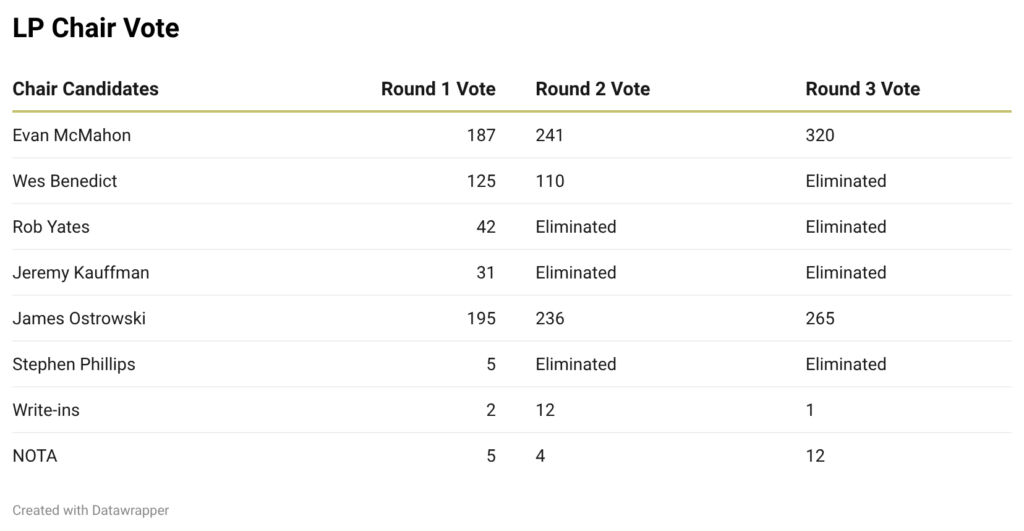
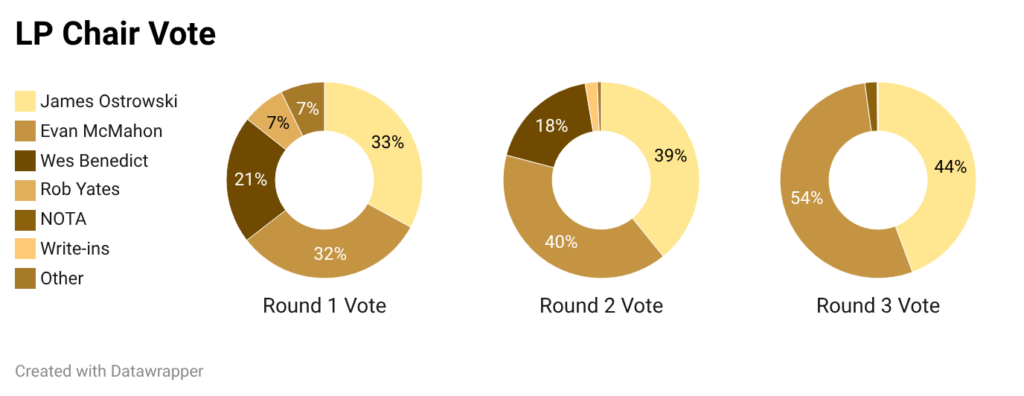
The new chair, Evan McMahon, was widely seen as a unity candidate for members exhausted by Mises Caucus rule. Much of his appeal came from his tenure as chair of the Libertarian Party of Indiana, where the party ran record-setting Donald Rainwater’s gubernatorial campaigns. McMahon campaigned on a promise to return the party to principled libertarian messaging while rebuilding engagement with the next generation of members.
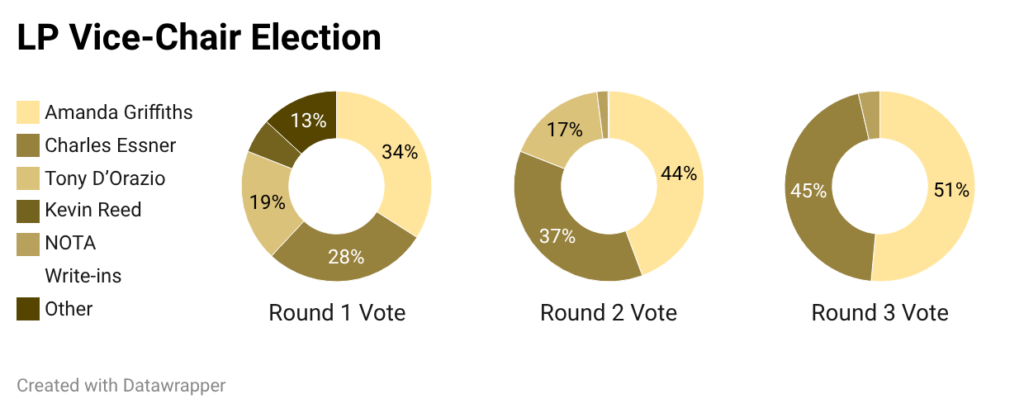
Similarly, the LP’s new vice chair is Amanda Griffiths, an anti-Mises Caucus candidate from Wisconsin. Griffiths has been a vocal critic of former LP Chair Angela McArdle’s “kingmaker” strategy, under which Libertarian candidates would drop out of major races in exchange for policy concessions from Republican candidates. She is closely involved with the LP Alliance network and previously served as editorial director of the Cato Institute’s Center for Monetary and Financial Alternatives. She has also been a Young Voices contributor, publishing in major outlets on tariffs, trade unions, and monetary policy.
On the convention floor, the mood among delegates seemed not triumphant but cautiously hopeful. One Michigan delegate we spoke to described it as “cautious optimism,” rooted not in any expectation that the Libertarian Party will suddenly become a national force, but in the belief that the party may be able to rebuild from the ground up.
“The point of the Libertarian Party in the United States is never really to win nationally,” the delegate said. “At least in my view, it’s always been about marketing — getting these ideas out there because you’re running candidates. Maybe you can get some local victories.”
The delegate pointed to the party’s new leadership as a reason for guarded optimism, especially its apparent focus on recruiting and electing candidates at the municipal level.
“I think the new leadership is actually pushing really hard to get local candidates on the ballot and elected at the city level, which I think is awesome,” the LP member said. “We could have a really good couple of years of getting a decent number of local candidates elected, because many of those races are nonpartisan. If they’re not aligned with a party, that’s helpful.”
Still, the optimism was limited. The party remains divided into caucuses and factions, with some delegates far more hopeful than others. Few appeared to expect a major national breakthrough anytime soon.
“You could call that pessimistic,” the delegate underlined. “But if you’re looking at it from the marketing side, it’s about getting the ideas out there and getting people talking about them.”
He also pointed out that the broader political chaos in the United States may create an opening. As the Michigan delegate put it, “The worse things get in our country, the more chaos there is, hopefully the more people become tired of it all.”
The End of LPNH?
One of the first decisions of the newly elected LNC has been the disaffiliation of the Libertarian Party of New Hampshire, led by Jeremy Kauffman, that has for a long time been spreading controversy through provocative rhetoric and actions often cited as incompatible with the national party’s platform and bylaws. Under its current leadership, the LPNH has devolved into a toxic stain that tarnished the reputation of libertarians nationwide (and even beyond America). This includes official social media posts promoting antisemitic conspiracy tropes, the endorsement of Donald Trump over the Libertarian presidential nominee, homophobic attacks on party members, and Kauffman’s own pattern of inflammatory conduct, including his recent arrest after an altercation in which he reportedly shouted racist slurs.
We asked the Michigan delegate about the mood among delegates toward the Libertarian Party of New Hampshire.
“I’d like to say everybody hates them because they’re Nazis, but I don’t know. Based on the people I’ve been talking to, most delegates don’t take them seriously — hopefully because they are literally actual white supremacists. [regarding disaffiliation] I was super excited when I heard that. Unfortunately, now there’s going to be a big lawsuit over it, which is exactly the kind of drama serious people are trying to avoid. The LP just keeps suing itself. Members keep suing each other. It’s become a whole thing. If you already come into politics hating politicians, the Libertarian Party doesn’t exactly offer much of an alternative. They’re constantly fighting and suing each other.”
Libertarians of the world, (don’t) unite!
A rather interesting part of the convention was Scott Horton’s speech and motion, focused on warning the Libertarian Party against closer alignment with parts of the broader global liberty movement. Horton argued that many self-described libertarians abroad, especially in Europe, have moved too far toward support for NATO, military aid to Ukraine, and a more interventionist foreign policy. He later made a motion to withdraw the Libertarian Party from the International Alliance of Libertarian Parties, but the motion failed.
The International Alliance of Libertarian Parties was founded in 2015 to facilitate cooperation among libertarian political organisations, promote the exchange of information and strategies, and represent libertarian viewpoints in international discussions. Among its members are Germany’s Party of Reason, the Libertarian Party of the Netherlands, Switzerland’s Libertäre Partei, Libertarian Party UK, and the Libertarian Party of the United States. None of the parties has parliamentary representation. It is headed by Belarusian dissident and renowned economist Jaroslav Romanchuk.
Horton’s crusade appears to be part of a broader battle over libertarian purity within antiwar, Mises Institute, paleolibertarian, and Hoppean circles. This year, that struggle has increasingly centred on Javier Milei, who continues to enjoy support from parts of the Mises Institute but has been denounced by Hans-Hermann Hoppe and his followers over his pro-Ukraine and pro-Israel positions.
The Tumultuous 4-year Reign
The Mises Caucus began its rule over the LP with an unusually strong mandate from party members in 2022, when it swept through the Reno Convention and secured virtually every position on the Libertarian National Committee and other key party bodies. The caucus itself branded the moment a “takeover.”
Yet within just two years, the Mises Caucus’s grip on the party began to loosen. At the 2024 convention, its endorsed presidential candidate, Michael Rectenwald, lost the nomination to Chase Oliver by roughly five percentage points. His support had already begun to erode after a pivotal speaking slot shortly after Donald Trump’s appearance at the Libertarian National Convention, during which Rectenwald appeared impaired and struggled through his remarks after reportedly consuming a cannabis edible. After losing to Oliver, Rectenwald spiralled on Twitter, posting antisemitic and homophobic attacks, including gay slurs directed at Oliver and calls for the physical removal of Jews.
Still, even after such a catastrophic blow to their image, the Mises Caucus managed to retain a majority on the Libertarian National Committee. Their candidates were re-elected to the chair and secretary positions, while non-Mises candidates won treasurer and vice chair. This was despite two years of visible decline under their rule: the party had been losing members, alienating donors, and becoming increasingly defined by internal scandal.
Much of the controversy centred on Chair Angela McArdle. One of the most damaging episodes involved her decision to hire her boyfriend, Austin Padgett, as the Libertarian Party’s chief fundraiser. Padgett was reportedly contracted without proper conflict-of-interest disclosure beforehand, fueling accusations of cronyism inside the party. Leaked chats between LNC members also suggested that McArdle was struggling financially at the time. Adding to the embarrassment, her own makeup company, launched around the same period, closed shortly after its debut.
Later, McArdle was responsible for the decision to invite Donald Trump to speak at the Libertarian National Convention in Washington, D.C., a move that provoked major controversy among libertarians. Yet even this did not seriously endanger her re-election chances.
Early into the new term, McArdle and the Colorado Libertarian Party attempted to place Robert F. Kennedy Jr. on the Colorado ballot instead of Chase Oliver. The manoeuvre was ultimately stopped by party secretary Caryn Ann Harlos, who filed Oliver’s candidacy with the state herself. Harlos was then removed from her seat over that decision and soon thereafter filed a lawsuit seeking to remove McArdle from the party chairmanship.
Meanwhile, key figures within the Mises Caucus began openly endorsing Donald Trump while attacking Oliver, often focusing not on policy but on his sexual orientation.
The Libertarian Party leadership also appeared to actively undermine its own presidential nominee. McArdle only endorsed Oliver days after he had been chosen by the delegates, and even then did so while dressed in a clown costume, turning what should have been a basic act of party unity into yet another spectacle. By the end of 2024, the internal backlash had grown serious enough that four LNC members moved to form an investigatory committee specifically to examine “allegations of misconduct by our Chair.” The concerns centred on alleged conflicts of interest and questionable financial dealings, including payments from the LNC to entities linked to McArdle.
In January, McArdle announced her resignation by email to the LNC, citing a “new opportunity” in the incoming Trump administration. To this day, no such opportunity has materialised. Her departure marked a fundamental breaking point for the Mises Caucus, which has since largely disintegrated. Michael Heise, the caucus’s lifetime chair, also stepped away, redirecting his efforts toward running a “media company” largely devoted to spreading populist-themed misinformation on Twitter.
Since then, the Mises Caucus coalition has been in shambles. The party found itself under the leadership of Steven Nekhaila, once himself a Mises Caucus–endorsed candidate, who has since drifted into more ideologically ambiguous territory. At the Libertarian National Convention, Nekhaila did not even run for another term as chair, likely recognising that the tide had turned decisively against the caucus. The Mises Caucus instead endorsed James Ostrowski, but he failed to gain more than 44 per cent in the final three-way voting round.
The paleo takeover seems, at last, to be history. Nonetheless, Dave Smith, the prime mover behind the 2022 takeover, has already floated the idea of doing it all again—this time to ensure that the Libertarian Party could nominate Thomas Massie if his hypothetical presidential run in the Republican Party proves unsuccessful. Here we go again.