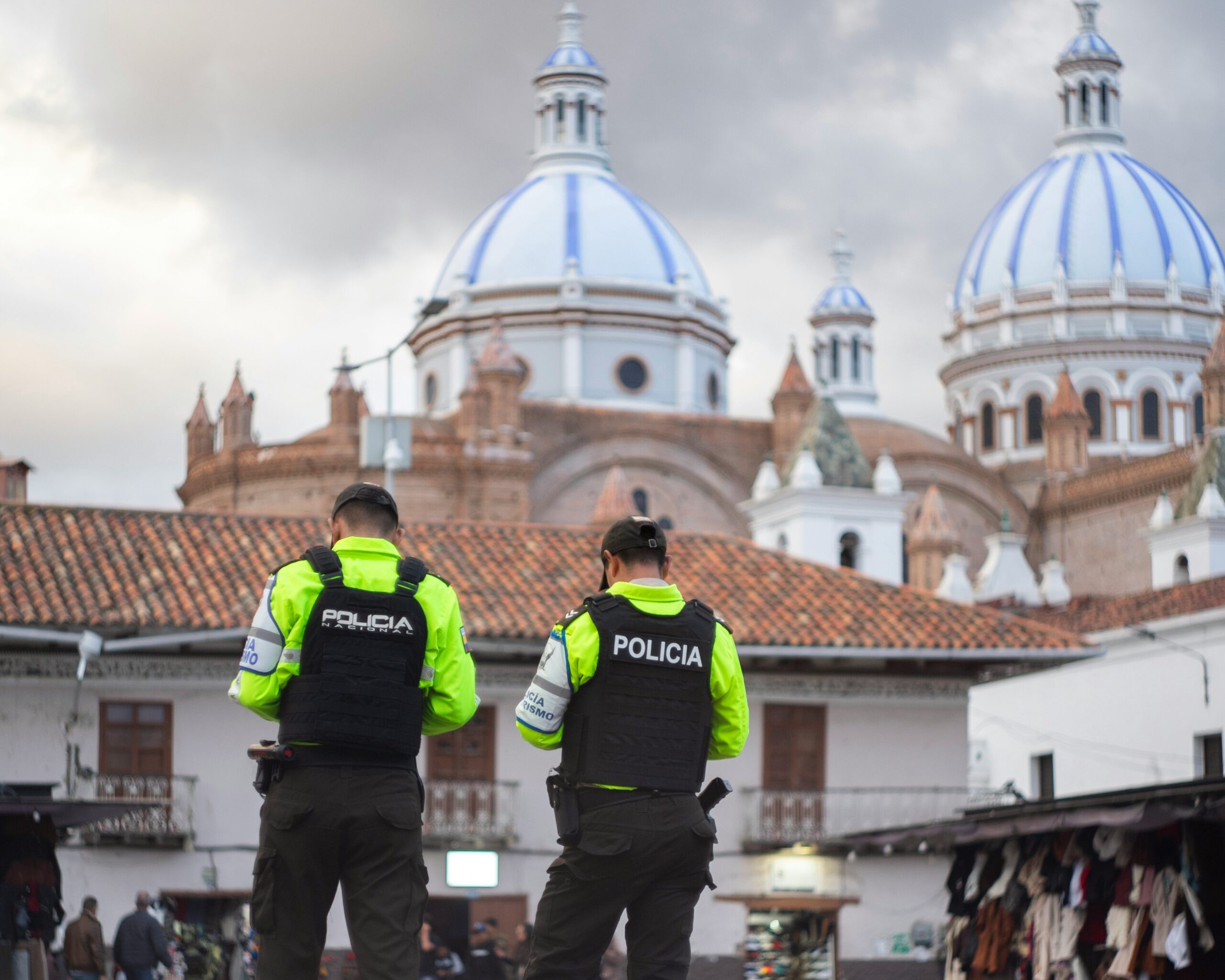
Ecuador undoubtedly has a crime problem. Organized crime, extortion, assassinations, drug trafficking networks, and institutional weakness have transformed how everyday Ecuadorian families live their lives. Families are drowned in fear, while businesses adapt to operate around violence. Young people are growing up in communities where transnational crime organizations (TCOs) recruitment takes precedence over educational or workforce recruitment. The state has a duty to respond.
But a serious problem does not automatically justify an ineffective solution.
In recent years, Ecuador’s government has consistently relied on states of emergency and curfews as central tools in its security strategy. These measures create the appearance of immediate action. They place soldiers in the streets, restrict mobility, and send a message that the government is “doing something.” But public policy should not be judged by how forceful it looks. It should be judged by whether it actually addresses the problem it claims to solve.
That is where the curfew strategy becomes questionable.
A curfew is, by design, a time-based restriction. It limits movement during specific hours, usually at night. In Ecuador’s March 2026 curfew evaluation, the restriction ran from 23:00 to 05:00. According to official data cited by El País, there were 229 homicides during the 15-day period, but only 26 occurred during the restricted hours. In other words, nearly 89 percent of homicides happened outside the curfew window. Michelle Maffei, security and conflict analyst, also points out that “around 70% of the homicides and violent deaths that happened within curfew hours are now happening in broad daylight”.
This does not mean every curfew is useless. However, it implies that Ecuador should ask a basic question: if most lethal violence during the evaluated period occurred during the day and in the evening, how can a nighttime curfew be considered an adequate response to the security crisis?
The government defended the March curfew by claiming a reduction in violence indicators, but official data showed most killings occurred outside the restricted hours. A short decline in the intentional homicide rate cannot be attributed only to curfew or operations, nor does it imply that it is the most effective or least harmful option available for both government and the people. In a country facing organized criminal networks, violence can shift by hour, territory, method, or target. Criminal groups adapt. Citizens and businesses pay the price.
Curfews have a cost. When mobility is restricted for a period of time, the legal economy is disrupted. All levels of the economic sector face multiple burdens, from the average worker to the business owner. If operations, transportation, and activities become restricted, then, the overall operational cost increases. In May 2026, a new 15-day curfew affected around 12 million people in nine provinces and several cities, with no exceptions for the productive or tourism sectors. Business groups warned about operational costs and economic disruption. Andrea Medina, a local entrepreneur, stated, “With the curfew, I closed at 10pm the latest. Everything I used to gain at the night shift was lost. I was also not able to pay the workers hired for those hours. This is a chain reaction”.
Weakening the formal economy can simultaneously strengthen the informal and illegal economy. TCOs are highly adaptable structures that already operate outside lawful frameworks. Thus, adapting to curfews will pose no difficulty for them. In their Research Brief on Transnational Organized Crime, The United Nations Office on Drug and Crime show that trafficking operations increased with international sanctions and organized crime is highly adaptable “in operating across illicit markets, exploiting regulatory gaps and market dynamics”. In places where extortion, money laundering, and drug trafficking already threaten legal activity, the state should be careful not to make legitimate work harder while criminal networks work around restrictions.
Ecuador’s violence is severe enough to demand more than symbolic policy. Reuters reported that homicides increased 40.36 percent in the first seven months of 2025, reaching 5,268 killings, the most violent seven-month period registered in Ecuador in the previous decade. CNN Español also reported that Ecuador recorded around 9,216 violent deaths in 2025, making it the bloodiest year in the country’s recent history. These numbers reflect a national moral emergency. But a constitutional state of emergency should not become the norm for governing.
Emergency powers are supposed to be exceptional. When emergencies become routine, the overall trade is retaining control at the expense of the relationship between the state and its citizens. The question is not only whether the government can restrict freedom, but whether these limitations are necessary, proportionate, and effective. If a curfew limits the movement of millions of citizens and dollars in the country’s economy while most homicides occur outside curfew hours, then the burden of proof should be very high.
Ecuador does not need a government that merely performs strength. It needs a government that builds capacity.
A serious security strategy should begin with data. Ecuador’s Ministry of the Interior already publishes official homicide datasets on the national open-data portal, which are described as official statistical information intended to support public policy and national or local security decision-making. ECU 911 also publishes national emergency coordination data in open formats such as CSV and XLSX, which can help researchers and authorities analyze incidents by geography, category, and time. These tools should be used not as bureaucratic decoration, but as the foundation for targeted policy.
Instead of relying primarily on broad curfews, Ecuador should prioritize precision. That means identifying violent hotspots, strengthening investigative capacity, improving intelligence coordination, protecting witnesses, attacking extortion networks, and securing ports and logistics corridors. It also means reforming the prison system to improve control and enforcement within this vulnerable system, which the national assembly recently voted in favor of. Accountability matters too. That means publishing clear evaluations of emergency measures: how many serious offenders were captured, how many weapons were seized, how many cases led to prosecution, and whether violence actually decreased because of the policy, not merely during the policy.
Civil society must also be part of the answer. Neighborhood groups, local businesses, universities, journalists, churches, NGOs, and local governments often understand the reality of insecurity before national authorities do. They can help identify vulnerable areas, monitor abuses, support prevention programs, and rebuild trust between citizens and institutions. Security cannot be understood as a single solution problem that can be solved through military action on the streets. It is a problem that needs to be addressed across multiple axes. Therefore, the government should not rely on coercive force, military operations, or an emergency state as the sole solution to the problem.
The choice is not between freedom and security. This is a false dichotomy, and forces citizens to choose between giving up their individual liberty and their overall safety. Ecuadorians deserve both. They deserve a state strong enough to confront organized crime and disciplined enough not to normalize extraordinary restrictions without evidence. If the proposed solution exercises control through the oppression of individual liberties, while not addressing the problem it intends to solve, it is not worthy of normalization. Ecuadorians deserve policies that target criminals, not routines that punish ordinary citizens for living, working, studying, or moving at the wrong hour.
Curfews may be politically convenient because they are visible. However, visibility does not equal effectiveness. If the majority of recorded homicides are occurring outside curfew hours, then curfews are only aiming at a low level of homicides at a major expense for the people.
Thinking that Ecuador can solve its crime problem through curfews is inadequate. What is needed is improved security, institutional reform, local and international cooperation, and a government committed to protecting its citizens under the rule of law, equally and in a predictable manner.
Photo Credit: Photo by Andrei Zhaboklitskii on Unsplash
We roast sacred cows medium-rare. Help fund the habit!
This piece reflects the author’s views, not necessarily the entire magazine. We welcome a range of pro-liberty perspectives. Send us your pitch or draft.